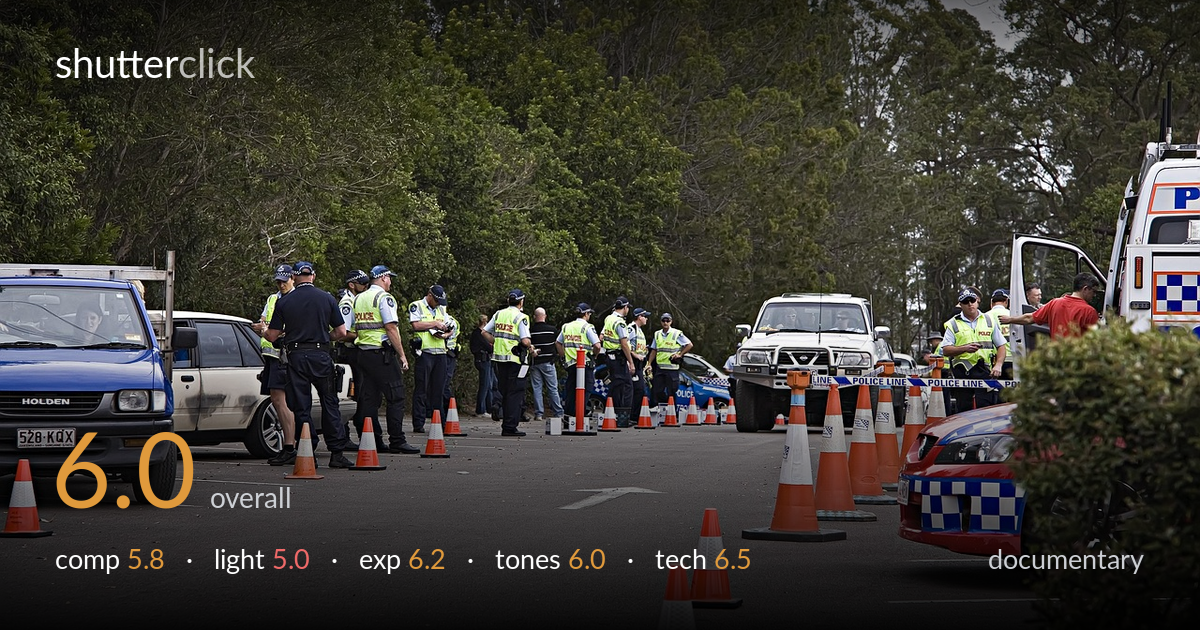
Police roadside checkpoint operation
Photo by angelic

No EXIF metadata in this file
Technical analysis based on visual assessment only.
A well-observed slice of police roadside operations that captures context and scale, but the storytelling stays diffuse. The cluster of officers in high-vis anchors the left, while the cones, police line, and marked cars fill the right — plenty of information, no single decisive moment. The eye wanders rather than landing. Flat overcast light and a foreground dominated by empty bitumen dilute the energy. The frame documents the scene competently but doesn't isolate the human interaction — a driver being processed, a gesture, an exchange — that would lift it from record to narrative. The raw material is strong; the edit and timing need tightening.
The frame reads as two competing halves: a dense knot of officers on the left, a scatter of cones and vehicles on the right, with a large expanse of empty tarmac between them. That void in the lower-centre drains tension rather than building it. The traffic cones do offer a loose leading line, but they trail toward nothing in particular. The treeline forms a heavy, undifferentiated backdrop. A tighter composition favouring the officer cluster, or a lower angle using a cone as deliberate foreground, would give the eye a clear path and purpose.
Flat, even overcast light keeps the high-vis vests legible and avoids blown highlights or crushed shadows, which suits documentary legibility. But it offers no modelling, no direction, and no drama — the scene feels lit by default rather than by choice. Shadows are minimal and the bitumen reads as a dull grey slab. The diffuse light flattens the depth between officers, vehicles, and trees. Nothing is wrong, but nothing is shaped either; the lighting documents without contributing mood or emphasis to the operation depicted.
Exposure is well controlled for the conditions. The overcast sky is held without clipping, shadow detail under the vehicles and in the foliage is retained, and the orange cones keep their saturation without glowing. Midtones sit a touch flat, which is partly the light and partly a conservative exposure that protects the highlights. The dark uniforms hold detail rather than blocking up. Overall a safe, accurate rendering with usable latitude across the frame — competent and deliberate, if lacking the contrast that would add punch.
Colour is natural and believable — the fluoro yellow-green of the vests, the orange cones, and the blue-and-white police markings read accurately, and white balance under the grey sky is neutral. The overall palette, however, is muted by the flat light and the dominant grey of road and overcast. Contrast is gentle, which keeps detail but leaves the image looking subdued. A modest contrast and clarity lift, with restrained vibrance on the safety colours, would let the operational palette carry more of the scene's energy.
Focus appears accurately placed on the officers around the mid-frame, and depth of field is deep enough to keep the cones, vehicles, and treeline acceptably sharp — appropriate for a documentary frame where context matters. There's no obvious motion blur, so the shutter handled the largely static subjects well, and noise is not a visible problem in this flat light. The focal length sits in a normal-to-short-telephoto range that compresses the scene moderately and keeps the police line readable across the width. The trade-off is that everything is rendered with equal weight: nothing is technically separated from the busy background, so the gear choices reinforce the documentary breadth at the cost of subject isolation. A slightly longer lens or a tighter crop would have let a wider aperture lift the key officers off the trees. Execution is clean and reliable; the limitation is decision-making about where to point the sharpness, not the sharpness itself.
What would elevate it
Tags
Shot something like this?
Expert photo critique, on demand — scored across six categories, EXIF-aware. Start with 3 free critiques, no credit card.
critique my photo — free