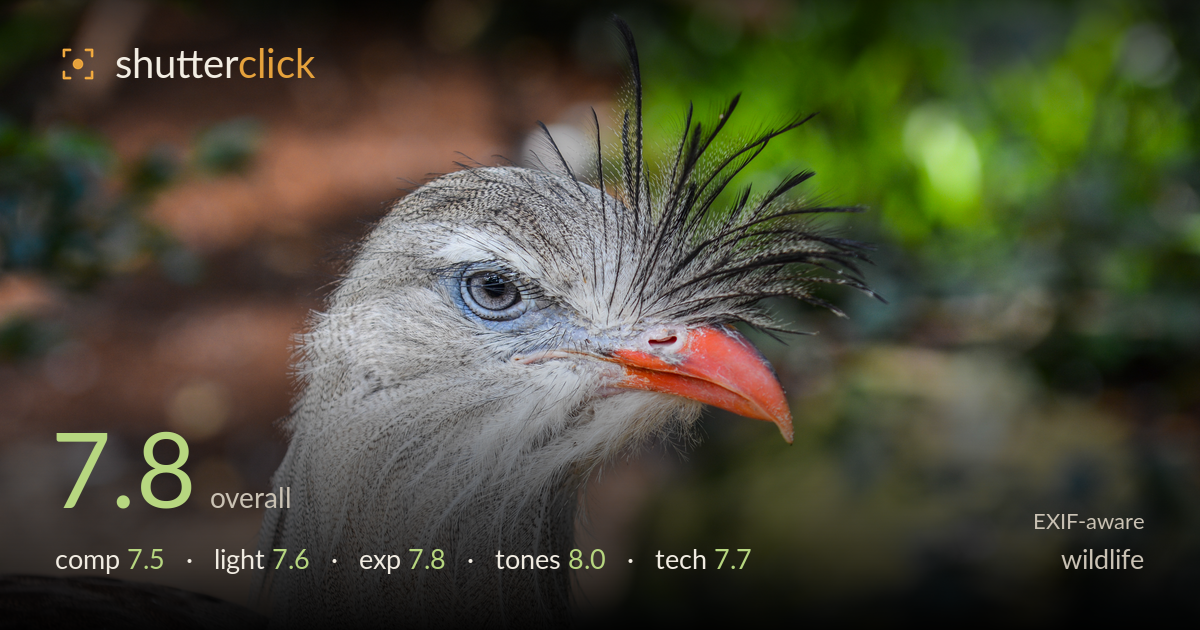
Portrait of a crested seriema
Photo by Olaf Oliviero Riemer

| Focal length | 70 mm |
| Aperture | f / 4.5 |
| Shutter | 1/160 s |
| ISO | ISO 160 |
A characterful, well-executed portrait of a red-legged seriema that leans on the bird's spectacular crest feathers and vivid orange beak against a soft, complementary background. The eye is sharp and full of catchlight, and the wispy crest reads crisply against the greens. What holds it back is placement: the head sits high and the beak points into a busy edge, while empty background fills much of the right frame with no counterweight. The 70mm short-tele on a standard zoom limits reach and separation slightly, but the settings are handled cleanly. A stronger crop or repositioning would elevate a strong subject.
The bird occupies the left and centre, with the gaze and beak leading toward the busier right side — a reasonable directional choice, but the head is pushed high and the crest crowds the top edge, clipping the tallest feather. The lower body is cut awkwardly across the bottom-left. Negative space on the right is generous but undifferentiated, offering little to balance the mass of the subject. A tighter frame around the head and neck, or lower placement giving the crest room, would strengthen the read.
Soft, diffused light — likely open shade — flatters the fine feather texture and avoids harsh specular hotspots on the grey plumage. Direction is gentle and slightly frontal, which keeps the eye and beak evenly lit and preserves a clean catchlight. The trade-off is modest dimensionality; the head lacks the modelling that a touch of directional side light would bring. The background greens and warm browns are pleasantly lit and unobtrusive, keeping attention on the subject.
Exposure is well judged. The grey plumage holds midtone detail across the neck and breast, and the delicate crest filaments retain separation against both the light and dark background patches. The orange beak stays saturated without clipping into flat red, and shadow areas in the lower body keep detail. Highlights in the background bokeh are bright but controlled. Overall a clean, deliberate exposure that respects the tonal range of a predominantly grey subject.
The colour palette is the image's quiet strength: cool grey plumage set against warm earthy browns on the left and cool greens on the right, with the orange beak as a punchy accent. White balance is accurate and natural. Contrast is gentle, suiting the feather detail, and saturation is restrained enough to feel true rather than boosted. The blue-grey skin around the eye reads convincingly. Tonal gradation across the neck feathers is smooth and pleasing.
At 70mm and f/4.5 on the 24-70mm f/2.8, focus lands accurately on the near eye, which is tack sharp with a clear catchlight and visible fine lashes. The 1/160s shutter is sufficient for a largely static bird and shows no motion blur, and ISO 160 keeps the image clean with no noise concern in the shade. The f/4.5 aperture yields a workable but not dramatic background blur; the crest feathers stay within the plane of focus, which serves the subject. The main limitation is reach — 70mm is short for wildlife, forcing proximity and constraining framing and subject-background separation. A longer telephoto would have compressed the background further and allowed a cleaner, more distant working position. The lower body toward the frame edge falls slightly softer as it exits the depth of field. Focus, shutter, and ISO decisions are all sound for the conditions; the gear choice is the compromise rather than the execution.
What would elevate it
Tags
Shot something like this?
Expert photo critique, on demand — scored across six categories, EXIF-aware. Start with 3 free critiques, no credit card.
critique my photo — free