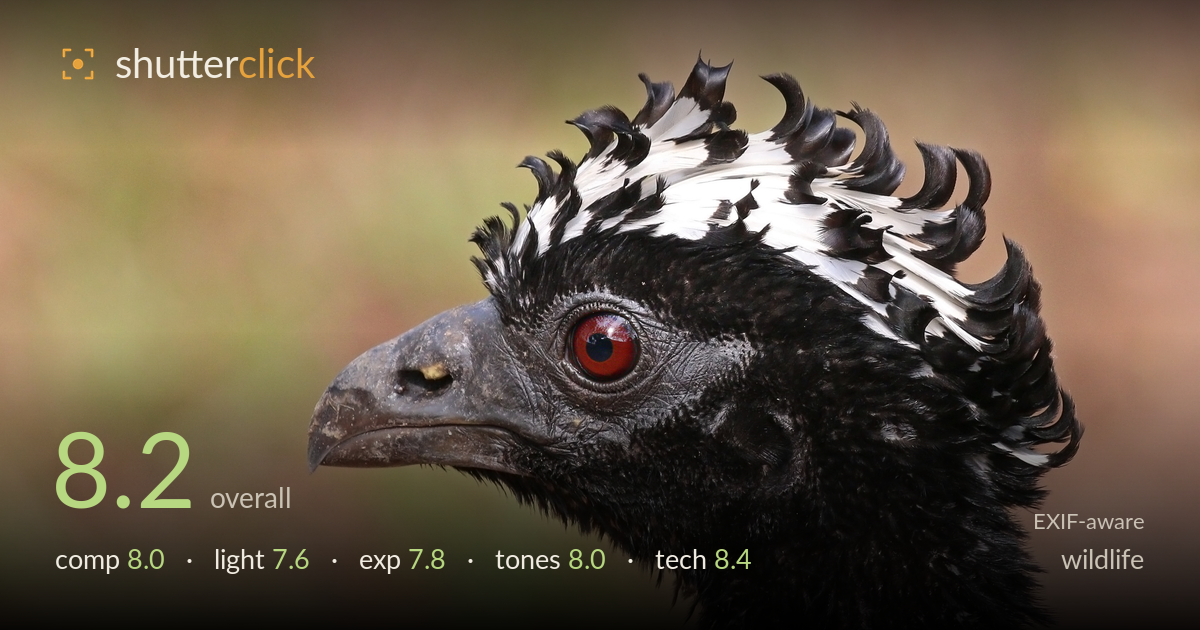
Profile of a crested curassow
Photo by Charles J. Sharp

| Focal length | 400 mm |
| Aperture | f / 7.1 |
| Shutter | 1/400 s |
| ISO | ISO 800 |
| Exp. comp. | 0.0 EV |
| Shot at | 14:19 · Sep 13, 2015 |
A striking, tightly observed head portrait of a curassow that succeeds on the strength of its subject rendering: the red eye, the sculptural white-and-black crest, and the crisp texture of the bill all read beautifully against a clean, muted background. The eye is sharp and the separation from the soft grass-toned backdrop is excellent. What most holds it back is the light — flat and slightly overcast — which keeps the black plumage from gaining dimensional modelling and leaves the darkest feathers reading as a mass. A touch of directional light, or slight shadow recovery, would give the form more depth.
The profile framing is classic and effective, with the head placed high-right and generous negative space to the left into which the bird looks — good breathing room in the direction of gaze. The crest fills the upper frame well and the diagonal of the neck anchors the base. The tight crop clips the top of the tallest crest feathers slightly, which nips the most dramatic silhouette. A hair more headroom would let that crown resolve fully against the soft background.
Soft, diffused light from an overcast sky flatters the red eye and keeps highlights on the white crest controlled, avoiding blown feathers. The trade-off is flatness: the black plumage lacks directional modelling, so much of the neck and face reads as an undifferentiated dark mass with little sense of contour. A low, raking side light would carve out the feather structure and separate the head from the neck. The current light serves detail on the pale feathers better than it serves the dark ones.
Exposure is well judged for a difficult high-contrast subject — the white crest holds detail without clipping while the eye retains its saturated red and the pupil stays clean. The black plumage sits deep but not crushed; some feather detail survives in the neck. Pushing shadows any further would risk noise given ISO 800, so the restraint is sensible. A slight lift of the darkest tones in post would reveal more of the neck feather texture without harming the highlights.
The colour palette works quietly in the subject's favour: warm ochre and olive background tones set off the cold black and clean white of the plumage, and the red iris becomes the single vivid accent. White balance is neutral and believable. The tonal range spans deep blacks to bright whites with the midtones carried mostly by the background. Black feathers verge on flat in places, but the overall grade is honest and restrained, letting the natural colours of the bird speak.
At 400mm on the 70D's crop sensor, this is a well-executed reach shot. f/7.1 gives enough depth of field to hold the eye and bill sharp while dissolving the background into smooth, distraction-free wash — exactly the isolation a wildlife head portrait wants. Focus is placed correctly on the eye, which is critical-sharp with visible catchlight and iris detail. 1/400s is adequate for a stationary head at this focal length with IS engaged, and the frame shows no motion blur, though it leaves little margin had the bird moved. ISO 800 is a sensible choice for the light and keeps noise negligible in the smooth background. The lens delivers its expected sharpness and pleasing rendering. The only technical caution is the shallow shutter headroom — 1/640 or faster would have added insurance for a sudden head turn while remaining within clean ISO territory. Overall a clean, competent capture with focus, aperture, and ISO all well matched to the subject.
What would elevate it
Tags
Shot something like this?
Expert photo critique, on demand — scored across six categories, EXIF-aware. Start with 3 free critiques, no credit card.
critique my photo — free