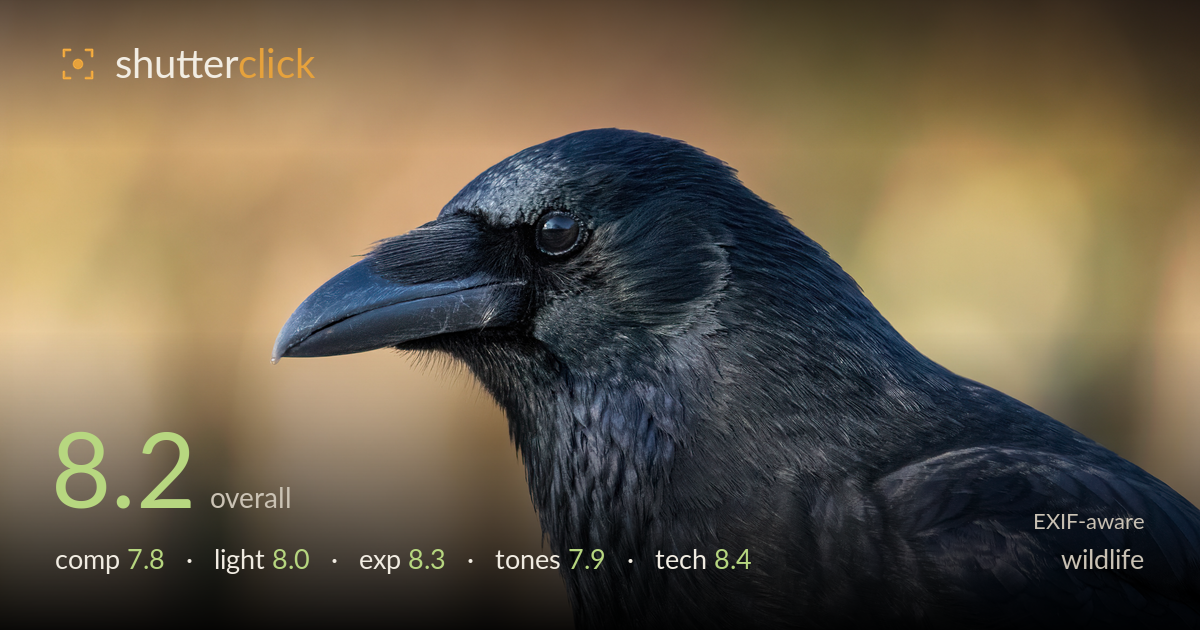
Profile portrait of a crow
Photo by Alexis Lours

| Focal length | 600 mm |
| Aperture | f / 6.3 |
| Shutter | 1/1250 s |
| ISO | ISO 3200 |
| Exp. comp. | 0.0 EV |
| Shot at | 15:04 · Jan 11, 2022 |
A crisp, intimate corvid portrait carried by a razor-sharp eye and beautifully rendered feather detail against a warm, creamy autumn background. The profile pose reads cleanly and the catchlight gives the bird life. What most holds it back is subject placement: the head sits high and close to the top edge while the body fills the lower-right, leaving the crow feeling slightly cramped against the frame's upper boundary. The left-facing gaze also has minimal space to look into. Small adjustments to framing would elevate an already accomplished image with excellent glossy-plumage texture.
The tight profile crop makes strong use of the diffused background, and the subject's dark mass balances against warm negative space on the left. The eye falls near a thirds intersection, which works well. However, the head crowds the top edge with little breathing room, and the bird faces into a large open area while the tail-side is clipped tight — reversing that spacing would let the gaze lead. The diagonal of the body adds energy, but a fraction more room above the crown would settle the frame.
Soft, directional light from the front-left models the head and beak nicely, raking across the crown to reveal the fine feather structure and delivering a clean, well-placed catchlight in the eye. The quality is flattering for a difficult subject — glossy black plumage is easy to render flat, yet the sheen and blue-purple iridescence come through. Shadows on the throat stay open enough to keep detail. Slightly lower, warmer angle light would add even more dimensionality, but the timing here serves the bird.
Exposing black plumage without losing feather detail or blowing the pale background is the real challenge here, and it's handled well. Shadow detail in the darkest breast and wing feathers is retained, the highlights on the beak and glossy crown hold texture, and the bright backdrop is not clipped. The overall placement keeps the bird from muddying into a silhouette. A touch more shadow lift in the lower body feathers would reveal the last of the detail hiding in the darkest zones, but nothing here reads as accidental.
The warm ochre-and-sage background is a lovely complement to the cool blue-black of the plumage, and that colour contrast gives the image much of its appeal. White balance sits slightly warm, which suits the autumnal feel. The iridescent highlights on the feathers carry subtle blue and violet gradation. Contrast is well judged — the bird has depth without crushing. The darkest feathers verge on losing separation in places, so a hair more midtone lift in the blacks would strengthen the tonal gradation across the body.
At 600mm the reach is well used to fill the frame with the head and shoulders, and 1/1250s comfortably freezes a static perched subject. Focus is precisely on the eye, which is critical for wildlife — the catchlight and iris detail are tack sharp, and the sharpness carries through the beak and crown feathers. f/6.3 wide open on this lens still delivers a beautifully soft background at this distance while keeping enough depth for the near-side of the face. ISO 3200 on the 7D Mark II's crop sensor is pushing the sensor, and some luminance noise is visible in the shadow feathers and smoother background tones, though it's controlled and acceptable given the light. The lens-and-body pairing suits the subject well. Slightly cleaner output would come from either a lower ISO in brighter light or careful noise reduction on the darkest zones, but the execution — focus, shutter, aperture choice — is sound throughout.
What would elevate it
Tags
Shot something like this?
Expert photo critique, on demand — scored across six categories, EXIF-aware. Start with 3 free critiques, no credit card.
critique my photo — free