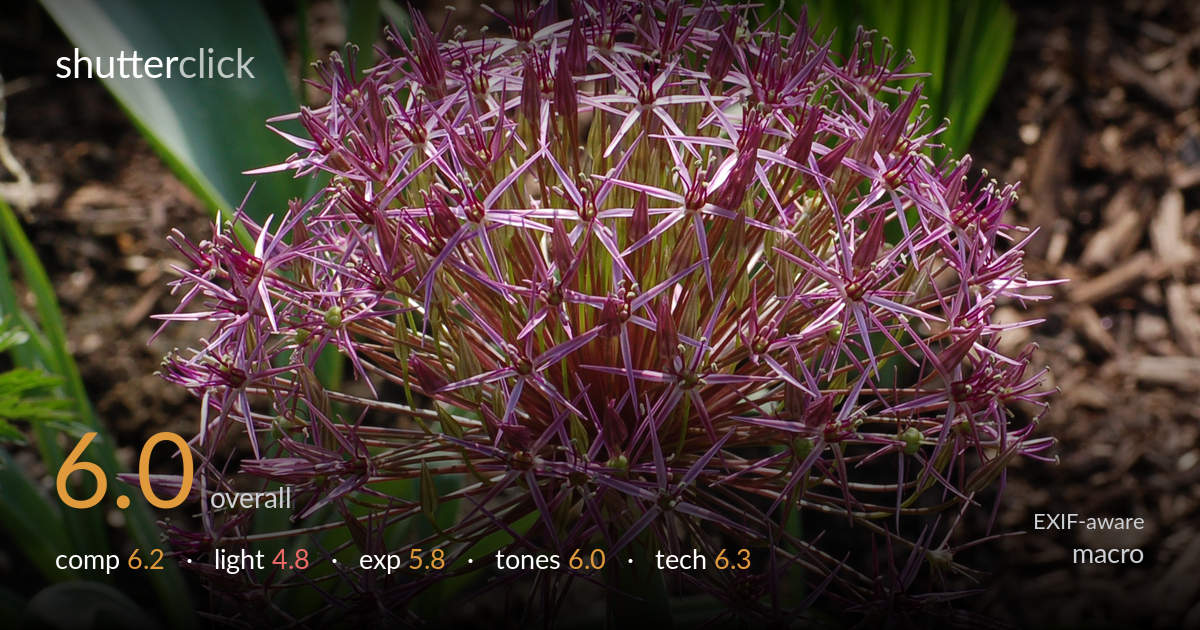
Purple allium starburst in the garden
Photo by Photo by and (c)2008 Derek Ramsey (Ram-Man). Co-attribution must be given to the

| Focal length | 70 mm |
| Aperture | f / 11.0 |
| Shutter | 1/250 s |
| Exp. comp. | -0.67 EV |
| Shot at | 15:53 · May 20, 2007 |
Harsh midday sun is the single biggest limiter here, scattering hard speckled highlights across the spherical bloom and stamping busy bright patches into the background. The Allium christophii itself is a gift of a subject — a starburst globe with strong graphic rhythm — and the f/11 choice keeps a useful portion of it sharp. But the light flattens the star structure rather than sculpting it, and the background's dappled hotspots compete for attention. The bloom is well centred and given room, yet softer light and a cleaner backdrop would let the intricate radial geometry read with the clarity it deserves.
The globe sits high and roughly centred, with the stem anchoring it down through the lower frame — a reasonable structure for a single specimen. There's enough negative space around the sphere to let its silhouette breathe. The trouble is the background: scattered green blades, mulch, and stones pull in multiple directions and never settle into clean separation. A slightly lower angle to set the bloom against the darker soil, or a tighter crop trimming the busy upper-right foliage, would let the radial form dominate rather than fight its surroundings.
Direct overhead midday sun is doing the most damage. It rakes across the bloom as hard specular flecks rather than revealing the delicate star-shaped florets, and it blows scattered hotspots through the background mulch and leaves. The contrast is high and unflattering, with little tonal gradation across the sphere to convey its rounded form. Open shade, an overcast sky, or a diffuser held over the flower would soften the speculars and let the translucent purple stamens glow, giving the structure depth instead of glare.
The -0.67 EV compensation was a sensible call to protect against the bright conditions, and the bloom holds its purple tones without major clipping. Still, the sunlit background patches and a few specular points on the florets push toward the top of the range. Shadow areas in the soil retain detail. Overall the exposure is competent and deliberate, just constrained by the harsh light it had to manage. Metering for the highlights on the brightest stamens would have secured those last specular points more reliably.
The dusty purple-mauve of the stamens is the photo's strongest colour note, and white balance reads accurate and neutral under the daylight. The green foliage and brown mulch sit naturally without a colour cast. Contrast runs high because of the lighting, which crushes some of the subtler tonal transitions across the sphere and leaves the colour feeling slightly hard rather than luminous. A touch of highlight recovery and reduced contrast in post would restore gradation and let the purples read with more delicacy.
At 70mm and f/11, depth of field covers a good slice of the globe, keeping the near florets crisp while the far side falls gently soft — a defensible compromise for a three-dimensional spherical subject, though even f/11 can't hold the whole sphere sharp at this distance. Focus lands accurately on the front face of the bloom. The 1/250s shutter froze any breeze movement cleanly, sensible given the thin stamen filaments that would smear at slower speeds. The D50's base ISO keeps noise negligible. The 70mm focal length on the APS-C body is a workable working distance, though a true macro lens or focus stacking would have rendered the whole globe sharp end-to-end and resolved finer texture on each floret. For a fully sharp sphere, a series of stacked frames at a wider aperture would beat the single f/11 exposure both in sharpness and in background blur. Solid, deliberate execution within single-frame limits.
What would elevate it
Tags
Shot something like this?
Expert photo critique, on demand — scored across six categories, EXIF-aware. Start with 3 free critiques, no credit card.
critique my photo — free