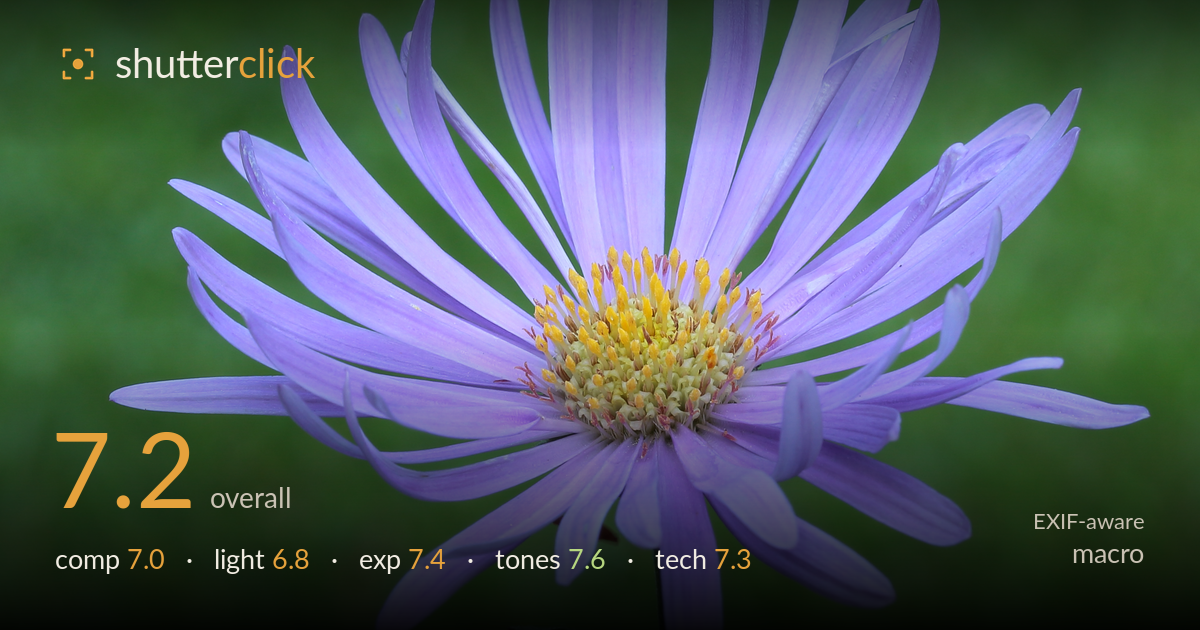
Purple aster against green
Photo by Dominicus Johannes Bergsma

| Focal length | 60 mm |
| Aperture | f / 13.0 |
| Shutter | 1/6 s |
| ISO | ISO 100 |
| Exp. comp. | 0.0 EV |
| Shot at | 19:51 · Jul 27, 2014 |
A clean, well-isolated aster set against an evenly rendered green field — the lilac-against-green complementary pairing carries the frame and the subject reads clearly. What holds it back most is the focus plane: the yellow disc florets, the natural focal point, sit slightly soft while the sharpest detail falls on petals just in front. The lighting is flat and overcast, which keeps texture and dimensionality muted. Centred placement and the slightly cramped top petals limit the composition. The foundations are strong; sharper focus on the center and more directional light would lift this from competent to striking.
The bloom is placed high and roughly centred, with the stem anchoring it to the base — a stable but somewhat static arrangement. The green background is generously abstracted, giving clean negative space, though the topmost petals nearly graze the frame edge, creating slight crowding above. The single leaf lower on the stem adds welcome context and a downward visual line. A touch more breathing room at the top and a small offset from dead-centre would introduce more tension. As is, it reads clearly but conventionally.
Soft, diffused overcast light wraps the petals evenly and avoids blown highlights on the pale lilac — a safe choice for a delicate subject. The trade-off is flatness: there's little directional modelling to separate individual petals or bring out the texture of the disc florets. The center stays somewhat dimensionless. Raking side light or backlight would give the translucent petals glow and carve depth into the layered form. The current light is competent and clean but does little to shape the subject.
Exposure is well judged for a tricky pale subject. The lilac petals hold their gradation without clipping, and the yellow center retains detail rather than burning out. Shadows within the petal cluster stay open, and the green background sits at a pleasant mid-value that doesn't compete. The histogram appears well distributed with no reckless highlight loss. At ISO 100 the file is clean throughout. There's little to fault here — exposure decisions read as deliberate and controlled.
The complementary lilac-and-green palette is the image's strongest asset, and white balance looks accurate and neutral. Petal tones range convincingly from near-white tips to deeper violet at the base, and the yellow disc adds warm contrast. The green background is smooth and consistent, if slightly flat in its own saturation. Contrast is gentle, matching the soft light. A subtle boost in local contrast on the center florets would add pop without disturbing the delicate overall harmony. Pleasant, well-controlled colour throughout.
At f/13 on the 60mm macro, depth of field should be adequate for a front-on bloom, yet the critical focus appears to fall on the forward petals rather than the disc florets, which read marginally soft — the one place macro demands crisp detail. Stopping to f/13 was reasonable for coverage but invites diffraction softening at this sensor's pixel pitch, and the gain in depth doesn't fully compensate for the missed focus plane. The real risk here is the 1/6s shutter: hand-held that would guarantee blur, so a tripod was almost certainly used, and the result is stable — no motion smear is visible. ISO 100 keeps the file clean and noise-free. Focus-stacking a few frames across the disc would have delivered edge-to-edge sharpness on the center while avoiding diffraction. Focusing manually on the florets, or f/9–f/11 with careful plane placement, would sharpen the most important detail. Solid execution overall, undercut mainly by focus placement.
What would elevate it
Tags
Shot something like this?
Expert photo critique, on demand — scored across six categories, EXIF-aware. Start with 3 free critiques, no credit card.
critique my photo — free