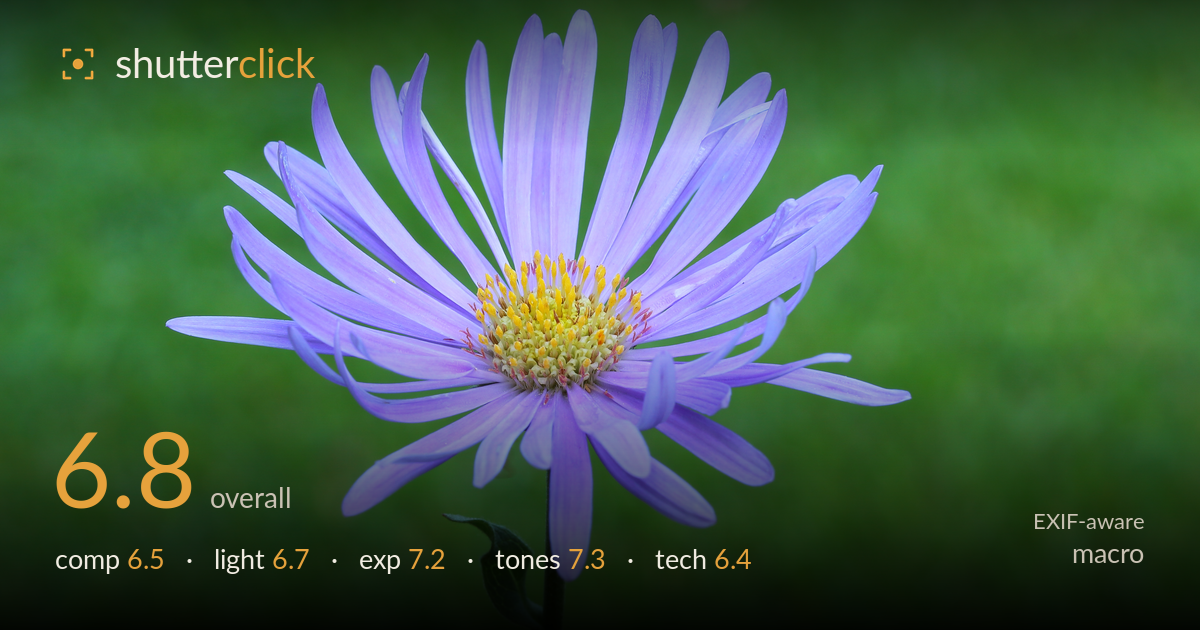
Purple aster against green
Photo by Dominicus Johannes Bergsma

| Focal length | 60 mm |
| Aperture | f / 11.0 |
| Shutter | 1/8 s |
| ISO | ISO 100 |
| Exp. comp. | 0.0 EV |
| Shot at | 19:49 · Jul 27, 2014 |
A clean, well-isolated aster against a smooth green field — the colour contrast between lilac petals and grass is the image's strongest asset. What holds it back is focus placement: the disc florets at the centre, the natural focal anchor, sit slightly softer than they should even at f/11, while several foreground petals fall out of the plane. The composition is safe and centred, leaving the flower feeling static rather than dynamic. Light is flat and overcast, gentle on colour but offering little modelling. A sharper centre, a stronger off-centre placement, and raking side light would lift this from a competent record shot to a compelling one.
The bloom sits nearly dead-centre horizontally, which suits the symmetry of the flower but leaves the frame feeling static and the negative space unevenly distributed. Including the stem, leaf and even a hint of a finger at the bottom edge grounds the subject but adds clutter that competes with the head. The clean green field is a genuine asset, giving the petals room to breathe. Placing the flower head slightly off-centre, or filling more of the frame with the bloom, would create more tension and intent.
The soft, diffuse overcast light is kind to the delicate lilac petals, avoiding blown highlights and preserving the gentle gradations along each ray. But it is also flat and directionless, giving the flower little dimensional modelling — the petals read as a graphic shape more than a form with depth. The yellow disc florets, the textural heart of the shot, receive no directional light to reveal their fine relief. A low, raking side light would carve out the petal ridges and make the central florets glisten.
Exposure is well judged for the subject. Highlights on the pale petals are held without clipping, and the yellow centre retains colour and detail rather than burning out. The green background sits at a pleasant mid-tone that doesn't pull attention from the flower. Shadow areas in the disc and lower petals keep detail. At ISO 100 the file is clean with a full tonal range. If anything, a touch more brightness on the shaded lower petals would even the read, but the balance here is deliberate and controlled.
The lilac-against-green pairing is the image's colour engine — complementary enough to make the bloom pop, muted enough to stay natural. White balance looks accurate; the petals carry believable cool-violet hues without a magenta cast. The green field is saturated but not garish. The yellow and rust tones in the central florets add welcome warmth against the cool petals. Contrast is gentle, matching the soft light. A slight increase in local contrast on the centre would give the florets more separation and punch without disturbing the harmony.
At f/11 on the 60mm macro the depth of field should have been enough to hold the whole flower head sharp, yet the plane of focus appears to sit just behind or beside the disc florets — the very centre reads slightly soft while some mid-length petals are crisp. For macro, the disc florets are the critical plane and deserved precise manual focus or a focus stack to guarantee front-to-back sharpness. The 1/8s shutter is the real risk here: that's slow enough that any breeze or hand shake would smear fine detail, and some petal softness looks consistent with subtle motion rather than pure focus miss. A tripod plus a remote or timer, or a faster shutter at a modestly higher ISO, would eliminate that doubt. ISO 100 was the right call for clean files. The lens choice is ideal; the execution just needs tighter focus discipline and camera stability to deliver the resolution the setup is capable of.
What would elevate it
Tags
Shot something like this?
Expert photo critique, on demand — scored across six categories, EXIF-aware. Start with 3 free critiques, no credit card.
critique my photo — free