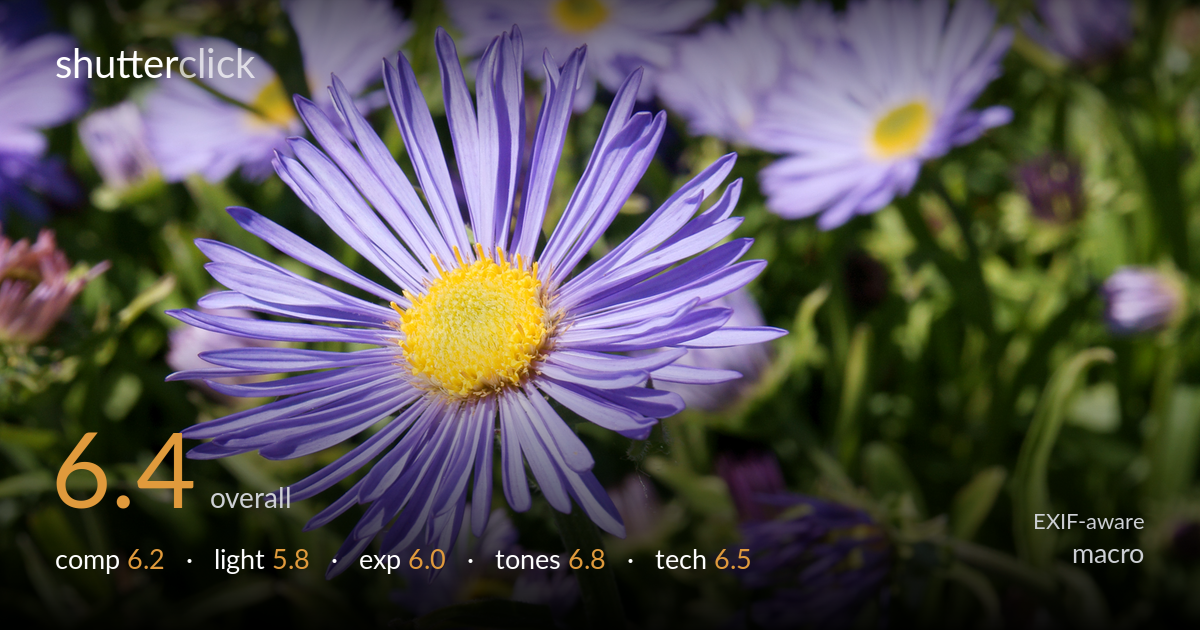
Purple aster in the garden
Photo by kallerna

| Focal length | 50 mm |
| Aperture | f / 11.0 |
| Shutter | 1/250 s |
| ISO | ISO 200 |
| Exp. comp. | 0.0 EV |
| Shot at | 15:02 · Jun 23, 2010 |
A clean, well-resolved hero bloom anchors a busy field of asters, and the purple-against-green colour relationship carries genuine appeal. What most holds the image back is the lighting: harsh midday sun blows out the upper petals and scatters distracting bright patches through the background, flattening the sense of depth. The composition places the main flower well but leaves the frame cluttered with competing blooms that pull the eye. A softer light, a wider aperture to quiet the background, and a cleaner sight-line on the subject would lift this from a competent garden record toward a more intentional macro study.
The main bloom sits in the upper-left third with its stem leading down through the frame, a reasonable structural choice that gives the image a backbone. The trouble is competition: numerous out-of-focus and partly-focused blooms crowd the surround, and the spent buds lower right and the secondary flower mid-frame split attention. The hero flower's petals are slightly cut at top-left. A tighter framing isolating the subject, or an angle that pushed the rival blooms further out of focus, would let the strongest flower truly dominate rather than share the stage.
Direct overhead midday sun is the limiting factor here. It renders the petal tips of the main bloom with blown highlights, and casts hard, contrasty pools of light across the foliage that read as visual noise rather than form. The yellow disc florets hold up, but the light does little to model the delicate ray petals or reveal their translucency. Soft, diffused light — an overcast sky or a diffuser held above — would even the petal tones and tame the bright background distractions that currently fragment the scene.
Exposure is broadly serviceable but the highlights on the upper petals of the main flower are clipped, losing the fine ray-petal detail where it matters most. The greens retain detail and the shadows in the foliage stay open, so dynamic range usage is acceptable for the conditions. A touch of negative exposure compensation, around -0.7 EV, would have protected those petal highlights, and the shadow latitude present suggests the midtones could have been lifted later in post without penalty. The yellow centre is well held.
Colour is the image's strongest suit: the cool lavender-purple of the petals plays cleanly against the warm yellow centres and the saturated greens behind, a classic complementary pairing that reads vividly. White balance looks accurate and the saturation feels natural rather than pushed. Contrast runs a little high courtesy of the hard light, which deepens some greens toward muddiness in the lower frame. Slightly lifted shadows and a small saturation pullback in the greens would keep the purples singing without the background feeling heavy.
At 50mm, f/11, 1/250s and ISO 200, the settings are sensible for a near-macro garden shot. The f/11 aperture buys enough depth of field to render the main bloom's face acceptably sharp across its disc and inner petals, and focus is placed correctly on that flower's centre. 1/250s froze any slight breeze movement cleanly, and ISO 200 keeps noise negligible. The compromise is that f/11 also partially resolves the surrounding blooms, contributing to the cluttered background — a wider aperture around f/5.6 would have thrown those into smoother bokeh while still holding the hero face, at the cost of some petal-tip sharpness. The 50mm focal length gives a natural perspective but limits working distance and magnification; a dedicated macro lens would allow tighter framing and finer petal detail. Overall the execution is technically clean and deliberate, with the depth-of-field choice being the main lever worth reconsidering.
What would elevate it
Tags
Shot something like this?
Expert photo critique, on demand — scored across six categories, EXIF-aware. Start with 3 free critiques, no credit card.
critique my photo — free