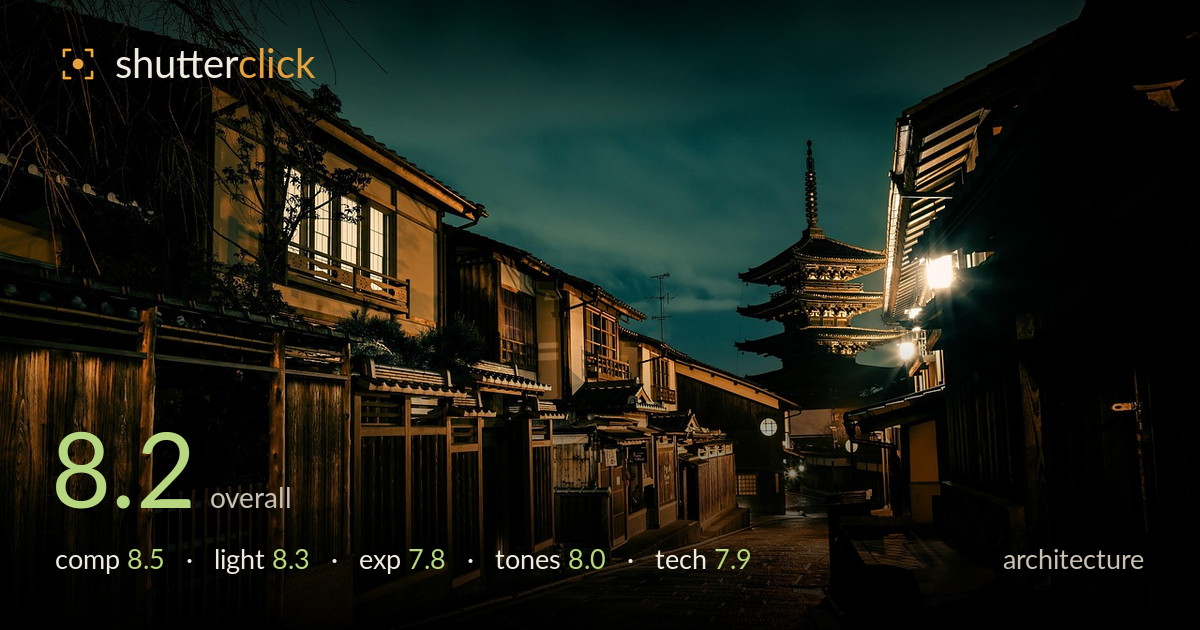
Quiet lane to the pagoda at dusk
Photo by Kanenori

No EXIF metadata in this file
Technical analysis based on visual assessment only.
A confident night composition of a Kyoto lane, with the cobbled street pulling the eye directly toward the illuminated Yasaka pagoda framed between converging rooflines. The empty street and warm glow create genuine atmosphere and a strong sense of place. Composition and light timing are the clear strengths; the framing uses the buildings as natural leading lines to a well-placed focal point. What most holds it back is deep shadow on the right-hand structures that reads as near-black clutter rather than intentional silhouette, and a slightly heavy overall darkness that buries some foreground texture. The pagoda, though the subject, sits small and could carry more visual weight.
The lane works hard as a leading line, and the wet cobbles carry the eye smoothly to the pagoda nestled in the gap between rooflines — a textbook use of converging architecture to frame a distant landmark. The empty street reinforces stillness and scale. The left buildings offer rich detail while the right slab of dark structure balances the frame, though it edges toward dead weight. The pagoda, the emotional anchor, reads slightly small and could hold more prominence with a longer focal length or tighter framing.
The mixed artificial lighting is handled well: warm lantern and window glow against a cool blue dusk sky sets a moody, layered palette. The uplit pagoda stands out cleanly against the sky, and pooled light on the wet stones adds depth. The bright lamp on the right building flares a touch hot and pulls attention from the pagoda. Overall the timing near blue hour is ideal, holding sky detail while artificial lights carry the scene rather than fighting a black void.
Exposure is largely deliberate, preserving sky gradation while letting the street fall into shadow for mood. Highlights on the right lamp are near clipping and slightly distracting, but the pagoda retains detail. The concern is the right-side buildings and lower-left foreground crushing to near-black, losing texture that could add depth. A brighter shadow lift or bracketed blend would recover that structure without flattening the atmosphere. The midtones on the illuminated street are placed nicely, keeping the wet-stone texture readable.
The teal-and-amber grading is fashionable but well suited here, separating the cool sky from warm street lighting to reinforce the night mood. White balance leans deliberately cool in the sky and warm in the pooled light, and the two coexist without clashing. Shadow depth is strong, though the grade pushes the darks slightly green, which can look artificial in the deepest corners. Contrast is well judged for atmosphere; a touch less saturation in the shadows would keep the tones honest without softening the impact.
Focus appears accurate across the street, with the cobbles and near buildings sharp and the pagoda holding detail at distance, suggesting a well-chosen aperture with sufficient depth of field for the scene. Noise is controlled for a night frame, indicating a reasonable ISO and likely a tripod given the clean shadows and the low-light rendering of the sky. The wide focal length exaggerates the lane's convergence effectively, though it does shrink the pagoda; a slightly longer lens would compress the scene and give the landmark more presence while keeping the leading line intact. Verticals on the left buildings lean inward from the wide perspective — some keystoning is visible and would benefit from perspective correction to keep the architecture upright. The right-side lamp flare suggests a small stopped-down aperture rendering starbursts, which reads fine, but its brightness competes with the subject. Overall execution is solid and clean for a demanding low-light architectural frame.
What would elevate it
Tags
Shot something like this?
Expert photo critique, on demand — scored across six categories, EXIF-aware. Start with 3 free critiques, no credit card.
critique my photo — free