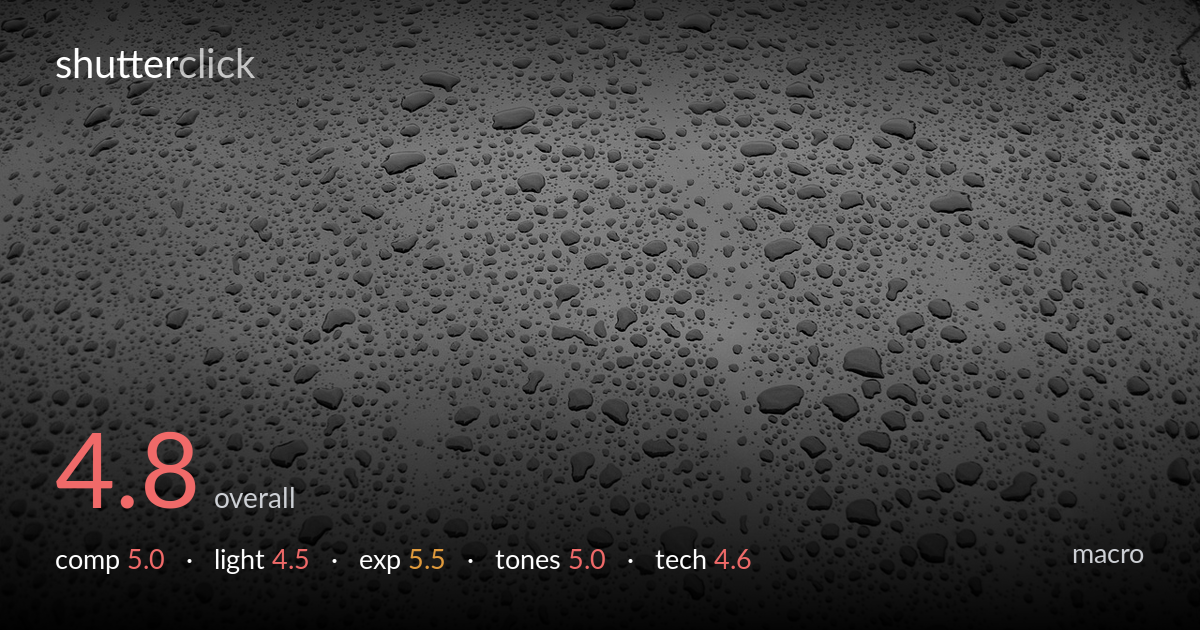
Rain droplets on a grey surface
Photo by CreaPark

No EXIF metadata in this file
Technical analysis based on visual assessment only.
An even field of water droplets on a flat grey surface — a competent texture study that never finds a focal point. The scattered beading reads as pattern, but nothing anchors the eye: no standout droplet, no sharp plane catching light, no graphic rhythm to organize the chaos. For macro, the defining strength is focus precision on a key plane and detail that rewards close looking, and neither is present here. The droplets sit soft throughout. The flat, diffuse light flattens the surface into uniform grey. There's a quiet, rainy mood worth building on, but the frame needs a subject within the texture and raking light to give the drops dimension.
The frame is an undifferentiated field of droplets, which gives even coverage but no hierarchy — the eye wanders without landing. A diagonal corner element at upper right hints at structure but is too marginal to anchor anything. Macro texture studies still need a focal point: a dominant droplet, a cluster, or a graphic line through the beading. As composed, every region carries equal weight, so the image reads as a sample rather than a picture. A tighter section emphasizing one striking droplet would give the frame purpose.
The light is flat and diffuse, typical of an overcast sky or shade, which keeps the droplets evenly lit but robs them of dimension. Each bead should act as a tiny lens, catching a highlight and casting a small shadow, but here the soft illumination flattens them into low-contrast lumps. Macro droplet work lives on directional light — a raking side light reveals the rounded form and lifts a specular sparkle from each drop. Without that, the surface stays uniformly grey and the texture never gains depth.
Exposure is safe and middle-grey, with no clipped highlights and shadows that retain detail throughout — technically clean. The histogram would sit compressed in the midtones, which matches the flat scene but contributes to the overall lifelessness. There's room to lift contrast without losing information, since both ends of the tonal range are unused. The exposure decision reads as deliberate and accurate, just conservative. A touch more separation between the droplets and the surface would help the beading register as form rather than stain.
As a monochrome rendering the tonal range is narrow, clustered in mid-grey with little true black or clean white. That keeps the mood muted and rainy, which suits the subject, but the lack of deep shadow and bright highlight leaves the image looking soft and undercooked. Droplet macros benefit from punchy contrast that makes each bead read crisply against the surface. The gradation across the frame is smooth, but the overall flatness reads more as missed contrast than as an intentional low-key choice.
The defining macro problem is focus: nothing in the frame is critically sharp. Droplet edges are soft across the entire surface, suggesting either a missed focal plane, camera shake, or a depth of field too shallow to catch the beading on a flat surface that is largely parallel to the sensor. On a flat plane like this, even modest stopping down should have rendered the whole field crisp, so the softness points to a focus or stability miss rather than a depth-of-field tradeoff. There's no visible noise and the rendering is clean, which is a plus. But for this genre, edge-to-edge bite on the key droplets is everything — a viewer should be able to count the specular pinpoints in each bead. A more secure focus on a chosen droplet cluster, a tripod to eliminate shake, and a working aperture that keeps the flat plane sharp would transform the result. The execution basics are sound; precision is what's missing.
What would elevate it
Tags
Shot something like this?
Expert photo critique, on demand — scored across six categories, EXIF-aware. Start with 3 free critiques, no credit card.
critique my photo — free