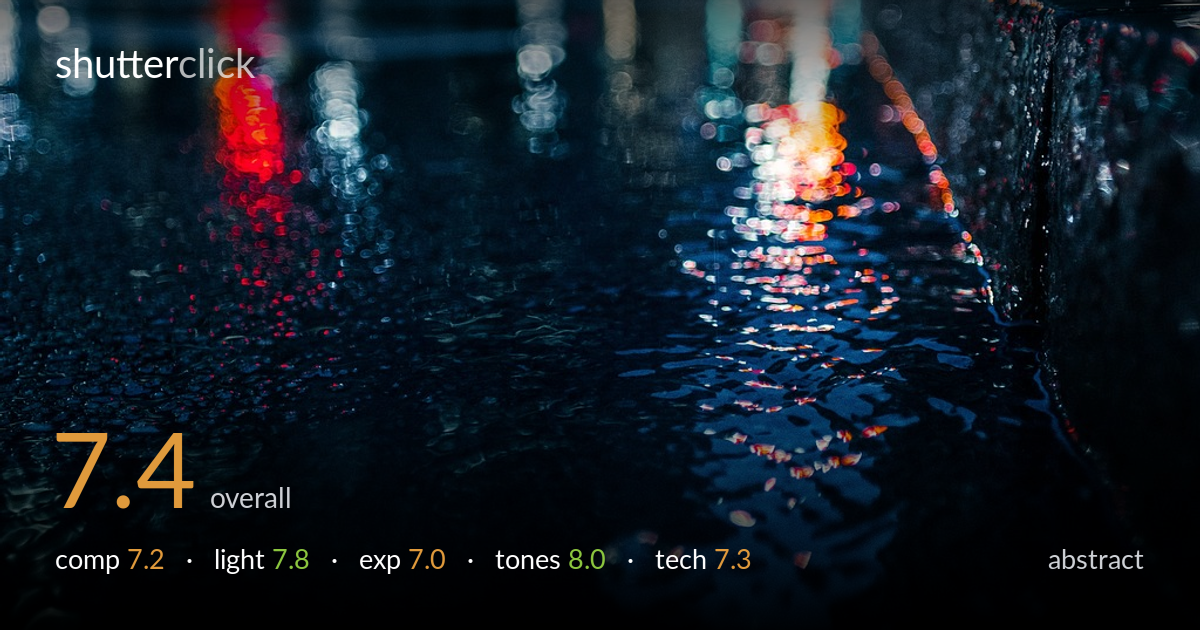
Rainy night city bokeh
Photo by StockSnap

No EXIF metadata in this file
Technical analysis based on visual assessment only.
A confident low-angle treatment of a rain-slicked street that converts a literal city scene into a field of colour, texture, and rhythm — exactly the abstract reading it's reaching for. The wet foreground reflections and the receding bokeh build genuine depth and graphic energy. What most holds it back is the middle band: the transition from sharp wet asphalt to soft background lights leaves a slightly mushy zone where neither sharpness nor abstraction fully commits. The bottom-right corner also runs very dark with little to read. Tighter intent in the focal plane and a touch more shadow recovery would sharpen the impact.
The street-level vantage is the strongest choice here, letting the wet foreground texture lead the eye toward the dissolving lights and the kerb line on the right acts as a useful diagonal. Balance leans heavily into the lower half, and the upper third — the soft skyline — competes a little with the more interesting reflections below. The red reflection on the left and the warm cluster on the right anchor the colour. A slightly higher proportion of foreground texture, or a cleaner exit on the right edge, would tighten the graphic flow.
The available city light is used well — mixed tungsten warmth, traffic reds, and cool blues read as deliberate colour blocks rather than chaos, and the rain turns every source into a smeared reflection that doubles the light's presence. The contrast between glowing points and deep wet shadow gives the frame its mood. The brightest highlights toward the upper centre carry a slight blown quality, and a marginally lower exposure on those sources would have preserved more colour information in the strongest bokeh discs.
Exposure is largely well judged for a dark, mood-driven night abstract, holding the deep shadows without crushing all the reflective detail in the foreground. The brightest light sources clip toward pure white in places, losing some of the colour that makes the rest of the frame sing. The bottom-right corner falls into near-total black with little recoverable texture. A slightly protected highlight exposure with shadow lifted gently in post would broaden the tonal range while keeping the intended darkness.
This is the standout. The cool teal-blue base against punchy reds and warm ambers is a classic but well-executed night palette, and the colour separation gives the abstraction its rhythm. White balance leans cool deliberately and it suits the wet, nocturnal mood. Saturation is pushed but stays short of garish, and the gradation from glowing highlight to inky shadow is smooth. The reds in the left reflection are the strongest tonal note — vivid without bleeding. A whisper less blue in the deepest shadows would add subtle dimension.
Focus sits on the wet asphalt in the near-to-mid foreground, where the rippled water texture is rendered with satisfying detail, while the background dissolves into large, creamy bokeh — a shallow depth of field used purposefully to drive the abstract effect. The bokeh discs are clean and round, suggesting a fast lens wide open. The trade-off is the mid-frame: there's a zone between sharp foreground and soft background that reads as neither fully crisp nor fully abstract, slightly weakening the sense of intent. Noise is controlled well for a low-light scene, with shadows staying reasonably clean rather than mottled. The low camera position close to the wet ground is the key technical decision and it pays off. Stopping down a touch, or focusing fractionally further into the frame, would extend the sharp zone deeper before the dissolve, giving the transition more authority. Overall the execution supports the concept rather than fighting it.
What would elevate it
Tags
Shot something like this?
Expert photo critique, on demand — scored across six categories, EXIF-aware. Start with 3 free critiques, no credit card.
critique my photo — free