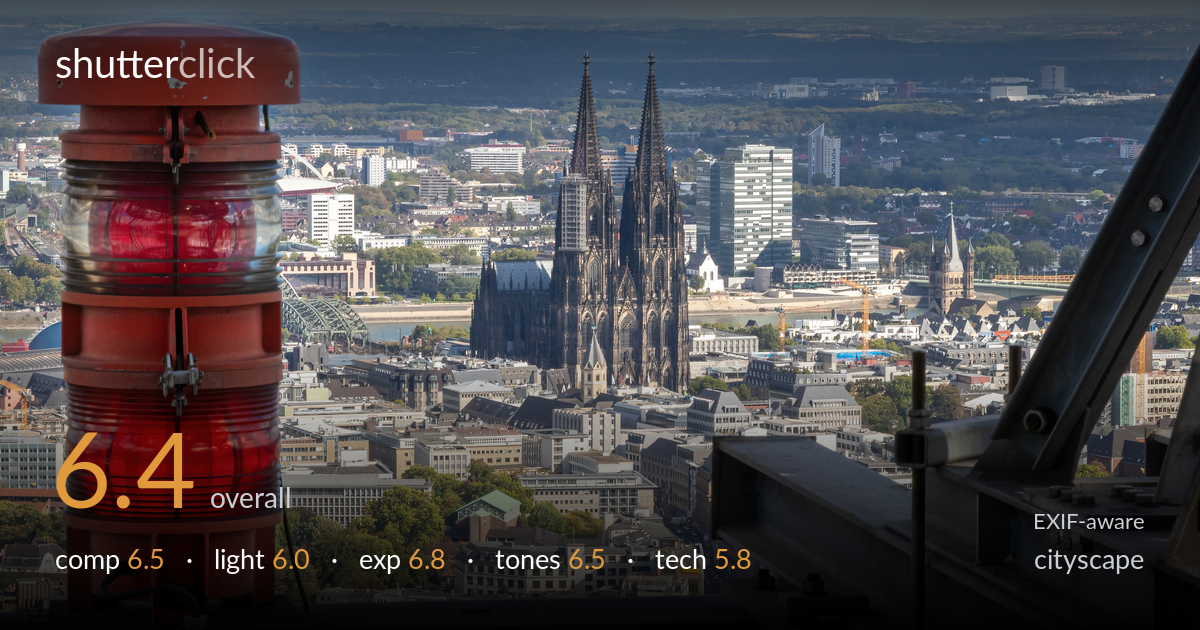
Red beacon over the cathedral city
Photo by Superbass

| Focal length | 75 mm |
| Aperture | f / 22.0 |
| Shutter | 1/100 s |
| ISO | ISO 320 |
| Exp. comp. | 0.0 EV |
| Shot at | 16:31 · Sep 9, 2020 |
The red aviation light works as a strong foreground anchor against Cologne's cathedral, building the rooftop-vantage layering a cityscape thrives on. The colour pop of the red lamp draws the eye and frames the scene with an industrial counterpoint. What most holds the shot back is the depth-of-field choice: f/22 introduces diffraction softness across the entire frame, and the cathedral — the clear secondary subject — never reaches crisp resolution. The light is flat midday, muting the city's texture. A tighter aperture decision and a moment of better directional light would lift this from a competent observation to a memorable one.
The placement of the red lamp on the left works as a bold foreground anchor, with the cathedral as the eye's destination across the river — a classic near-far cityscape relationship. The steel beam and stay on the right add an industrial counterweight but crowd the frame and pull attention from the skyline. The horizon sits high, devoting much space to dense city below, which suits the aerial vantage. The cathedral is slightly small in the gap between foreground elements; a tighter framing on the lamp-to-cathedral axis would strengthen the dialogue.
The light is flat, high midday sun under a partly clouded sky, which flattens the cathedral's intricate stonework and leaves the cityscape low in contrast and texture. The red lamp catches enough light to glow convincingly, the one element the lighting genuinely serves. The distant haze further softens separation between the city and the hills beyond. Golden-hour or low-angle side light would rake across the cathedral's spires and the rooftops, restoring the dimensionality this scene needs to read as more than a flat record.
Exposure is well controlled overall. Highlights in the bright sky and the white facades hold without obvious clipping, and shadow detail survives in the darker cathedral stone and the foreground beam. The midtones across the cityscape sit at a reasonable level, preserving the dense detail of the rooftops. The red lamp retains internal structure rather than blowing to a flat patch, which is a credit to the metering. Nothing here looks accidental — the brightness reads deliberate, balancing a bright sky against a busy, mid-toned city below.
The red lamp is the tonal star, saturated and vivid against the cooler grey-green city, and that contrast carries the image. Elsewhere the palette is muted by atmospheric haze, which washes the distant hills toward a flat blue-grey and lowers overall contrast. White balance reads slightly cool but neutral. The cathedral's stone lacks the tonal separation that would make its detail sing. A modest contrast and dehaze lift would recover punch in the mid-distance without making the red appear artificial against the subdued surroundings.
The f/22 aperture is the central technical misstep. At 75mm on the EOS 80D's APS-C sensor, the entire scene is already effectively at infinity for depth of field, so stopping down this far buys no extra sharpness — it only introduces diffraction that softens the whole frame, robbing the cathedral's spires of the crisp detail they deserve. Something around f/8 would have delivered the lens's peak resolution with ample depth for both the lamp and the city. The 1/100s shutter is adequate for this static scene and handheld at this focal length, and ISO 320 keeps noise negligible. Focus appears placed on the foreground lamp, which is acceptable given its prominence, though the diffraction means even that isn't tack-sharp. The 24-105 f/4L is a capable lens here and the 75mm focal length compresses the layers nicely. The fix is simple: an aperture in the f/8 range would transform the per-pixel sharpness of this frame.
What would elevate it
Tags
Shot something like this?
Expert photo critique, on demand — scored across six categories, EXIF-aware. Start with 3 free critiques, no credit card.
critique my photo — free