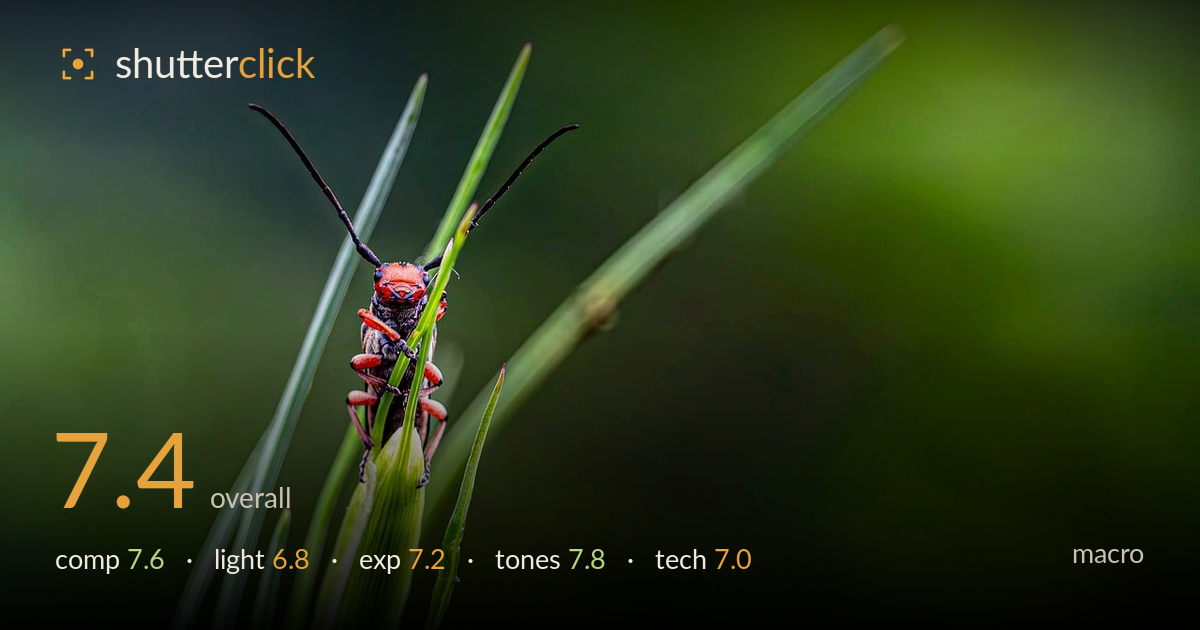
Red beetle on a grass stem
Photo by terbe_rezso

No EXIF metadata in this file
Technical analysis based on visual assessment only.
A striking red beetle clinging head-on to a grass stem, its symmetrical antennae forming a natural frame that anchors the whole image. The frontal, eye-contact pose is the shot's biggest strength — it reads as deliberate and engaging. The lush green negative space on the right gives room to breathe and lets the red pop. What holds it back most is focus precision: the face and eyes are close but not tack-sharp, and the shallow plane leaves the antennae tips and lower legs soft. Slightly more depth of field on the key plane would lift this from good to memorable.
The head-on beetle sits left of centre with the antennae splaying into a V that frames the head beautifully — an instinctive, effective piece of framing. The generous green space to the right balances the busy stem cluster on the left and gives the eye somewhere to rest. The diagonal grass blades add movement and lead upward to the subject. The lower stem base is a little cluttered and slightly distracting; a marginally tighter crop from the bottom would concentrate attention on the insect and its perch.
The light is soft and diffuse, likely overcast or shaded, which suits macro by avoiding blown highlights on the beetle's shell and keeping the green background smooth. However, that same flatness costs the image dimensionality — the beetle's red carapace lacks the sheen and modelling that a touch of directional or raking light would give. There are no catchlights in the eyes to bring them alive. A small reflector or a low-angle side light would carve out texture on the exoskeleton and add sparkle.
Exposure is well controlled. The dark green background holds detail without crushing to black, and the red of the beetle is saturated without clipping. Shadow areas on the insect's underside retain some information, and the bright grass blades on the right avoid blowing out. The overall placement leans slightly dark, which supports the moody feel, but a touch more lift on the beetle's face would reveal detail currently lost in the shadowed head and legs without harming the mood.
The colour palette is the image's quiet triumph — vivid red against a deep, layered green reads with strong complementary contrast and immediate impact. White balance is neutral and believable, and the greens gradate smoothly from bright foreground blades to darker background without muddiness. Saturation is pushed but stays within natural bounds. The tonal range is handled well, holding both the bright grass and the shadowed background. A hair more separation between the darkest greens would add depth to an already pleasing grade.
The shallow depth of field is characteristic of macro, and the background rendering is creamy and clean, isolating the subject well. The critical weakness is focus: the plane of sharpest detail sits close to the beetle's face but doesn't quite nail the eyes, which look marginally soft — a costly miss in macro where the eye is the anchor. The antennae tips and the lower legs fall well outside the focal plane. With a subject at this magnification, the razor-thin depth of field means a slightly smaller aperture, or focus stacking a few frames, would render the whole beetle sharp from face to legs. Handheld motion may also be contributing to the softness; a tripod or higher shutter speed would firm up the detail. Noise is well controlled and the lens delivers pleasant bokeh, so the fundamentals are sound — the gap is precision on the key plane, which is the single most important thing to get right here.
What would elevate it
Tags
Shot something like this?
Expert photo critique, on demand — scored across six categories, EXIF-aware. Start with 3 free critiques, no credit card.
critique my photo — free