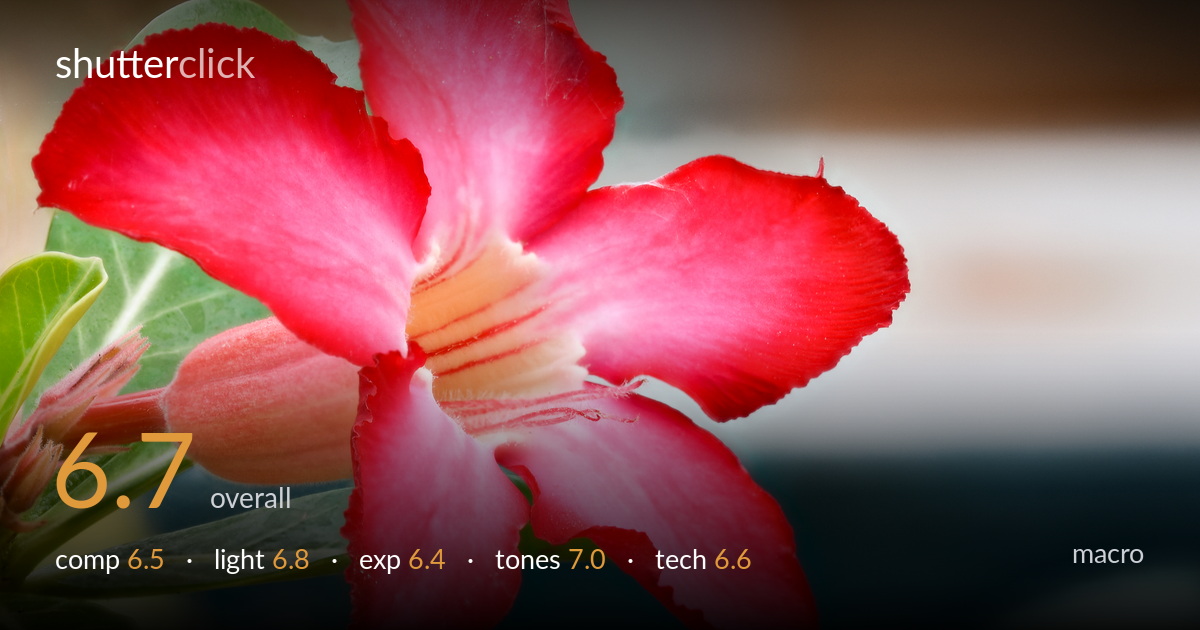
Red desert rose in bloom
Photo by This Photo was taken by Timothy A. Gonsalves. Feel free to use my photos, but pl

No EXIF metadata in this file
Technical analysis based on visual assessment only.
A vivid desert rose rendered with strong colour and a clean, creamy background that isolates the bloom well. The main flaw is the focus plane: the throat and central stamens — the natural focal point — sit slightly soft, while sharpness drifts toward the upper-left petals. The face-on framing also flattens the five-petal geometry and pushes the subject hard into the left half, leaving a large empty right side. The frilled petal edges and the supporting bud add interest, but a touch of highlight clipping in the brightest reds robs petal detail. Refined focus and a tighter frame would lift this considerably.
The bloom is placed left of centre with the petals fanning outward, which gives energy, but the right third is largely empty soft background that doesn't earn its space. The supporting bud and leaves at lower left add useful context and balance. A face-on angle flattens the trumpet's depth — a slight three-quarter view would reveal the throat's form. The lower petal runs close to the bottom edge, feeling slightly cramped. Tightening the frame around the flower and bud would concentrate attention.
Bright, fairly direct daylight gives the reds punch and lifts the saturation, but it's hard light that flattens petal texture and pushes the brightest pinks toward burnout. The frontal direction leaves few shaping shadows, so the flower reads as a flat graphic rather than a dimensional form. The soft, diffuse background suggests open shade or distance behind. A softer, more raking light — overcast or sidelit — would model the petal ridges and the throat far more delicately.
Overall brightness is workable, but the brightest red and pink petals show signs of clipping, where the deepest saturation flattens into detail-free patches. The throat's pale yellow-cream holds, and the shadowed leaves retain detail. The histogram leans bright in the reds, a common challenge with intense floral colour. Dialling exposure down slightly, or pulling the red and magenta channels in post, would recover petal striations. The shadows are healthy and clean, so the dynamic range itself is handled reasonably.
Colour is the strongest element — the crimson-to-pink gradient across the petals is rich and believable, set against muted green leaves and a softly desaturated background of warm and cool tones. White balance reads natural, with the cream throat holding neutral. The complementary red-green relationship is pleasing. The main risk is oversaturation in the reds, where the hue starts to lose gradation. A slight saturation pullback in the most intense areas would preserve the subtle vein structure within the petals.
The shallow depth of field renders a clean, distraction-free background that suits macro work, but focus placement is the weak point. The sharpest detail sits on the upper and left petal edges and frilled margins, while the central throat and stamens — where the eye wants crispness — fall slightly soft. For a flower shot at this magnification, the focal plane ideally lands on the reproductive centre. A narrower aperture, or focus stacking, would carry sharpness from the throat through the petal tips, which currently can't both be sharp at once given the angle. Noise is well controlled and the rendering is clean. The working distance and framing show the petal serration and the supporting bud nicely. Fine surface texture on the petals is partly lost to the bright frontal light rather than to the lens. Precise focus on the throat, plus a stop or two of stopping down, would resolve the central detail this composition is built around.
What would elevate it
Tags
Shot something like this?
Expert photo critique, on demand — scored across six categories, EXIF-aware. Start with 3 free critiques, no credit card.
critique my photo — free