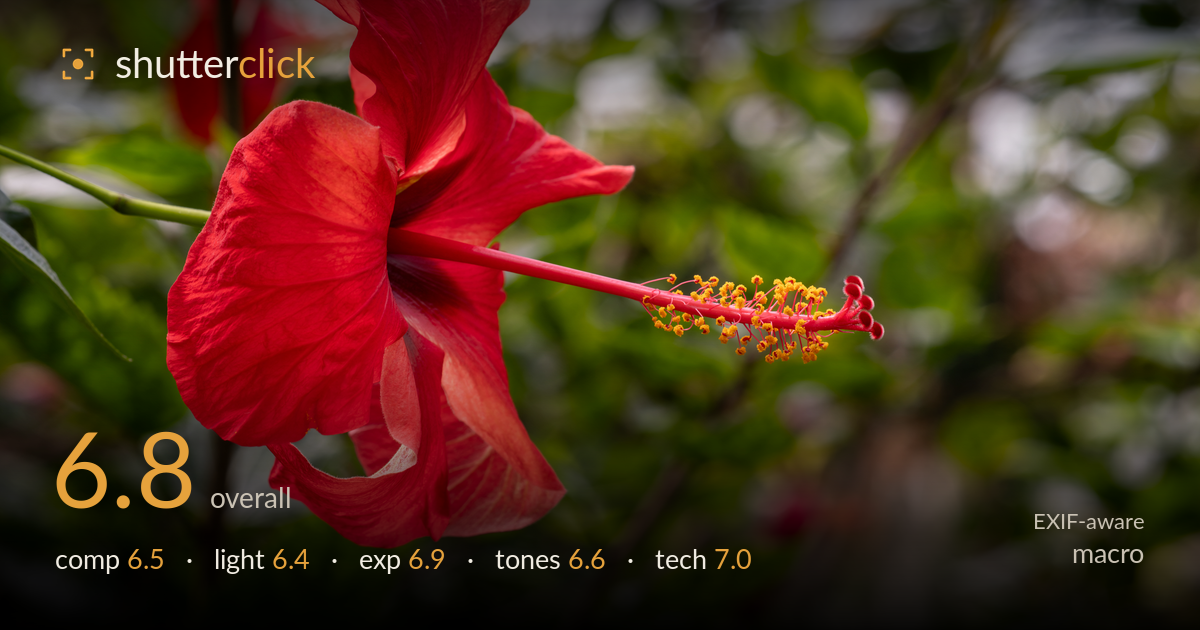
Red hibiscus reaching into the light
Photo by Jules Verne Times Two

| Focal length | 65 mm |
| Aperture | f / 1.0 |
| Shutter | 1/125 s |
| ISO | ISO 200 |
| Exp. comp. | -0.33 EV |
| Shot at | 09:36 · May 8, 2021 |
The staminal column — the flower's most photogenic feature — carries this frame beautifully, its coral stalk reaching across the composition with orange anthers dusted in pollen. That's the strength. The weakness is focus placement: the pollen-tipped anthers, the natural focal point, sit softer than they should while sharpness clings closer to the base of the column. The petals also read a touch tired and translucent, with one curling awkwardly at top. The bright, blown greenhouse background top-right pulls the eye and flattens the mood. A tighter frame on the reproductive parts with critical focus there would transform this.
Placing the flower on the left and letting the staminal column reach into negative space is a sound instinct — it gives the frame direction and breathing room. But the column points into a soft, busy area rather than resolving cleanly, and the blown-out greenhouse panelling top-right competes for attention. The topmost petal curls back awkwardly, breaking the flower's form. A cleaner background quadrant and a hair more room ahead of the anthers would let that reaching gesture land with more purpose.
Soft, diffused greenhouse light suits the delicate petals and avoids harsh specular hotspots on the glossy red surface. However, the light is flat and directionless, offering little to model the petal folds or bring out the fine texture of the pollen grains. A raking side light would carve dimension into those curling petals and make the anthers sparkle. As shot, the flower reads a bit two-dimensional, and the bright background window undercuts the mood rather than supporting it.
The -0.33 EV pull was a reasonable call to protect the saturated reds, and the flower holds its detail without the petals clipping into solid patches — impressive given how easily deep red channels blow. The background greenhouse glazing is fully blown, but that's a controlled trade for keeping the subject clean. Shadow detail in the dark stems reads adequately. The midtones on the anthers sit well. Overall the exposure decisions appear deliberate and serve the subject.
The red is rich and saturated without tipping into the oversaturated, detail-crushing territory red flowers often suffer. The coral of the staminal column separates nicely from the deeper petal red, and the orange anthers add a warm accent. The green backdrop, though, skews a little yellow and flat, and the blown highlights leave dead white patches with no tonal information. White balance is broadly neutral. A slightly cooler, deeper green background would push the red forward more emphatically.
The Laowa 65mm is a capable macro choice, but the recorded f/1.0 aperture is worth scrutiny — this lens is f/2.8, so the EXIF likely reflects a manual, uncoupled aperture the body couldn't read, meaning the true working aperture is unknown. Whatever it was, the depth of field is thin, and that exposes the core problem: focus sits on the base of the staminal column while the pollen-laden anthers — the true subject in a macro of this bloom — fall slightly soft. On this lens, focusing critically on the anther tips and stacking two or three frames would resolve both the shallow plane and the softness. 1/125s at ISO 200 was fine for a still flower in soft light, and noise is a non-issue. Sharpness where achieved is good, and the rendering of the out-of-focus foliage is pleasant. Focus precision on the key plane is what separates a good macro from this one.
What would elevate it
Tags
Shot something like this?
Expert photo critique, on demand — scored across six categories, EXIF-aware. Start with 3 free critiques, no credit card.
critique my photo — free