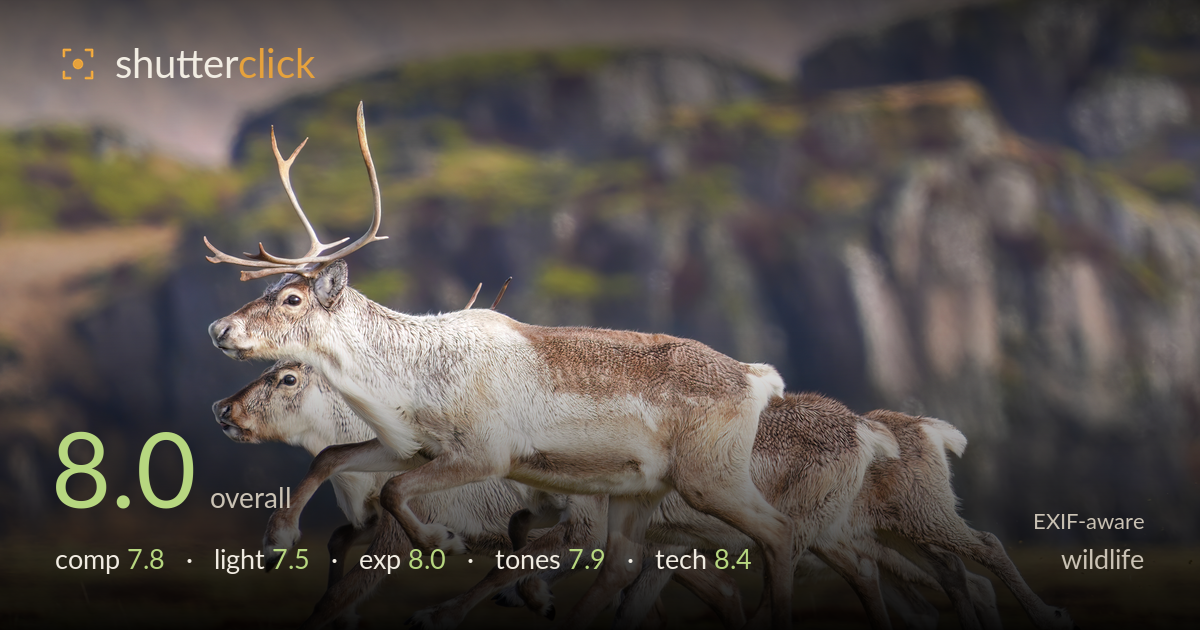
Reindeer running across the tundra
Photo by Giles Laurent

| Focal length | 600 mm |
| Aperture | f / 6.3 |
| Shutter | 1/1000 s |
| ISO | ISO 320 |
| Exp. comp. | 0.0 EV |
| Shot at | 11:09 · Mar 24, 2022 |
A strong wildlife capture of reindeer in mid-stride, with the lead animal's antlers crowning the frame and the low camera angle placing the herd right into their environment. The action reads clearly and the eye is sharp. What most holds it back is the overlapping mass of bodies in the rear — the second and third animals merge into a tangle of legs and hindquarters, making the group harder to parse. The lead animal carries the image, and its separation from the soft cliff backdrop is excellent. A cleaner moment where the herd staggered rather than stacked would elevate this from very good to exceptional.
The low, ground-level perspective is the right instinct, embedding the herd in the tundra and giving the antlers room against the blurred cliff. The lead reindeer sits nicely off-centre with space into its direction of travel. The weakness is the rear of the group: the second and third animals overlap into a congested mass of legs and rumps, and the trailing hindquarters at right compete for attention. A moment with more separation between individuals would read cleaner. The lead antler tips staying clear of the frame edge is well judged.
Soft, slightly warm light rakes across the animals from the front-left, revealing the texture of the shaggy winter coats and lifting the pale chest and neck. The direction gives gentle modelling without harsh shadow, appropriate for the herd's varied tones. It lacks the punch of golden-hour side light — the scene sits in a flatter, diffused wash that keeps detail but limits drama. The eye of the lead animal catches enough light to read, though a stronger catchlight would sharpen the connection. Pleasant, functional light rather than defining.
Exposure is well controlled across a tricky tonal range, holding detail in the bright cream flanks without clipping while keeping the darker legs and antlers readable. The 0.0 EV choice works because the diffused light kept contrast manageable. Shadow areas under the bellies retain enough information, and the highlights on the pale chest sit just below the ceiling. The soft background absorbs any excess without distraction. A touch more shadow lift on the near legs would balance the lower frame, but the histogram is used cleanly and deliberately.
The palette is warm and cohesive — russet tundra, cream and taupe coats, and a soft ochre-green cliff behind. White balance leans warm, which suits the coats but slightly muddies the greens in the backdrop. Contrast is moderate, keeping the mood natural rather than punchy, and saturation is restrained enough to stay believable. Tonal gradation across the pale flanks is smooth with no banding. The reddish foreground vegetation adds a welcome accent. A slightly cooler correction in the mid-greens would clean up the environment without touching the animals.
The 600mm reach on the 200-600 G lens is used to good effect, compressing the cliff into a soft wash while isolating the herd. At f/6.3 the depth of field is shallow enough to melt the background yet holds the lead animal front-to-back reasonably well, though the rear animals drift slightly softer — inevitable given the plane of focus falls on the leader. Focus is accurately placed on the lead reindeer's eye and head, which is exactly right. 1/1000s froze the running gait cleanly with no motion blur on the legs, a sound choice for animals at this pace. ISO 320 keeps noise negligible and preserves the coat texture. OSS and a fast shutter combined to deliver a sharp result handheld at extreme focal length. The only refinement would be a marginally faster shutter or a moment when all animals shared a focal plane, but the technical execution here is genuinely accomplished.
What would elevate it
Tags
Shot something like this?
Expert photo critique, on demand — scored across six categories, EXIF-aware. Start with 3 free critiques, no credit card.
critique my photo — free