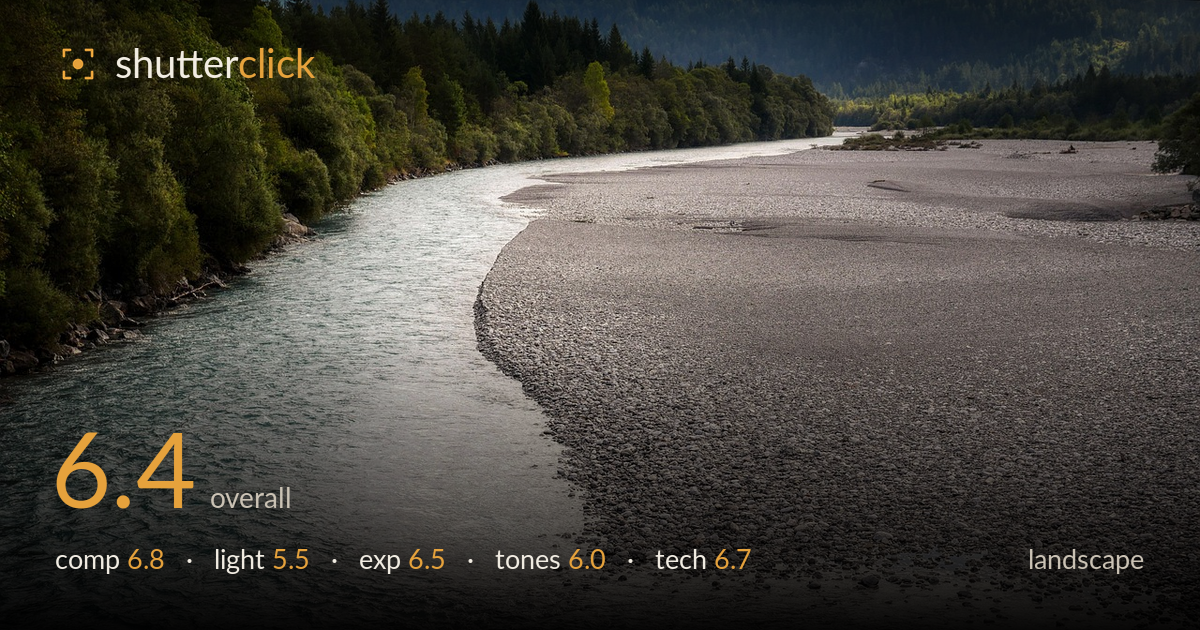
River curving past a gravel bank
Photo by fietzfotos

No EXIF metadata in this file
Technical analysis based on visual assessment only.
A strong compositional idea — the S-curve of the river sweeping against a broad gravel bank — undercut by flat, midday-ish light that leaves the scene grey and low in energy. The curve is the clear strength: it carries the eye from the foreground into the treeline and distant hills, and the split between turquoise water and pale shingle gives good textural contrast. What holds it back most is the timing of the light. The gravel dominates the frame as a large, tonally uniform mass, and the muted palette needs warmer, more directional light to come alive. A tighter framing or a lower angle would give the composition more punch.
The winding river forms a natural leading line, curving from the lower-left corner up into the distance — the picture's biggest asset. The diagonal boundary between water and gravel bank splits the frame cleanly and adds structure. The horizon sits high, which suits the emphasis on the riverbed, though the gravel occupies so much of the frame that it becomes a passive grey mass rather than active interest. A slightly lower vantage point, or including more of the far hills for depth cues, would give the vast shingle bank more purpose and scale.
This is the weakest element. The light is flat and diffuse, likely overcast or high-sun, producing little directional modelling across the gravel and no sparkle on the water beyond a broad, dull sheen. Shadows are absent, so the countless river stones read as an undifferentiated texture rather than dimensional forms. Golden-hour raking light, or even a break in cloud lighting the treeline, would separate the tonal zones and give the water reflective life. The current lighting keeps the whole scene subdued and low in impact.
Exposure is competently handled for tricky conditions. The bright gravel holds detail without blowing out, and the darker treeline retains some structure rather than blocking to black. The water's highlight sheen is controlled. Shadows in the trees on the left edge run a little dense and could use lifting to reveal foliage detail. Overall the histogram appears well spread with no serious clipping at either end — a safe, deliberate reading of a wide dynamic range, even if the flat light limits how much that range delivers.
The palette is dominated by cool greys and a muted turquoise in the water, set against green foliage — an accurate but low-energy rendering. White balance leans slightly cool, which reinforces the flatness rather than counters it. The gravel's tonal range is narrow, sitting almost entirely in the mid-greys. A touch more contrast and a subtle warmth would separate the shingle from the water and give the greens more vitality. As it stands the tones are honest but lack the punch to lift the scene.
From visual evidence the image is technically sound. Sharpness is good across the gravel bank and the near water, suggesting a well-chosen aperture with adequate depth of field for a scene shot from a raised vantage. The treeline holds detail into the distance, and there's no obvious motion blur in the flowing water — the shutter appears to have frozen the surface texture rather than smoothing it, a valid choice though a longer exposure would have rendered the current as silk and contrasted more dramatically with the static stones. Noise is not apparent, indicating a low ISO. Focus falls appropriately across the mid-ground where the compositional interest lies. The lens choice gives a natural, slightly compressed perspective that suits the subject. No distortion or fringing is evident along the high-contrast water edge. Execution is clean; the main opportunity is a creative one — using a tripod and neutral-density filter to slow the water would add a dynamic element the flat light otherwise denies.
What would elevate it
Tags
Shot something like this?
Expert photo critique, on demand — scored across six categories, EXIF-aware. Start with 3 free critiques, no credit card.
critique my photo — free