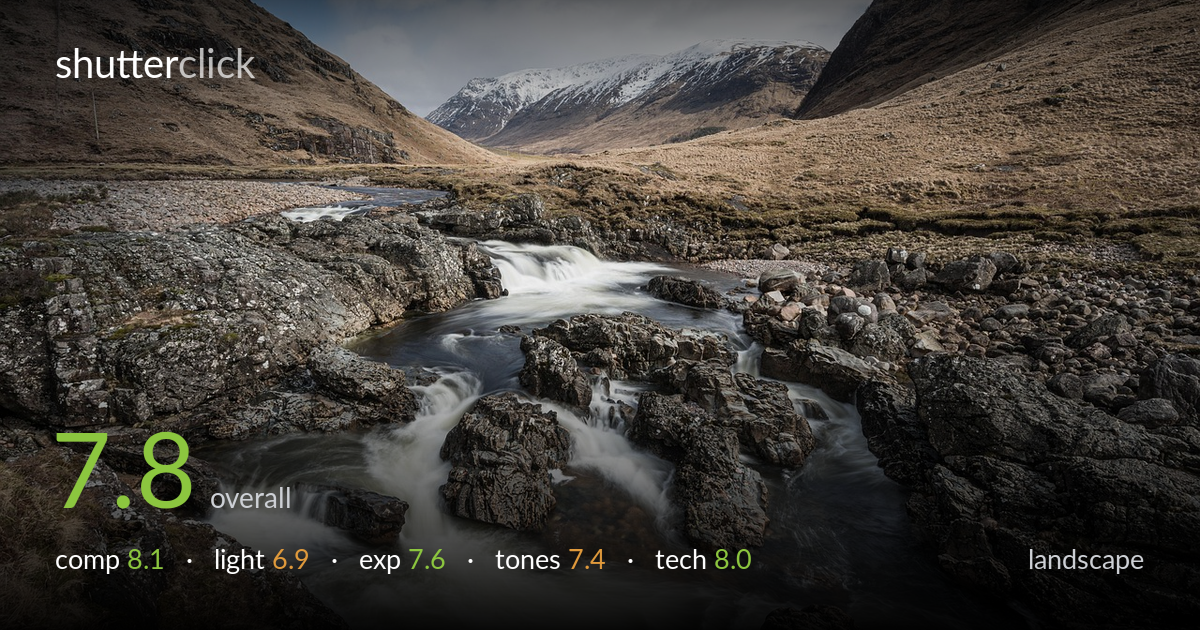
River through a highland valley
Photo by ebor

No EXIF metadata in this file
Technical analysis based on visual assessment only.
A textbook Glen Etive composition that uses the river as a leading line into a snow-capped peak, with strong foreground rock interest and the classic valley funnel framing the eye toward the distance. The flowing water is the clear strength — its silken motion against hard rock gives the frame energy and depth. What most holds it back is flat, diffuse midday light that leaves the slopes and rock looking dull, and a slightly heavy-handed processing pass that flattens the sky's drama. Better timing and gentler tonal handling would lift this from competent to memorable.
The river works hard as a leading line, snaking from the bottom edge up through the rock garden to the snow-capped peak that anchors the centre distance — a strong foreground-to-background relationship. The valley walls funnel the eye naturally inward. The midground rocks carry real texture and weight. The horizon sits comfortably high, giving the foreground room to breathe. The only weakness is a slightly cluttered right-hand rock field that competes for attention; a fraction more separation between the lead water and the static rocks would sharpen the read.
The light is the weak link. This was shot under broad, diffuse midday cloud, which flattens the slopes and robs the rock and grass of the modelling that raking light would bring. The snow peak holds some sparkle, but the valley sides read as muted and tonally similar. There's no directional shadow to give the boulders dimension, so they sit flat against the water. Golden-hour or low side light would carve out the texture in the rock and warm the dead bracken across the slopes.
Exposure is well controlled across a wide dynamic range. The white water retains texture without blowing out — no small feat against dark wet rock — and shadow detail in the deeper crevices holds up. The snow on the peak keeps detail rather than clipping. The brighter sky patches edge toward the bright end but stay recoverable. Midtones in the bracken sit a touch dark, contributing to the heavy feel. Overall a deliberate, balanced exposure that handles the contrast between foam and rock cleanly.
The palette leans cool and slightly heavy, with muscular contrast that suits the rugged subject but tips toward the processed look in the rock and sky. The blue of the sky is rendered a little artificially saturated against the grey clouds, and the rocks carry a darkened, crushed quality that flattens their mid-tones. White balance is broadly neutral. The bracken's tan could sing more with warmer handling. A gentler contrast curve and a lighter touch on clarity would restore some of the natural luminosity.
Execution is the standout. The long exposure renders the water as flowing silk while keeping the rocks crisp and detailed — a tripod-and-ND discipline that pays off cleanly here. Focus is well placed and depth of field carries sharpness from the nearest foreground rock all the way to the distant snow peak, indicating a sensibly stopped-down aperture and good hyperfocal judgement. The wide focal length captures the valley sweep without obvious distortion, and the verticals on the mountain walls stay convincing. Detail in the rock texture is excellent, and there's no visible noise. The only technical caution is in post: the heavy clarity and contrast push gives the rocks an over-sharpened, gritty edge that competes with the soft water and reads as digital rather than natural. A lighter processing hand would let the genuinely strong capture speak for itself. The fundamentals of the shot — focus, depth, exposure length — are all sound.
What would elevate it
Tags
Shot something like this?
Expert photo critique, on demand — scored across six categories, EXIF-aware. Start with 3 free critiques, no credit card.
critique my photo — free