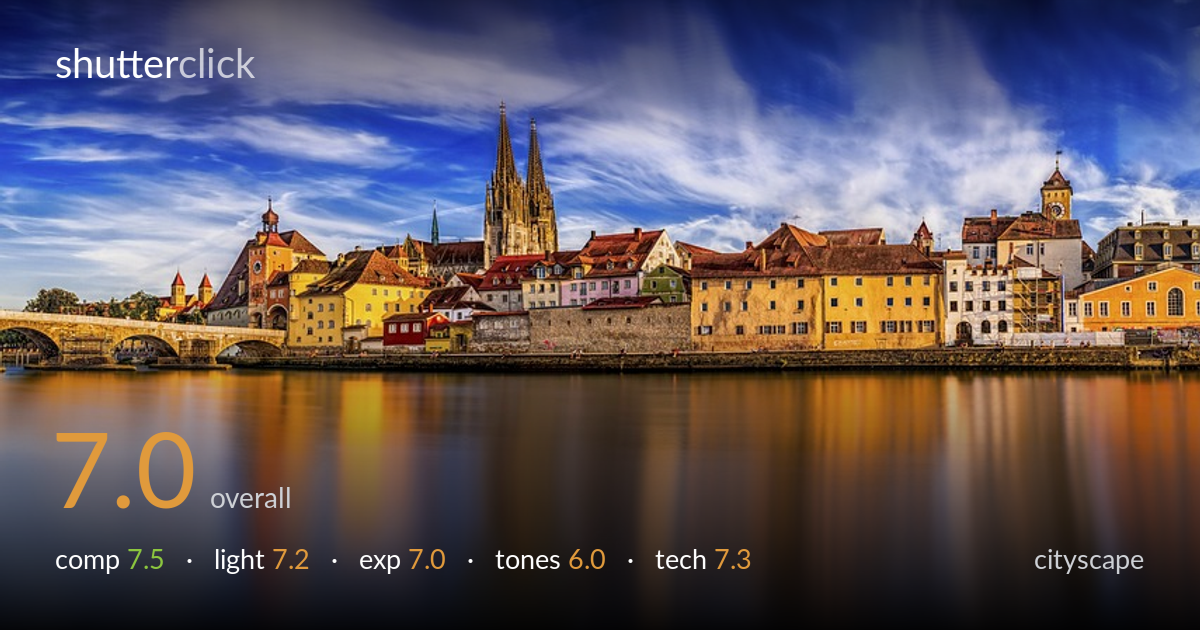
Riverfront town mirrored at golden hour
Photo by Felix-Mittermeier

No EXIF metadata in this file
Technical analysis based on visual assessment only.
A clean, well-balanced panoramic skyline anchored by the cathedral spires, with the long-exposure water delivering glassy reflections that mirror the warm facades. The horizontal layering — water, waterfront, rooftops, sky — reads clearly and the format suits the subject. What most holds it back is the colour grade: saturation and HDR processing are pushed hard, leaving the blues electric, the oranges glowing, and the cloud structure crunchy and over-defined. Pulling the vibrance back and softening the local-contrast treatment would let the genuinely lovely light and reflections breathe rather than shout. The bones are strong; the finishing is where restraint pays off.
The panorama distributes the town evenly across the frame, with the cathedral spires giving a clear vertical anchor against an otherwise low, horizontal skyline. The reflection doubles the subject and fills the lower half effectively, though the waterline sits almost dead-centre, which flattens the depth slightly. The bridge entering at far left adds a useful foreground cue. A touch more sky or a marginally higher horizon would have weighted the composition toward the dramatic clouds. Subject placement is competent and the spires fall pleasingly off-centre.
Low, warm side light rakes across the waterfront facades, picking out the yellows, oranges and reds of the buildings and giving the stone real dimension. The timing — late golden hour — is well chosen for a riverfront town, warming the architecture while the sky holds blue. The clouds catch directional light that adds movement overhead. The light is genuinely the image's strongest natural asset; the issue is that processing has amplified it past what the scene delivered, tipping warmth into glow.
The exposure holds detail across a wide range, from the shadowed waterfront wall to the bright sky, suggesting HDR blending or heavy shadow lifting. Highlights in the pale facades and clouds stay just shy of clipping, and shadow detail in the buildings is preserved. The overall brightness is balanced for the panorama. The trade-off is the flattened, slightly artificial midtone rendering that comes with aggressive dynamic-range compression — the tonal transitions feel compressed rather than natural, robbing the scene of some depth.
This is where the image overreaches. The blue sky is pushed to an electric, oversaturated cyan that fights the warm town, and the orange reflections glow with unnatural intensity. White balance leans heavily warm in the lower half and cool up top, exaggerating the split. The HDR local contrast crunches the cloud edges into a hard, processed texture. Dialing back vibrance, easing the clarity on the sky, and reconciling the warm/cool split would yield a far more believable, and ultimately more impactful, tonal palette.
The long exposure is the key technical choice and it works — the water is rendered as a smooth, glassy mirror that returns clean reflections of the skyline, requiring a tripod and likely a neutral-density filter to drag the shutter in daylight. Sharpness across the architecture appears solid corner to corner, suggesting a well-chosen aperture in the mid range and careful focus on the building line. The panoramic format is either a wide crop or a stitched sequence; either way the stitch holds without obvious seams or warping. Verticals on the spires and towers stand acceptably straight, with no glaring keystoning. The main technical caveat is in post rather than capture: the HDR and local-contrast processing introduces a slightly crunchy, haloed quality around the cloud edges and rooftops that undermines the otherwise clean execution. A lighter processing hand would let the strong in-camera work speak for itself.
What would elevate it
Tags
Shot something like this?
Expert photo critique, on demand — scored across six categories, EXIF-aware. Start with 3 free critiques, no credit card.
critique my photo — free