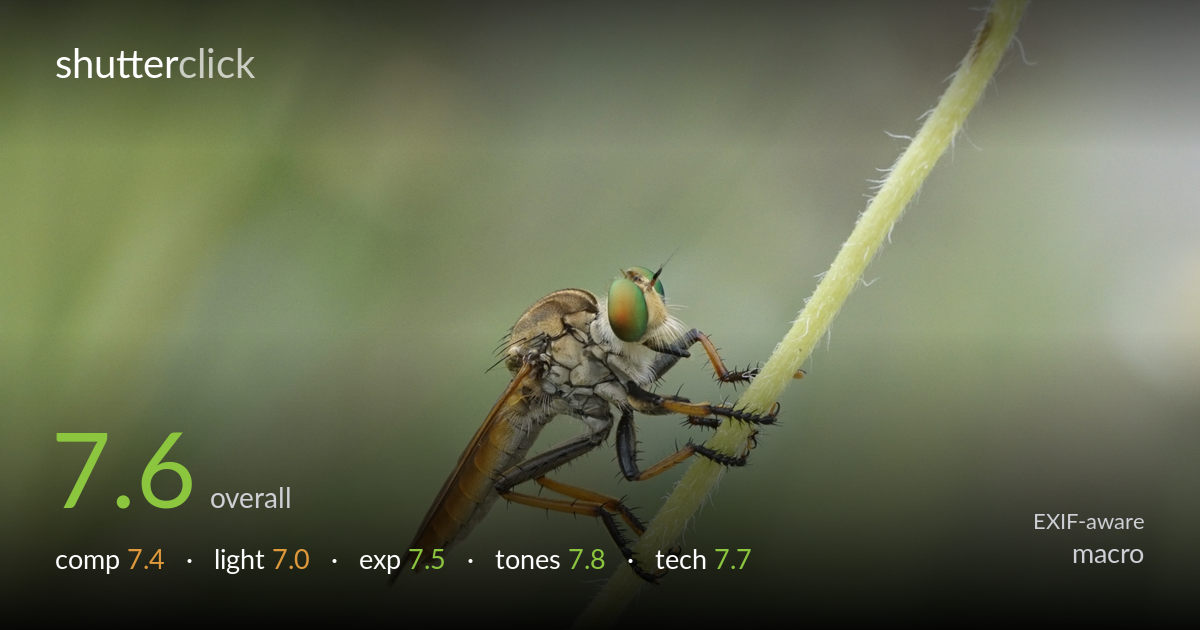
Robber fly on a stem
Photo by Vengolis

| Focal length | 150 mm |
| Aperture | f / 8.0 |
| Shutter | 1/160 s |
| ISO | ISO 400 |
| Exp. comp. | 0.0 EV |
| Shot at | 16:33 · Sep 2, 2016 |
A robber fly captured with the iridescent green-and-orange eye sharp and rendered in full colour — the most rewarding plane in any insect portrait, and it lands. The diagonal stem provides a natural perch and leads the eye, while the soft green wash isolates the subject cleanly. What most holds the shot back is depth of field: the eye and near legs are crisp, but the abdomen and far details drift soft, and the head sits slightly past peak sharpness. The lighting is flat and even, which protects highlights on the eye but leaves the body's texture under-modelled.
The diagonal stem cutting from lower-left to upper-right gives strong structure and a believable perch, and the fly is placed left of centre facing into open space, which reads well. The wing tip nearly touches the left edge, though, crowding that corner, and a touch more room behind the abdomen would let it breathe. The stem exits the top-right cleanly. Negative space on the left is generous and supports the subject. A slightly lower angle to the head would have aligned the eye more directly with the viewer.
Soft, diffuse light keeps the highly reflective compound eye from blowing out and preserves the iridescent banding — a genuine win for this subject. The trade-off is flatness: the body, hairs, and stem fuzz lack the raking modelling that would separate fine texture from form. There is no clear directional shaping, so the abdomen reads slightly two-dimensional. A low side light or a small diffused fill from camera-left would have carved out the bristles and given the orange abdomen more dimensional glow.
Exposure is well judged for a tricky high-reflectance subject. The green eye holds its colour banding without clipping, and the orange abdomen retains detail in the segment ridges. Shadows under the thorax keep enough information without going muddy. The bright stem on the right approaches but does not blow its highlights. The overall brightness sits comfortably mid-range, leaving the histogram balanced. Nothing here looks accidental — the 0 EV choice was right for the even light and avoided crushing the darker leg joints.
The colour relationship is the photograph's quiet strength: warm orange abdomen and legs against a cool, muted green field is a complementary pairing that draws the eye straight to the subject. White balance reads neutral, with the green background convincingly natural rather than oversaturated. The iridescent eye carries genuine green-to-orange transition. Contrast is gentle, in keeping with the soft light, though the body could take a small mid-tone lift to add snap. Saturation is restrained and tasteful, avoiding the cartoonish look macro often falls into.
The 150mm f/2.8 macro lens stopped to f/8 is a sensible choice, giving more depth than wide open while staying away from diffraction softening. Focus is placed on the eye, which is the correct priority, and it is acceptably sharp — though critical examination suggests the true plane of focus sits just in front, on the near foreleg, leaving the head a hair soft. At f/8 the depth of field still cannot hold the whole insect: the abdomen and far legs fall off. ISO 400 is clean and well within the sensor's comfort, and noise is a non-issue. The 1/160s shutter froze a static subject adequately, but for a perched fly that can flick away, a faster speed paired with flash would have bought both sharpness insurance and more aperture for depth. A focus stack of three or four frames would have resolved the depth limitation entirely while keeping the eye tack-sharp.
What would elevate it
Tags
Shot something like this?
Expert photo critique, on demand — scored across six categories, EXIF-aware. Start with 3 free critiques, no credit card.
critique my photo — free