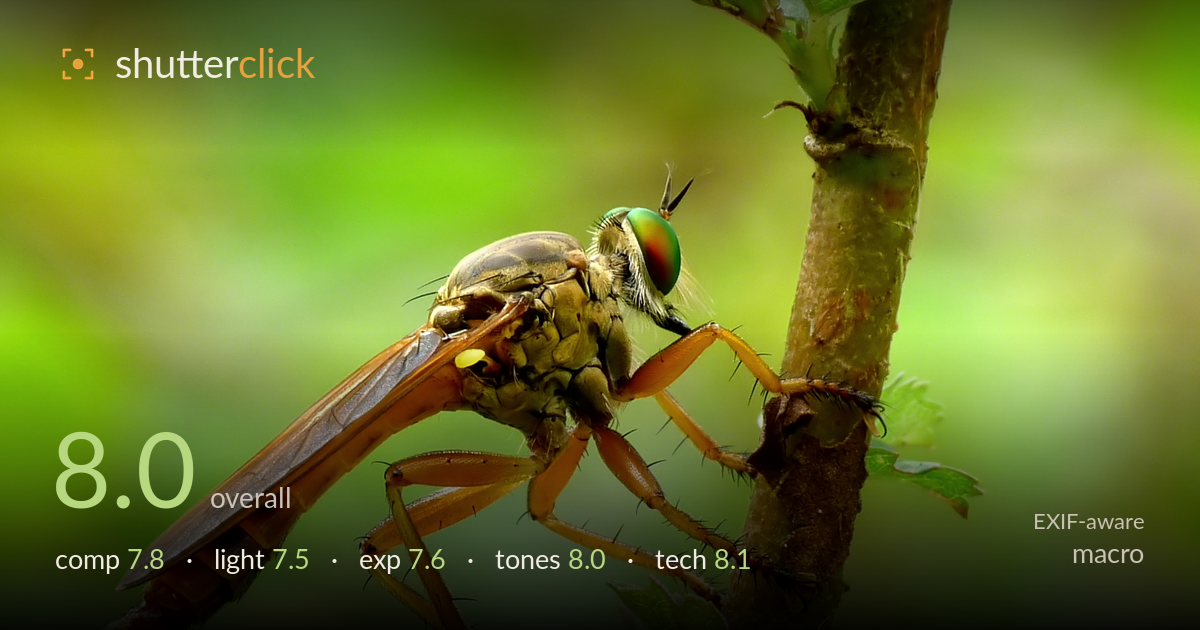
Robber fly on a stem
Photo by Jeevan Jose, Kerala, India

| Shot at | 15:45 · Sep 12, 2010 |
A robber fly rendered with genuine authority: the iridescent green eye and its sliver of red catchlight anchor a full-length profile against a clean, buttery green wash. The framing places the insect diagonally with the stem as a natural perch, and the level of detail across the head bristles and eye is the standout. What most holds it back is that the plane of focus favours the head and thorax while the abdomen tip and hind tarsi drift soft, and the light is flat and even rather than shaped. A little more depth of field or a stack, and directional light, would push this from strong to exceptional.
The diagonal orientation of the fly across the frame works well, with the stem on the right giving a believable perch and a sense of place. The head is positioned near the upper third and the abdomen sweeps down and left, creating movement. The clean green background isolates the subject cleanly. The abdomen tip crowds the left edge, though, sitting a touch tight, and the leaf clutter at bottom right competes slightly with the legs. A hair more room at the left and lower edge would let the form breathe.
The light is soft and diffuse, typical of an overcast or shaded forest setting, which avoids harsh shadows and keeps the whole body evenly readable. It flatters the subtle browns and golds of the legs and wing. The trade-off is flatness: there is little directional modelling to carve out the thorax texture or the segmented abdomen, so the fly reads slightly two-dimensional. The one real spark is the catchlight in the compound eye, which brings the head alive. Raking side light would have added dimensionality.
Exposure is well judged for a high-key green setting. The subject holds midtone detail across the thorax and legs without the bright background pulling the fly into silhouette. Highlights on the wing membrane and the lit tarsi are close to clipping but retain texture. Shadow areas under the body keep enough information to read structure. The histogram sits high overall, appropriate to the airy backdrop, and the exposure decision looks deliberate rather than accidental. A touch less exposure would have preserved a little more of the brightest wing sheen.
The colour palette is the image's quiet strength: warm amber and tan legs set against cool, desaturated greens, with the electric green-and-red eye as the focal accent. White balance reads natural and the greens are pleasantly creamy rather than garish. Contrast is gentle, suiting the soft light, and the tonal gradation across the translucent wing is lovely. Saturation is restrained and believable. If anything, the background greens could carry a hint more separation in luminance, but the tonal harmony overall is handled with a good eye.
Shot on the Panasonic DMC-FZ28, a small-sensor superzoom bridge camera, this is an impressive result given the gear's limits. Focus is sharpest on the eye, head bristles and front of the thorax — exactly where it should be — and the fine hairs are crisply resolved. Depth of field, however, runs out before the abdomen tip and the far hind legs, which soften noticeably; the small sensor works in favour of DoF here but the working distance still left the rear third out of the plane. A slightly smaller aperture, or a focus stack of two or three frames, would have carried sharpness the full length of the body. Noise is well controlled and the background stays clean and smooth without mushy artefacting, suggesting a sensible ISO. Handheld stability appears good — no motion blur on the key details. The lens resolves the subject well for a bridge camera at close range. Solid technical execution within the camera's constraints.
What would elevate it
Tags
Shot something like this?
Expert photo critique, on demand — scored across six categories, EXIF-aware. Start with 3 free critiques, no credit card.
critique my photo — free