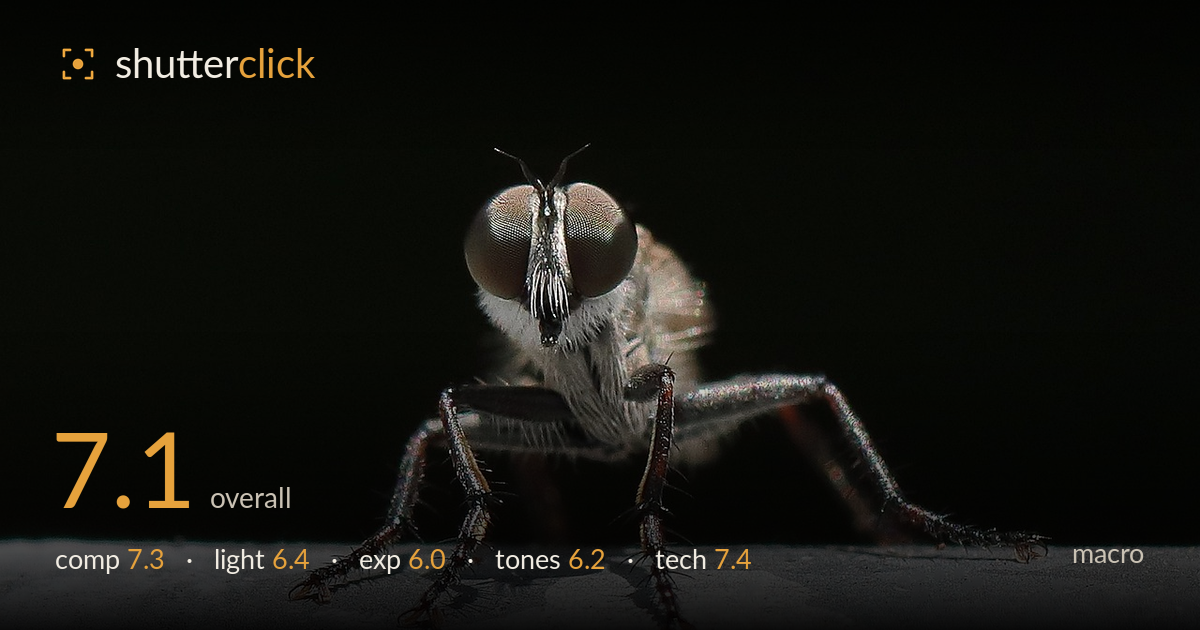
Robber fly staring down the lens
Photo by Christian_Crowd

No EXIF metadata in this file
Technical analysis based on visual assessment only.
A confrontational, head-on robber fly portrait with genuine presence — the frontal symmetry, spread legs, and locked-in compound eyes give the frame real character. What most holds it back is the harsh, contrasty light and the resulting exposure spread: the near-black background swallows the abdomen while the pale substrate borders on blowing out. The eyes and facial bristles carry good detail, but the overall rendering feels raw rather than refined. Softer light and a gentler tonal balance would let the specimen's fine texture speak without the fight between crushed shadow and hot highlight.
The head-on framing is the strongest choice here — the symmetry of the eyes and the braced, spread front legs create a stance that reads as alert and slightly menacing, exactly what suits this predator. The subject sits high enough that the pale substrate anchors the lower third well. The dark upper background gives useful negative space, though the abdomen trailing off to the right breaks the otherwise tidy symmetry. A fraction more room beneath the feet would settle the base rather than clipping so close to the frame edge.
The light is hard and directional, producing bright specular hits along the legs and a strongly lit face against deep shadow. It carves the bristles and leg spines with dramatic edge definition, which serves the aggressive mood, but the quality is unforgiving — the transition from lit subject to black surround is abrupt with little modelling in between. A diffused source, or fill bounced from below, would tame the harshness and reveal the thorax and abdomen that currently disappear into shadow.
The exposure is caught between two extremes. The pale limestone substrate approaches clipping in its brightest patches, while the background and much of the abdomen fall to near-black with no recoverable detail. The face and eyes are well placed — bright enough to read the ommatidia clearly without burning out — but that leaves a wide, unmanaged dynamic range on either side. Exposing a touch darker overall and lifting shadows selectively would hold the highlights on the substrate and recover some body detail.
The palette is largely neutral — greys, silvers, and browns against black — which suits the subject, but the tonal range feels stretched thin. Contrast is high, and the midtones are sparse, leaving a jump from bright substrate to crushed shadow. The metallic sheen on the legs shows some pleasant iridescence, a welcome bit of colour. White balance reads slightly cool on the substrate. Gentler contrast and a touch more midtone gradation would make the rendering feel less brittle.
Focus lands convincingly on the near eye and the facial bristles, which is the correct plane for a frontal insect portrait, and the fine hair detail across the face holds up well at this magnification. Depth of field is shallow, as expected — the abdomen and rear legs soften off, and the front legs stay reasonably crisp where they matter. There's visible specular noise and some edge harshness that suggests aggressive sharpening or a hard flash; either way the leg spines read a little crunchy. The framing captures the full spread of the stance without cutting a leg awkwardly, and the working distance appears well judged for the subject. A focus-stacked approach would bring the thorax and both front legs into full sharpness, and slightly softer processing would reduce the brittle, over-crisp look along the high-contrast edges. As it stands the critical plane is sharp and purposeful, which is the hardest part to get right in macro.
What would elevate it
Tags
Shot something like this?
Expert photo critique, on demand — scored across six categories, EXIF-aware. Start with 3 free critiques, no credit card.
critique my photo — free