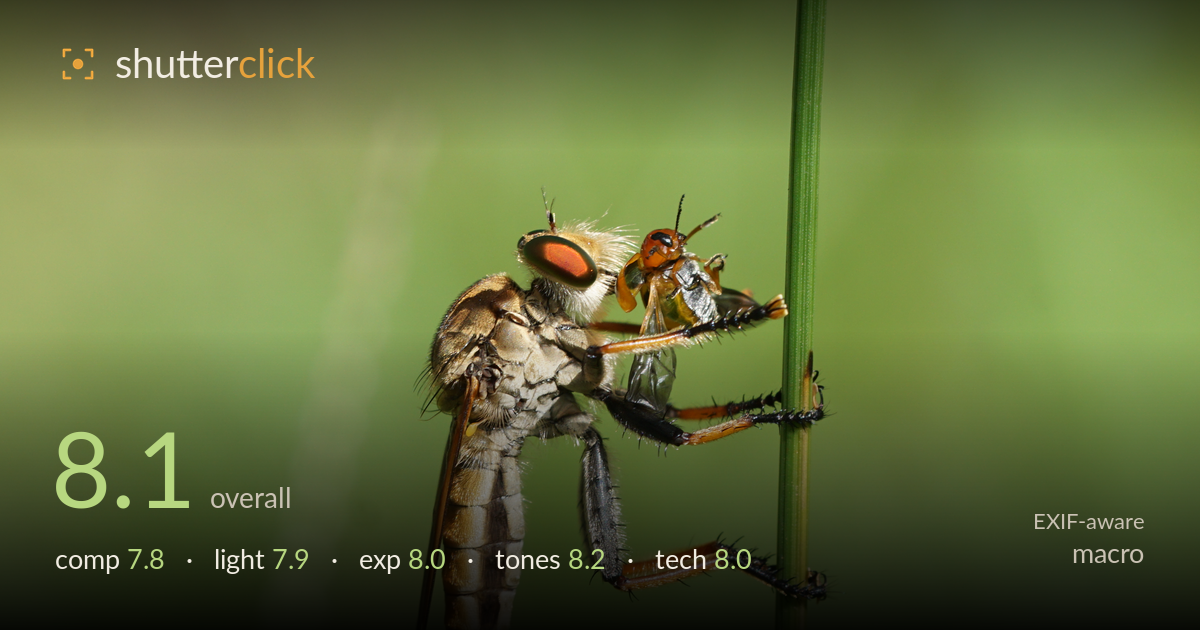
Robber fly with its prey
Photo by Vengolis

| Focal length | 150 mm |
| Aperture | f / 7.1 |
| Shutter | 1/200 s |
| ISO | ISO 200 |
| Exp. comp. | 0.0 EV |
| Shot at | 15:10 · Jun 28, 2015 |
A predation moment cleanly told — the robber fly gripping a grass stem with prey in its grasp gives this frame genuine behavioural weight, the kind of storytelling that lifts a macro shot above a mere portrait. The compound eye's iridescent glow and the fine hair detail across the thorax are the strongest elements. What holds it back most is the focus plane: the fly's head and eye are sharp, but the abdomen tip and the far legs drift soft against a shallow depth of field. The clean green wash is a real asset. A hair more depth and slightly cooler frame would finish it.
The vertical grass stem anchors the right third and gives the fly something to grip, which reads naturally. The predator faces into the frame with its prey, leaving productive space to the left for the abdomen to trail. The eye sits close to a thirds intersection, well judged. The abdomen tip nearly touches the bottom edge, though — a touch more breathing room below would relax the crop. The stem cutting the frame vertically is slightly rigid; angling the shot a few degrees would soften that division.
Soft, diffused daylight rakes across the thorax enough to model the segmented armour and catch the halo of fine hairs around the head, which is exactly what this subject needs. The catchlight and iridescence on the compound eye come through cleanly. Shadows stay open and never block up. The light is a shade flat on the abdomen, where more directional side light would have carved out the banded texture. Overall the timing and quality suit the subject well without harshness.
Exposure is well controlled. The metallic sheen on the wing and the bright eye hold highlight detail without clipping, and the shaded underside of the fly retains shadow information. The bright green background sits at a comfortable high-key level without blowing out. Midtones across the thorax are placed to show texture. Nothing here reads as accidental — the zero exposure compensation was the right call for this even, diffused light, and the histogram would sit comfortably clear of both edges.
The warm ochre and gold of the fly's body play cleanly against the cool green wash, a pleasing complementary balance that keeps the subject distinct. White balance looks accurate — the greens read natural rather than yellow-cast. Saturation is restrained and believable. The tonal range runs from the deep leg shadows to the bright eye without feeling forced. The green background is perhaps a touch uniform; a subtle gradient or cooler shadow tone would add depth, but the palette overall is handled with a good eye.
At 150mm f/7.1 on the APS-C ILCA-77M2, the depth of field is inevitably shallow at macro range, and the focus was placed on the head and eye — the correct priority. Those are critically sharp, with the compound eye's facets and the surrounding hairs resolving well. The trade-off shows in the abdomen tip and the far legs gripping the stem, which fall outside the plane. ISO 200 keeps noise invisible and preserves fine detail. The 1/200 shutter froze this static subject cleanly, though it leaves little margin had the fly moved — a faster speed or flash would add insurance for behaviour shots. A narrower aperture around f/11, or a short focus stack, would have brought more of the body into acceptable sharpness while the diffused light still allowed workable exposure. Lens choice is ideal for the working distance this skittish subject demands. Execution is strong; the main gain lies in extending the sharp zone.
What would elevate it
Tags
Shot something like this?
Expert photo critique, on demand — scored across six categories, EXIF-aware. Start with 3 free critiques, no credit card.
critique my photo — free