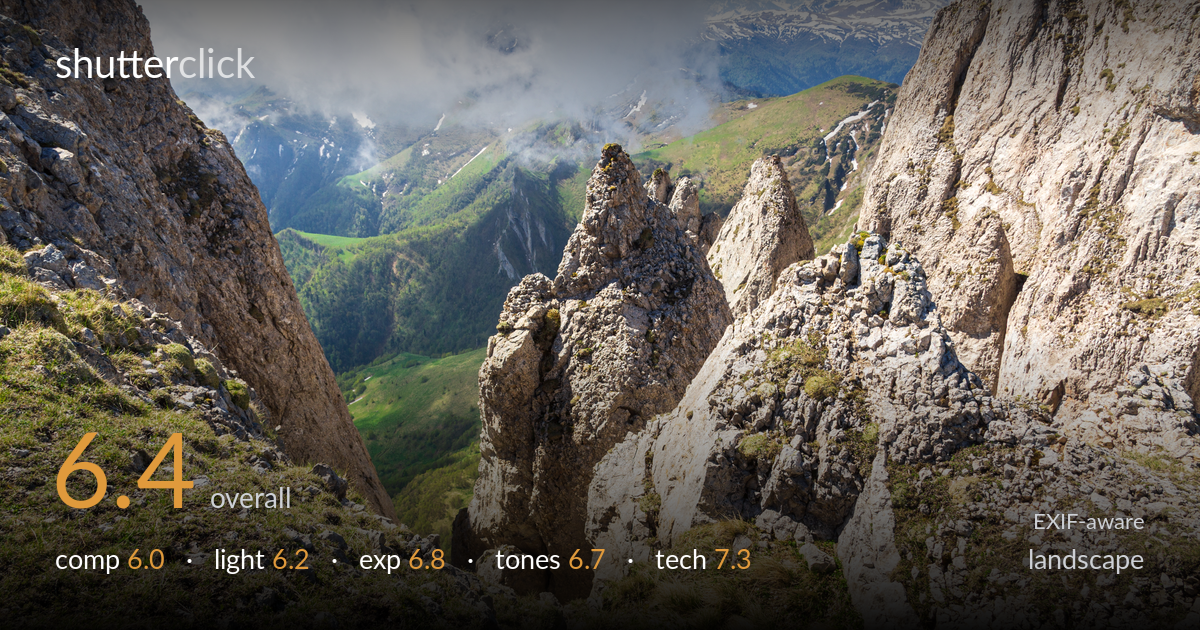
Rock spires above a hazy valley
Photo by Vyacheslav Argenberg

| Focal length | 17 mm |
| Aperture | f / 7.1 |
| Shutter | 1/250 s |
| ISO | ISO 100 |
| Exp. comp. | 0.0 EV |
| Shot at | 09:11 · Jun 2, 2015 |
A dramatic alpine vantage with strong jagged rock pinnacles framing a hazy valley, but the composition is cramped by the two heavy rock masses that hem the frame on both sides and crowd the eye. The wide 17mm view captures depth and scale, yet the central spires compete with the foreground slope and the distant ridge for attention, leaving no clear hierarchy. Light is flat midday haze, which softens the far mountains and flattens contrast. The rugged texture and sense of altitude are genuine assets; tighter framing and better timing would sharpen the impact considerably.
The towering rock spires at centre are a compelling subject, and the green valley below adds welcome depth and scale. But the frame is congested: the large rock wall on the right and the grassy slope on the lower left both claim significant real estate without contributing much, squeezing the spires into a busy middle band. The eye struggles to settle. Lowering the viewpoint or stepping to isolate the pinnacles against the valley would clean up the clutter. The horizon and distant ridge sit high and hazy, weakening the sense of resolution at the top.
This reads as midday light under thin high cloud — bright but flat. The foreground rock and grass receive some directional modelling that hints at texture, but the distant peaks and valley dissolve into atmospheric haze that drains contrast and separation. There are no long shadows to sculpt the spires, so their three-dimensional form is underplayed. The cloud-wrapped background adds mood but also a washed-out band across the upper frame. Side light earlier or later in the day would carve the rock and deepen the valley.
Exposure is well controlled for difficult conditions. The bright cloud band in the upper left is close to clipping but retains some structure, and the shadowed rock faces hold detail without muddiness. Midtones in the green valley and the textured stone sit comfortably. The histogram is using most of the range without obvious blown highlights or crushed blacks. Slight underexposure of the foreground rock would have preserved more highlight headroom in the clouds, but the balance struck here is sensible and clearly deliberate.
Colour is natural and pleasant — the spring greens read true and the warm grey-tan rock contrasts nicely with the cool hazy distance. White balance is neutral. Where the image loses ground is contrast: the atmospheric haze flattens the far ranges into low-contrast grey, and the overall tonal separation between near and far is weak. The foreground holds the strongest tonality. A modest contrast and clarity lift, plus selective dehaze on the distance, would restore depth and make the layers read as distinct planes.
The settings are well chosen for the scene. At 17mm and f/7.1, depth of field is ample, holding sharpness from the foreground grass through to the distant ridge, and ISO 100 keeps noise negligible with clean shadow detail. The 1/250s shutter is more than enough to freeze a static landscape handheld. Focus appears accurate on the central rock mass. The 17-50 f/2.8 is a capable lens, and stopping it to f/7.1 sits near its sharpness sweet spot, so corner-to-corner detail is solid. The main limitation isn't gear or settings but the optical haze and flat light, which no aperture choice can fully overcome. A polarising filter would have cut some of the atmospheric scatter and deepened the sky and greens. Bracketing for an HDR blend, or simply waiting for raking light, would also have given more to work with. Execution is technically sound throughout; the constraints here are atmospheric and compositional rather than technical.
What would elevate it
Tags
Shot something like this?
Expert photo critique, on demand — scored across six categories, EXIF-aware. Start with 3 free critiques, no credit card.
critique my photo — free