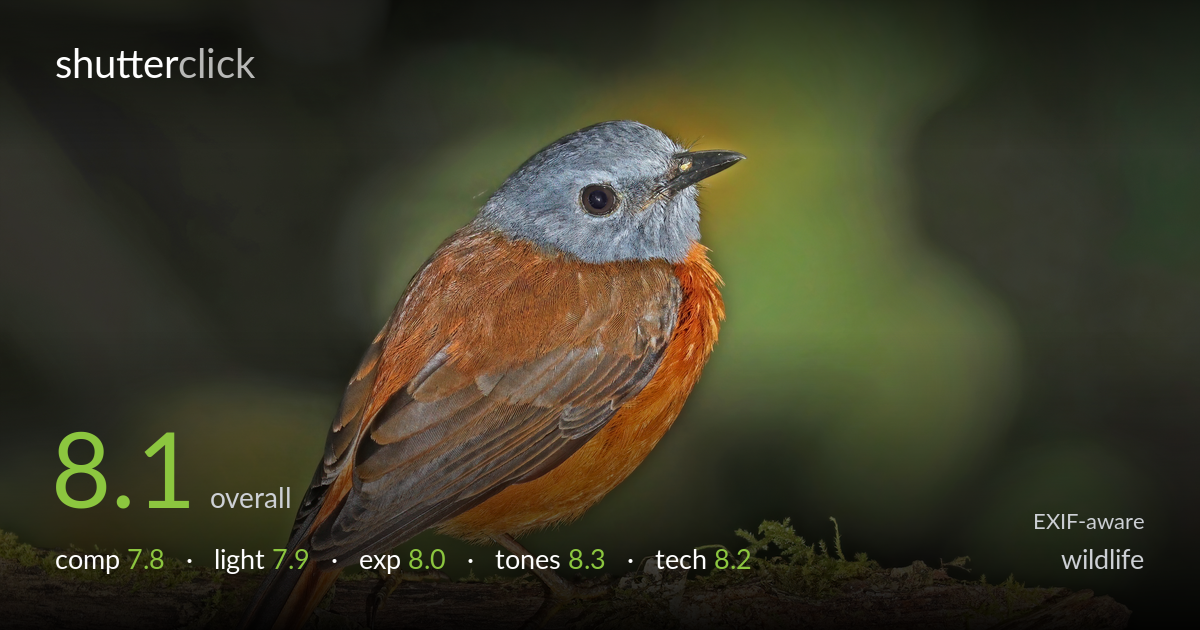
Rock thrush on a mossy log
Photo by Charles J. Sharp

| Focal length | 400 mm |
| Aperture | f / 8.0 |
| Shutter | 1/250 s |
| ISO | ISO 500 |
| Exp. comp. | 0.0 EV |
| Shot at | 10:39 · Dec 1, 2018 |
A clean, well-resolved portrait of a rock thrush perched on mossy deadwood, carrying a sharp eye, a clear catchlight, and beautifully separated colour against a soft green wash. The rich rufous and slate-grey plumage reads with excellent detail and texture. What most holds it back is a slightly static, full-profile pose and a perch that occupies a large share of the lower frame without adding much interest beyond the foreground moss. A touch more breathing room ahead of the bill and a stronger sense of behaviour would lift this from a strong field record toward a more memorable image.
The bird sits high and slightly left, with the tail running diagonally down to the perch — a balanced, readable arrangement. The smooth background gives clean separation and lets the plumage carry the frame. The full side-profile is classic but static, and the gaze runs nearly into the right edge, leaving little space ahead of the bill for the eye to travel. The lower third is dominated by the log, which is textured but heavy. A fraction more headroom and a hair more space in the looking direction would improve the flow.
Soft, diffused light wraps the bird evenly, holding detail in both the dark slate head and the bright rufous flanks without harsh shadows — well suited to high-contrast plumage. A clear catchlight sits in the eye, giving it life. Direction is gentle and slightly frontal, which keeps everything legible but flattens some of the feather modelling on the back. A touch of side or raking light would have carved more dimension into the wing coverts and breast, but the gentle quality serves the subject cleanly.
Exposure is well judged for a tricky tonal spread. The bright orange breast holds saturation and detail without clipping, while the dark grey head and shadowed tail retain structure. The perch highlights stay in check. The histogram looks comfortably contained with no blown channels in the rufous, which is easy to lose. Midtones sit naturally and the eye remains readable against the dark face. There is little to fault here — it reads as a deliberate, controlled rendering rather than a lucky middle-of-the-road frame.
Colour is the standout. The warm rufous of the underparts plays against the cool slate head and the muted green background for a pleasing complementary balance. White balance looks accurate, with no colour cast in the neutral greys. Saturation is rich but stops short of looking pushed, and the feather tones gradate smoothly from grey to orange. The mossy perch adds earthy mid-tones that anchor the palette. Contrast is handled so detail survives in both the darkest and brightest plumage areas.
The 400mm reach on the 80D delivers good working distance and pleasant background compression, and f/8 gives enough depth of field to carry the whole bird sharp while still melting the background to a clean wash. Focus is placed accurately on the near eye, which shows a crisp catchlight and fine feather detail across the head and breast. ISO 500 keeps noise negligible and the files clean. The main caution is the 1/250s shutter — adequate here because the bird held still, but marginal for any sudden head turn or wing movement at this focal length, even with IS. A faster shutter near 1/640–1/1000s, with ISO lifted to compensate, would have bought insurance against motion with little visible noise penalty. Sharpness, rendering, and lens choice are all well matched to the subject; only the shutter margin leaves room to improve.
What would elevate it
Tags
Shot something like this?
Expert photo critique, on demand — scored across six categories, EXIF-aware. Start with 3 free critiques, no credit card.
critique my photo — free