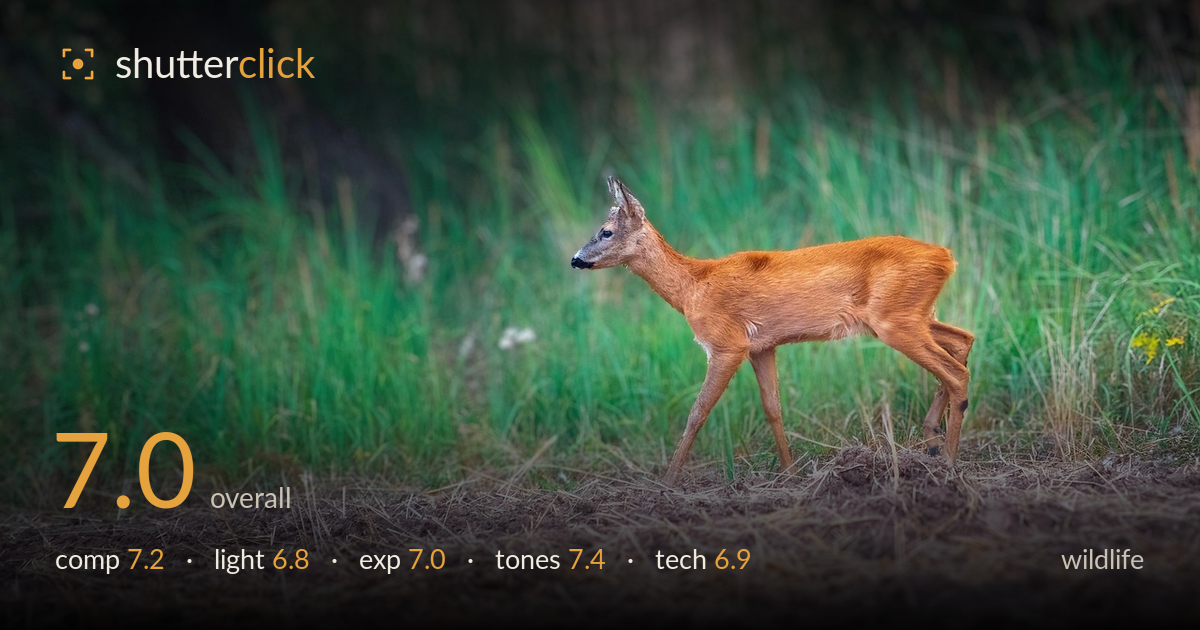
Roe deer stepping across open ground
Photo by Juergen57BS

No EXIF metadata in this file
Technical analysis based on visual assessment only.
A clean, well-observed roe deer frame with the animal caught mid-stride and the head turned into open space — a natural, unforced moment. The low shooting angle and long-lens compression separate the subject nicely from the soft green backdrop. What most holds the image back is critical sharpness on the head: the eye and muzzle read soft, which matters more than anything else in wildlife work. The foreground of churned earth is a little heavy and slightly out-of-focus at the base, and the subject sits close to frame centre. The moment and the pose carry this; tighter focus would elevate it.
The side-on stride with the head turned frame-left leaves welcome breathing room ahead of the animal's nose, which reads as intentional and natural. The low vantage puts the viewer at the deer's level and the soft grass wall gives clean separation. The subject sits close to horizontal centre, though, and the broad band of churned foreground earth eats a large share of the frame without adding much interest. Slightly more elevation on the deer within the frame, and less bare ground below, would sharpen the balance.
The light is soft and diffuse — likely overcast or open shade — which flatters the coat and avoids harsh shadow on the flank. It is flattering but flat: there is little directional modelling to give the animal three-dimensional form, and no catchlight in the eye, which weakens the connection typical of strong wildlife portraits. The warm rufous coat still separates well against the cool green. A lower, raking side light near golden hour would carve more shape into the body and add life to the eye.
Exposure is well controlled across a tricky range of warm coat, dark earth, and bright green grass. The highlights on the sunlit flank hold detail without clipping, and shadow areas on the underbelly and legs retain enough information to read form. The overall brightness suits the subdued light. The blurred foreground earth runs a touch dark and muddy, pulling the eye down, but nothing looks blown or blocked. A deliberate, balanced exposure that lets the coat sing without sacrificing the surrounding tones.
The colour palette is the image's strongest asset: the warm chestnut coat against the saturated cool green makes for a clean complementary contrast that isolates the subject. White balance looks accurate, with natural skin-of-coat warmth and no colour cast in the grass. Contrast is gentle and appropriate for the soft light. The foreground browns are slightly flat and could carry more separation. Overall the tonal range is pleasing and controlled, holding the eye on the deer without heavy-handed grading.
The long lens and wide aperture clearly did their job on background separation — the grass melts into pleasant, non-distracting bokeh, and the low angle helps that. The problem is focus placement: the sharpest plane appears to fall around the shoulder and mid-body rather than the head, leaving the eye and muzzle noticeably soft. In wildlife the eye must be tack-sharp, and here it isn't, which is the single biggest limitation. Depth of field looks shallow enough that a slight focus miss or subject movement at the moment of capture would explain it. The near foreground is also soft to the point of mush, suggesting the focus plane sits well behind it. Shutter speed appears to have frozen the stride adequately — no obvious motion blur in the legs — so this reads as a focus-acquisition issue rather than shake. Single-point AF locked on the eye, or back-button focus with continuous tracking, would put sharpness exactly where it counts.
What would elevate it
Tags
Shot something like this?
Expert photo critique, on demand — scored across six categories, EXIF-aware. Start with 3 free critiques, no credit card.
critique my photo — free