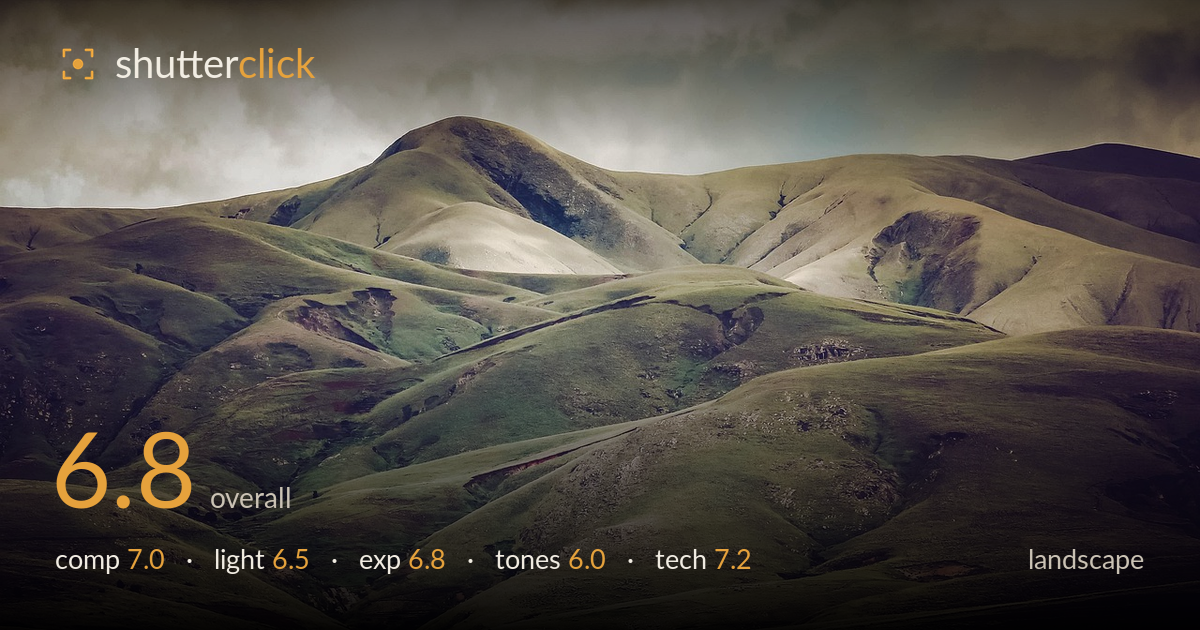
Rolling green hills under a grey sky
Photo by Pexels

No EXIF metadata in this file
Technical analysis based on visual assessment only.
A layered study of rolling green hills carried by strong undulating ridgelines that lead the eye toward the central peak. The overlapping folds create real depth and rhythm, and the peak gives the frame a natural anchor. What most holds it back is the heavy vignette and murky processing that darken the corners and mute the greens into a flat, slightly grimy cast. The sky is soft and low in contrast, missing the drama the terrain deserves. Cleaner tonal work and a livelier sky would let the landscape's structure breathe rather than fighting a heavy-handed grade.
The overlapping ridgelines are the strength here, folding into one another to build genuine depth from foreground to the central peak that anchors the frame. Horizon placement in the upper third works, giving the terrain room. The peak sits slightly left of centre, which reads as intentional. The lower foreground is a touch featureless and repetitive, and the eye lacks a small point of scale — a lone tree, animal, or structure — to measure the vastness against. Still, the layering and diagonal flow are handled with a good instinct for landscape rhythm.
The diffuse overcast light flattens the scene, which suits the moody intent but robs the hills of the raking side light that would carve out their texture and volume. There are patches where sun breaks through onto the mid-ground slopes, and those pockets of brightness are the most alive part of the frame. A more directional low-angle light — early or late in the day — would model the folds far more dramatically. As it stands the illumination is even and a little inert across much of the terrain.
Overall exposure holds detail across the hillsides without significant clipping, and the brighter sunlit slopes retain texture rather than blowing out. The sky is a touch flat but not lost. The main issue is the darkened corners from the heavy vignette, which crush shadow detail unnaturally at the edges and pull attention inward too forcefully. The midtones sit a little muddy overall, and lifting them slightly would reveal more of the terrain's structure. Broadly a competent exposure fighting an aggressive post-processing decision rather than a capture fault.
This is where the image struggles most. The grade pushes toward a desaturated, slightly grimy olive-and-grey palette that mutes the greens and leaves the whole frame feeling murky. The heavy vignette compounds it, tinting the corners toward brown. White balance leans cool and dull in the sky against warmer, dirty midtones, and the contrast is low enough to sap the terrain of punch. A cleaner, more natural rendering with restored green saturation and a gentler vignette would let the landscape read as vivid rather than processed.
Sharpness across the ridgelines is solid, with fine detail holding on the rocky outcrops and grass texture visible on the nearer slopes, suggesting a well-chosen aperture and a steady capture. Depth of field is deep and appropriate for the subject, keeping foreground and distant peak equally crisp. The focal length compresses the layers nicely, enhancing the sense of stacked ridges. Noise is well controlled in the midtones, though the darkened corners hide whatever detail lived there. The visible softness toward the very top of the frame is atmospheric haze rather than a focus error. The main technical caveat is the post-processing: the heavy vignette and muddy grade are execution choices that undercut an otherwise clean capture. Dialing those back would let the underlying sharpness and detail speak. Nothing here points to a capture flaw — the raw material is technically sound and simply over-processed in the finish.
What would elevate it
Tags
Shot something like this?
Expert photo critique, on demand — scored across six categories, EXIF-aware. Start with 3 free critiques, no credit card.
critique my photo — free