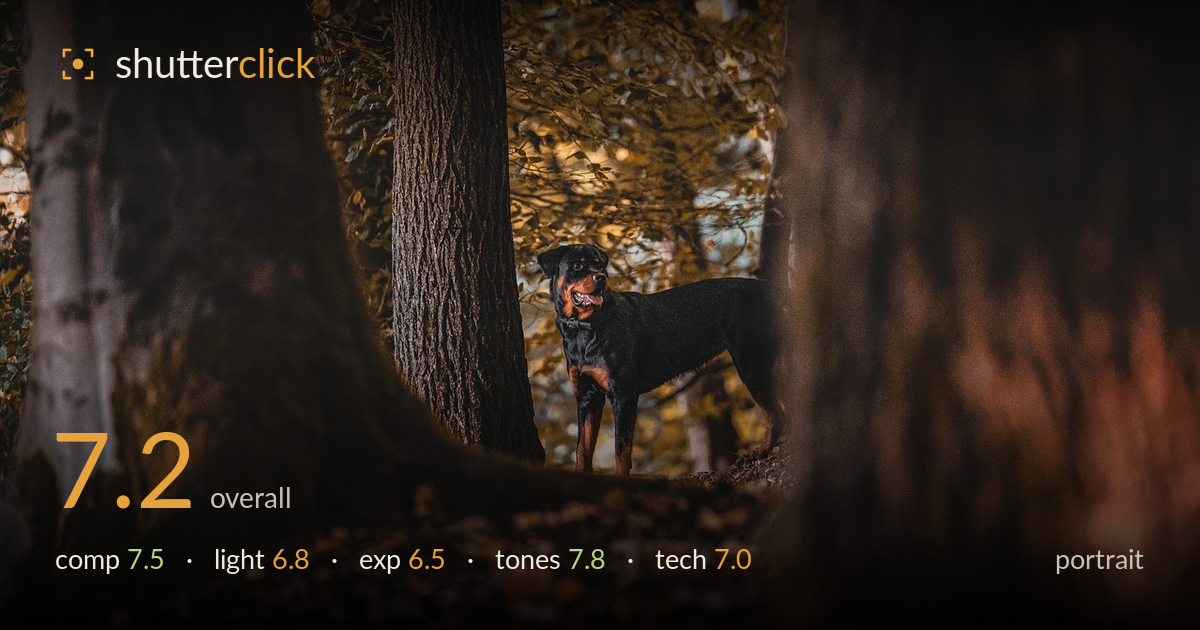
Rottweiler framed among autumn trees
Photo by KVNSBL

No EXIF metadata in this file
Technical analysis based on visual assessment only.
A well-observed environmental portrait that uses foreground trees to frame the dog and create a sense of stumbling upon a wild moment. The autumnal palette and the animal's alert, engaged pose carry the image. What holds it back most is the subject: the Rottweiler's black coat sinks into shadow and reads as a silhouette in places, losing the muscular form and detail that would give the portrait weight. The face is the anchor and it works, but a touch more light or lift on the body would separate the dog from the dim understory and complete what is otherwise a considered, atmospheric frame.
The framing device of out-of-focus trunks on both edges is the strongest idea here — it isolates the dog and adds depth, placing the eye on a natural window into the scene. The dog sits roughly on a third and the diagonal of the foreground leaf litter leads up to it. The large central trunk competes slightly with the subject and crowds the left side, and the dark right-hand trunk eats a lot of frame. A slightly wider gap between subject and that central trunk would breathe more.
Soft, diffuse forest light suits the autumnal mood and avoids harsh contrast in the canopy. The problem is direction and level on the subject: the dog stands in relative shade so its dark coat receives little modelling light, flattening the body into a mass. The brightest light falls on the background foliage, pulling attention away from the animal. A pocket of dappled light on the dog, or positioning it where a shaft caught the coat, would have given the form dimension and made the eyes and muzzle sing.
Exposure is a reasonable compromise for a tricky scene — the golden background retains highlight detail and the leaf litter holds midtones. But the black coat is pushed too far into shadow, and large areas of the body clip to near-black with little recoverable detail. The face and collar just about survive. Exposing slightly brighter, or lifting shadows in post, would recover the chest and hindquarter musculature that currently disappears. The background exposure is well judged; the subject exposure is where it falls short.
The autumn palette is the highlight — warm ambers, rusts and olive greens are handled with a cohesive, slightly muted grade that feels seasonal and unified. White balance leans warm, appropriate to the setting. Contrast is on the heavy side, which deepens mood but contributes to the crushed blacks on the dog. The tan markings on the muzzle and legs provide welcome warm accents that tie the subject to the palette. A subtle shadow lift would preserve the mood while restoring tonal separation in the coat.
The shallow depth of field is used deliberately and well, throwing the flanking trunks into soft blur to build the framing window while keeping a plane of focus on the dog. Focus appears to land on the dog's head and front — the eyes and muzzle read acceptably sharp, though not tack-sharp, and some of that softness may be the dim light limiting contrast on a dark subject. The background bokeh is smooth and pleasant. The main technical limitation is that the dark coat, combined with underexposure, hides whatever fine detail the lens resolved on the body. Noise is controlled and the image holds together at viewing size. A slightly smaller aperture or focus placement further back would have extended sharpness across more of the dog's length, and a faster, brighter capture on the subject would have let the sensor render coat texture rather than a shadow mass. Solid execution overall, with headroom in subject rendering.
What would elevate it
Tags
Shot something like this?
Expert photo critique, on demand — scored across six categories, EXIF-aware. Start with 3 free critiques, no credit card.
critique my photo — free