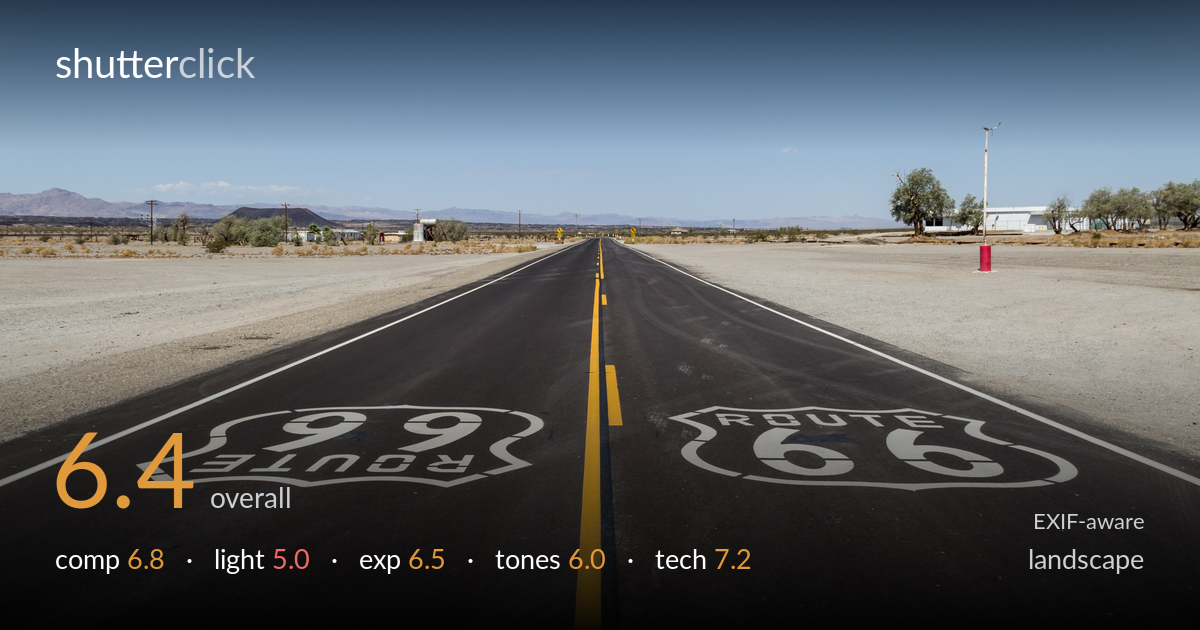
Route 66 markings on an empty desert road
Photo by Dietmar Rabich

| Focal length | 18 mm |
| Aperture | f / 10.0 |
| Shutter | 1/250 s |
| ISO | ISO 100 |
| Exp. comp. | 0.0 EV |
| Shot at | 10:27 · Jul 24, 2012 |
The Route 66 shields and the converging yellow line make a strong, instantly readable visual anchor, but flat midday light undercuts the impact. The road runs dead-centre to a perfect vanishing point, which suits the symmetry of the twin shields, yet the empty foreground asphalt dominates more than it earns. The desert horizon and distant mountains add scale but sit hazy and low-contrast under a harsh sun. The composition is solid and the storytelling clear; the biggest limiter is the timing — this scene is built for golden-hour rake light it never received.
The centred road and dead-on vanishing point work here because the mirrored Route 66 shields demand symmetry — the line bisects the frame deliberately. The horizon sits low at roughly the upper third, leaving room for sky, which is the right call. The twin shields anchor the lower frame and the yellow centre line is a clean leading element. The foreground asphalt, however, occupies a large area with little to reward the eye. A slightly lower angle or stepping back to include more of one shield in full would tighten the read.
This is the weakest element. Overhead midday sun flattens the entire scene — the road, the desert, and the mountains all sit at similar low-contrast values with no directional modelling. The shields read clearly only because of their paint, not the light. Hazy atmosphere washes the distant ranges to near-grey. The harsh top light also leaves the asphalt texture undifferentiated. Side light at golden hour would rake across the road surface, separate the mountain layers, and warm the whole desert palette into something far more evocative.
Exposure is technically clean and well controlled. The sky retains gradation without clipping, the dark asphalt holds shadow detail, and the white shield paint sits just below blowout. The histogram looks balanced edge to edge with no recovery needed. Midtones are placed sensibly given the bright conditions. There's nothing accidental here — the metering handled a high-contrast desert scene competently. The only minor note is that the bright asphalt in the lower foreground pushes toward the lighter mid-greys, slightly flattening that area, but no real loss of information.
White balance is neutral-to-cool, suiting the harsh blue desert sky, though the overall palette feels muted — the desert tans and asphalt greys lack vibrancy. The yellow centre line provides the one saturated accent and it carries the frame. Distant haze flattens the mountain tones to a low-contrast wash. A touch of clarity or dehaze on the background and a gentle contrast lift would separate the layers. The blue sky gradates nicely from top to horizon, which is the strongest tonal element present.
Settings are well chosen for the scene. At 18mm and f/10 on the EF-S 18-135, depth of field runs deep and front-to-back sharpness is achieved — the painted shields are crisp and the distant mountains hold detail, which is exactly what a landscape like this needs. ISO 100 keeps noise nonexistent and tonal smoothness intact. 1/250s is more than enough for a static, handheld shot and eliminates any shake risk. The 18mm wide end exaggerates the road's convergence effectively, reinforcing the vanishing-point pull. Corner sharpness on this kit lens at f/10 is acceptable, and f/10 sits in the lens's sweet spot, avoiding diffraction softening. Focus appears placed correctly through the mid-distance, keeping the whole plane acceptably sharp. Execution is essentially faultless for the conditions — the limitation is creative timing, not technique. The only refinement would be a polarizer to deepen the sky and cut some of the atmospheric haze on the distant ranges.
What would elevate it
Tags
Shot something like this?
Expert photo critique, on demand — scored across six categories, EXIF-aware. Start with 3 free critiques, no credit card.
critique my photo — free