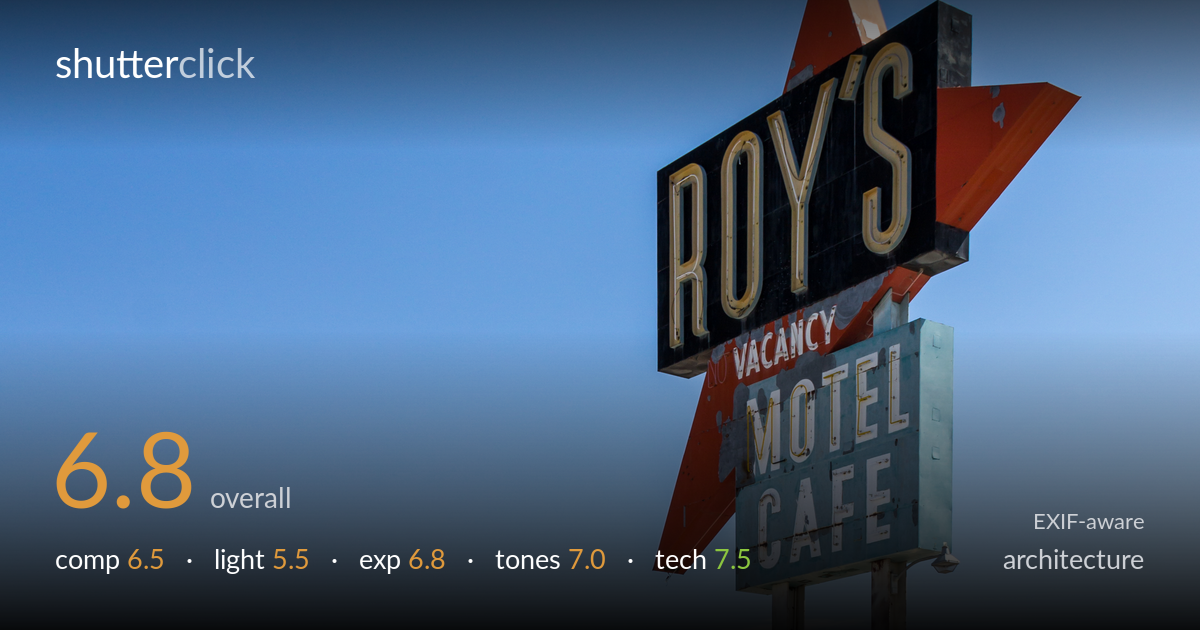
Roy's motel sign in the desert
Photo by Dietmar Rabich

| Focal length | 18 mm |
| Aperture | f / 10.0 |
| Shutter | 1/250 s |
| ISO | ISO 100 |
| Exp. comp. | 0.0 EV |
| Shot at | 10:27 · Jul 24, 2012 |
The iconic Roy's sign anchors the frame with strong graphic appeal, its starburst form and weathered colour playing well against the row of motel cabins and the mountain ridge behind. The placement on the right with open sky to the left gives the sign room to breathe. What most holds the image back is the flat midday light, which drains modelling from the white cabins and dulls the desert. The wide 18mm angle also introduces some keystoning, with the sign and cabin verticals leaning outward. A cleaner foreground and warmer light would lift this from a competent record shot to something with real atmosphere.
Placing the sign on the right with sky filling the left gives the dominant subject breathing room and lets its star shape read clearly. The cabin row provides a useful horizontal counterweight and a sense of place. The mountain ridge ties the background together. The expanse of empty gravel foreground, however, does little work and could be trimmed. The sign also crowds the top edge, clipping the upper point of the arrow, which weakens the silhouette. Lower framing or a step back would give the apex room.
Harsh overhead midday sun is the weakest element here. It flattens the white cabins into near-featureless blocks, robs the mountains of texture, and casts the sign's own structure into muddy, contrastless shadow on its underside. Highlights on the white walls run hot. The clear sky offers no diffusion or drama. The scene would transform under low golden-hour light, which would rake across the cabin walls, model the sign's relief, and warm the desert tones. Timing, more than anything, limits the mood.
Exposure is handled competently for difficult conditions. The bright sky and white cabin walls sit near the top of the range but retain detail without significant clipping. Shadow areas under the sign and in the cabin eaves hold reasonable information. The histogram skews bright, appropriate for a high-key desert scene, and the f/10 at ISO 100 base setting keeps things clean. A touch more shadow recovery on the sign's underside would help, but nothing here reads as accidental or careless.
The colour palette is the image's quiet strength. The faded teal of the motel panel, the rust-orange star, and the cream lettering sit naturally against the deep blue gradient sky. White balance reads accurate and the weathered, sun-bleached patina of the sign comes through honestly. Contrast is on the flat side thanks to the lighting, and the whites of the cabins lack tonal separation. Slightly deepened blues and a gentle contrast lift would give the frame more punch without looking processed.
Settings are well chosen for the situation. At 18mm, f/10 delivers front-to-back sharpness across sign, cabins, and mountains, which suits a documentary architectural record. ISO 100 keeps the file clean, and 1/250s is more than enough for a static scene. Focus appears accurate, with the sign's lettering crisp and the distant ridge holding detail. The main technical compromise is the wide focal length itself: at 18mm the converging verticals are noticeable, the sign post and cabin walls lean outward toward the edges. Shooting from slightly further back at a longer focal length would have reduced this distortion while keeping the sign prominent. Lens choice is otherwise reasonable for a single-shot wide capture. Perspective correction in post would straighten the verticals cleanly given the deliberate aperture and clean base ISO. Overall the execution is solid and the technical foundation is sound, leaving the creative variables, light and framing, as the larger opportunities.
What would elevate it
Tags
Shot something like this?
Expert photo critique, on demand — scored across six categories, EXIF-aware. Start with 3 free critiques, no credit card.
critique my photo — free