Ruined settlement across the plain
Photo by Ggia

| Shot at | 10:04 · Apr 19, 2011 |
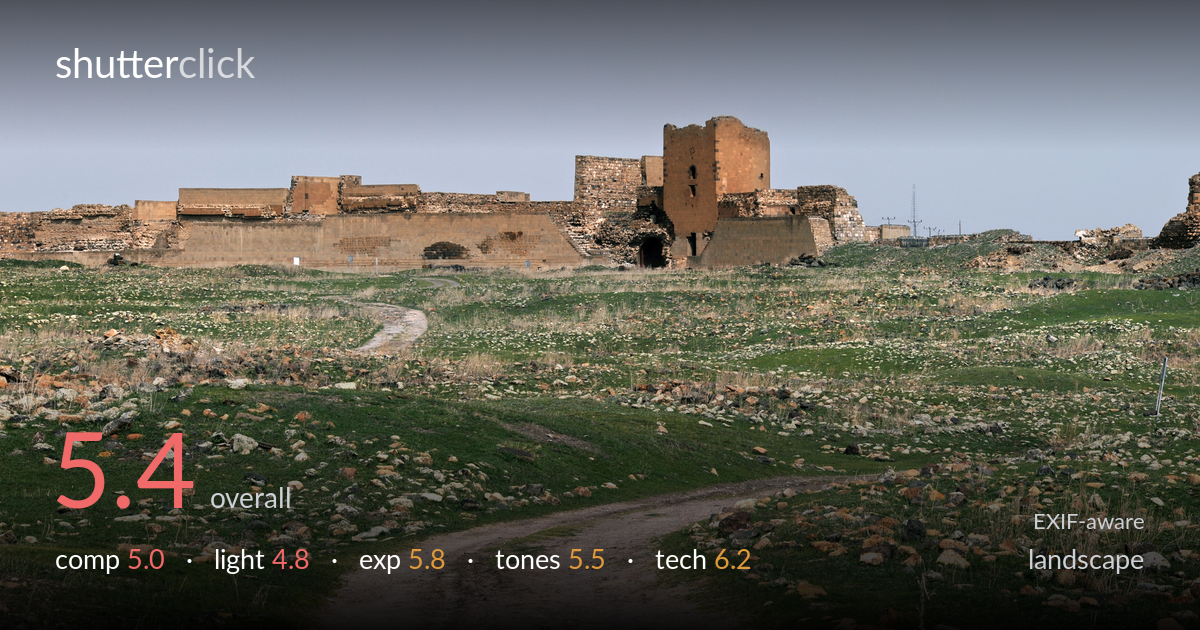
A wide stitched panorama of a ruined hilltop settlement that reads more as a documentary record than a landscape with impact. The extreme 9:1 letterbox aspect ratio spreads the scattered ruins thinly across a band, leaving no single anchor for the eye and a foreground of empty grass and stone rubble that contributes little. Flat midday light flattens the masonry and the dirt path leading in is the strongest element. The subject — historically rich ruins — deserves a frame that builds toward a focal structure, shot under raking low-angle light that would carve out the stonework and lend the scene the depth it currently lacks.
The panorama format distributes the ruins evenly across the strip with no dominant focal point, so the eye drifts without resting. The dirt path entering lower-left is the one genuine leading line and the most useful element in the frame, but it peters out rather than guiding toward a clear subject. The horizon sits high and stable, which suits the wide format, yet the broad foreground of grass and loose stone is largely empty filler. Tighter framing around the densest cluster of structures would concentrate the interest.
Flat, high overcast or near-midday light dominates, leaving the masonry without the directional shadows that would reveal texture and three-dimensional form in the ruins. The stonework reads as a uniform tan band with little modelling, and the green foreground lacks the warmth and shadow play that low-angle light brings. There is no sense of time of day or atmosphere. Golden-hour or early-morning raking light across these structures would transform the scene, separating individual walls and lending depth to an otherwise flat record.
Exposure is safe and even across the wide stitch, with the pale sky holding without obvious clipping and the foreground retaining shadow detail in the grass and stones. The overall rendering sits a touch flat and slightly bright, which mutes the ruins against the sky. Highlights in the lighter masonry are controlled. There is headroom to deepen the midtones for more presence. Nothing is badly blown or crushed — the issue is gentleness of contrast rather than any technical exposure fault.
The palette is honest but muted: hazy blue-grey sky, tan ruins, and a green-to-straw foreground that lacks vibrancy. White balance reads neutral, perhaps a fraction cool, leaving the stone less warm than it might be. Contrast is low and the tonal range compressed, which contributes to the flat, documentary feel. A modest contrast lift and a warmer balance on the masonry would give the scene more separation and atmosphere without straying into oversaturation. As stitched, the tones are consistent across the panorama.
Shot on a Nikon D700, a capable full-frame body, and executed as a multi-frame stitched panorama given the extreme aspect ratio. The stitch itself is clean — no obvious seams, ghosting, or alignment errors across the join, which is competent work. Depth of field is deep and the distant ruins appear adequately sharp, appropriate for landscape, though fine masonry detail is softened more by the flat light and likely downscaling than by focus error. Without aperture, shutter, or ISO reported it is hard to judge specific settings, but there is no visible motion blur or high-ISO noise. The main technical limitation is resolution and detail rendering at this viewing size — the structures lack crispness that a tripod-mounted stitch at base ISO and a sharp mid-aperture should deliver. The format choice is the bigger issue than execution: such an extreme crop sacrifices the vertical information that would give the ruins context and scale.
What would elevate it
Tags
Shot something like this?
Expert photo critique, on demand — scored across six categories, EXIF-aware. Start with 3 free critiques, no credit card.
critique my photo — free