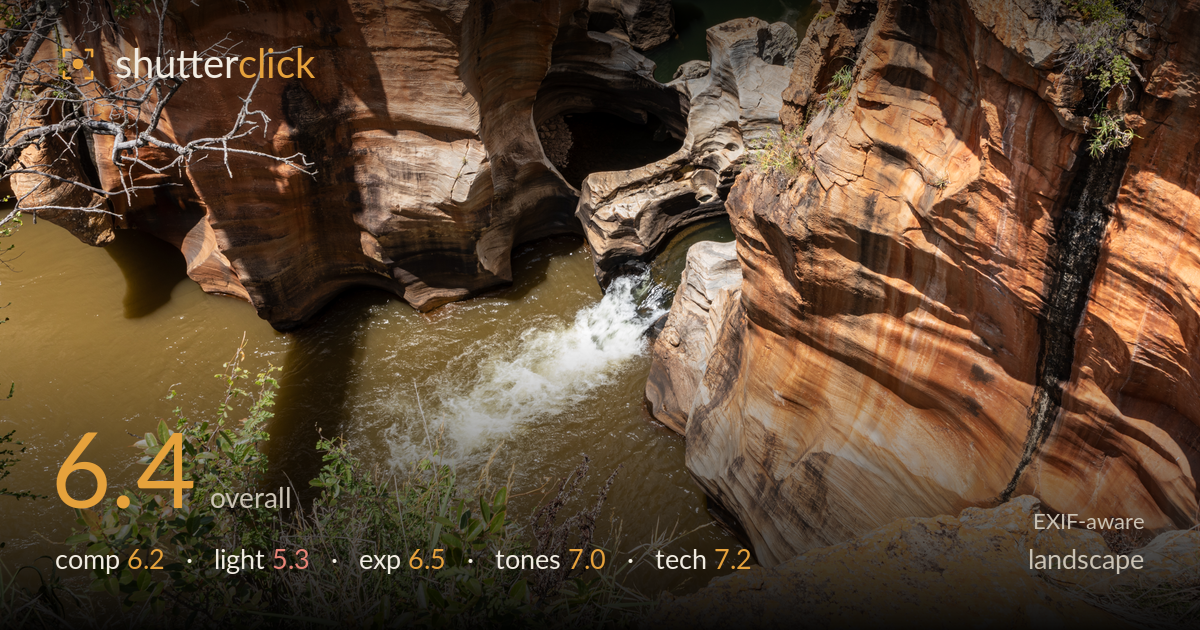
Rushing water through the sandstone gorge
Photo by Dietmar Rabich

| Focal length | 31 mm |
| Aperture | f / 16.0 |
| Shutter | 1/40 s |
| ISO | ISO 125 |
| Exp. comp. | 0.0 EV |
| Shot at | 09:32 · Feb 20, 2024 |
The water-carved sandstone is the real draw here — those layered, potholed formations of Bourke's Luck-style geology carry genuine visual interest, and the frothing rush of white water gives the frame a focal anchor. What most holds the image back is the harsh midday light, which splits the scene into hot highlights and heavy shadow and flattens the rock texture just where it should sing. The composition is busy and slightly unresolved: the eye wanders between the water at bottom and the dark cave upper right without a clear path. A softer light and a more deliberate structure would elevate strong subject matter that currently reads as a snapshot of an impressive place.
The diagonal thrust of the white water from lower centre into the frame is the strongest structural element, drawing the eye through the gorge. But the frame is cluttered at its edges — foreground grass and branches on the left compete without adding depth, and the dark cave opening upper right pulls attention off to a dead corner. The layered rock is compelling yet the vantage point flattens the sense of depth. A cleaner edge treatment and a stronger single focal path would resolve the wandering.
Harsh overhead midday sun is the core limitation. It carves the scene into blown highlights on the sunlit sandstone and dense, detail-poor shadow in the recesses, and the flat frontal angle robs the sculpted rock of the raking texture that would reveal its layered erosion. The green pool upper right sits in shade while the near cliff burns bright, creating an uneven, high-contrast spread that the sensor struggles to hold. Softer overcast light or the low angle of early morning would transform this subject.
Exposure is a reasonable compromise for difficult contrast. The sunlit sandstone edges approach clipping in the brightest whites, and the white water is close to losing texture, but most highlights retain some detail. Shadow areas in the deeper crevices go dark without fully blocking up, preserving a sense of depth. The choice to protect midtones over the shadows appears deliberate. The dynamic range here simply exceeds what a single frame handles cleanly under this light, so some sacrifice was inevitable.
The warm oranges and rust reds of the sandstone are the tonal highlight, and white balance renders them naturally without oversaturation. The murky olive-green of the water reads honestly against the rock. Contrast is high by necessity of the light, which suits the rugged subject but pushes the shadows toward muddiness in places. The greens of the foliage stay believable rather than lurid. Overall the palette is cohesive and true to the location, with pleasing separation between rock, water, and vegetation.
At f/16, 1/40s, ISO 125 on the 5D Mark IV with the 24-105mm at 31mm, the choices are sound for a static landscape. The narrow aperture delivers front-to-back sharpness across the deep gorge, and the low ISO keeps noise negligible with clean tonal transitions. At 1/40s the churning water shows a gentle motion softness that reads as texture rather than blur — acceptable here, though a tripod would have been prudent at this shutter given the diffraction risk f/16 introduces on a 30MP sensor. Focus appears accurately placed on the mid-distance rock and holds well. The 31mm framing is a natural, undistorted perspective that avoids exaggerating the scene. Diffraction at f/16 costs a little critical bite; f/11 would likely have retained sufficient depth of field while preserving more resolving power. Overall the technical execution is competent and deliberate, well matched to the subject, with only minor room to optimise sharpness.
What would elevate it
Tags
Shot something like this?
Expert photo critique, on demand — scored across six categories, EXIF-aware. Start with 3 free critiques, no credit card.
critique my photo — free