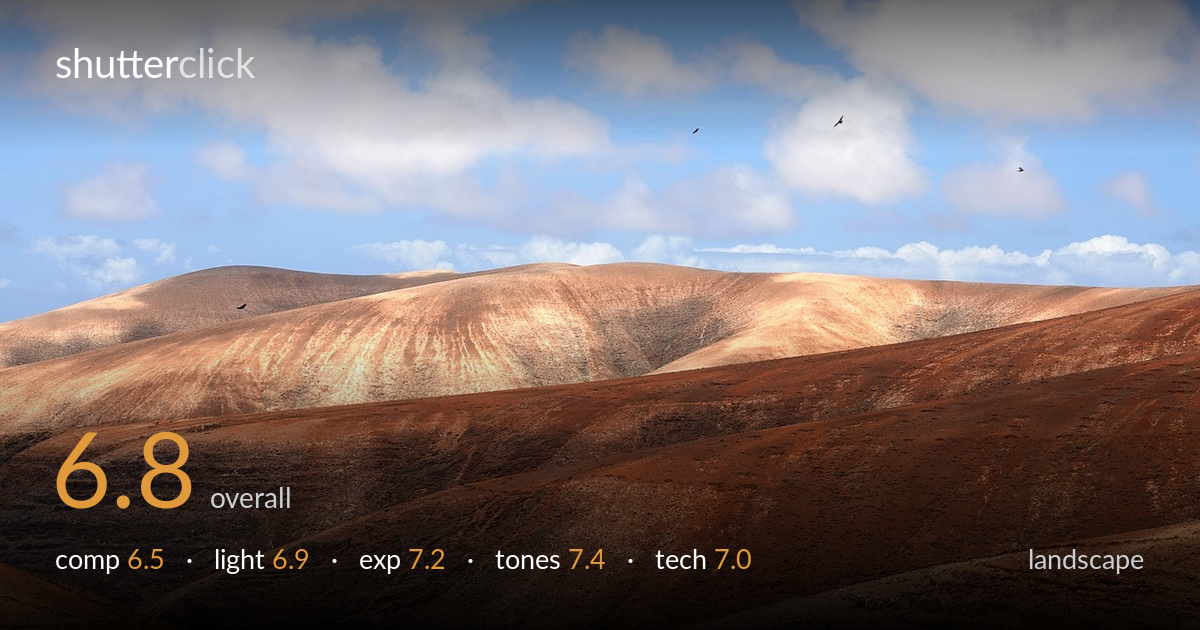
Rust-coloured desert hills under broken cloud
Photo by hankaverzichova

No EXIF metadata in this file
Technical analysis based on visual assessment only.
The layered, undulating hills carry this frame, building a satisfying recession of warm ochre and rust ridgelines toward a softer, paler crest. The colour palette and the dry desert texture are the real draw, and the three birds add a quiet sense of scale. What most holds it back is a lack of a clear foreground anchor and a horizon-heavy split: the eye reads the hills well but never lands on a deliberate point of interest. A stronger compositional hierarchy and tighter timing on the cloud light would lift this from pleasant to memorable.
The overlapping ridgelines build genuine depth, and the diagonal flow from the dark foreground valley up to the pale distant crest gives the frame movement. The horizon sits roughly on the upper third, which works. The weakness is the absence of a foreground anchor — the lower-left valley is shadowed and lacks a feature to hold the eye, so the frame reads as texture without a focal destination. The birds are pleasant but too small and scattered to organise the composition. A nearer subject would resolve this.
Side light rakes across the hills and reveals the desert's contours and erosion patterns nicely, separating the rust foreground slopes from the paler sunlit crest behind. The broken cloud creates patches of light and shade that add interest across the terrain. It reads as midday-to-afternoon rather than golden hour, so the light is a touch flat and lacks the long, sculpting shadows that would make the ridges more three-dimensional. Lower-angle light would deepen the modelling and warm the tones further.
Exposure is well managed across a wide brightness range. The bright clouds retain texture without blowing out, and the shadowed foreground valley holds detail rather than crushing to black. Midtones in the rust-coloured slopes sit comfortably, preserving the surface texture that gives the scene its character. The histogram looks balanced for the conditions, with no obvious clipping at either end. A slightly brighter lift in the deepest foreground shadows would open up that lower-left corner without sacrificing the highlight control already achieved.
The earthy palette is the strongest element — warm rust, ochre, and tan ridges grade cleanly against a cool blue sky, and that complementary contrast carries real appeal. White balance reads accurate, with neutral clouds and believable reds. Saturation is healthy without tipping into garish. The tonal transition from dark foreground to pale distant crest is smooth and natural. Slightly more separation between the similar rust tones in the mid-ground would prevent those layers from merging, but the colour work here is largely successful.
Sharpness is solid across the hillsides, with the erosion lines and dry vegetation rendering crisply through the mid and far ground — front-to-back focus looks well handled, suggesting an appropriately small aperture for the deep scene. There's no visible motion issue, and noise is well controlled in both the shadows and the clean sky. The birds, though small, are frozen without blur. The lens choice gives a natural, undistorted perspective suited to the layered terrain. The main technical limitation is depth perception rather than execution: without a sharp near-field element, the deep depth of field has nothing close to anchor it, so the resolving power is spent entirely on distant texture. A focal length slightly longer to compress the ridgelines, or a wider framing that includes a sharp foreground rock or plant, would put the technical sharpness to better compositional use. As captured, the execution is clean and competent throughout.
What would elevate it
Tags
Shot something like this?
Expert photo critique, on demand — scored across six categories, EXIF-aware. Start with 3 free critiques, no credit card.
critique my photo — free