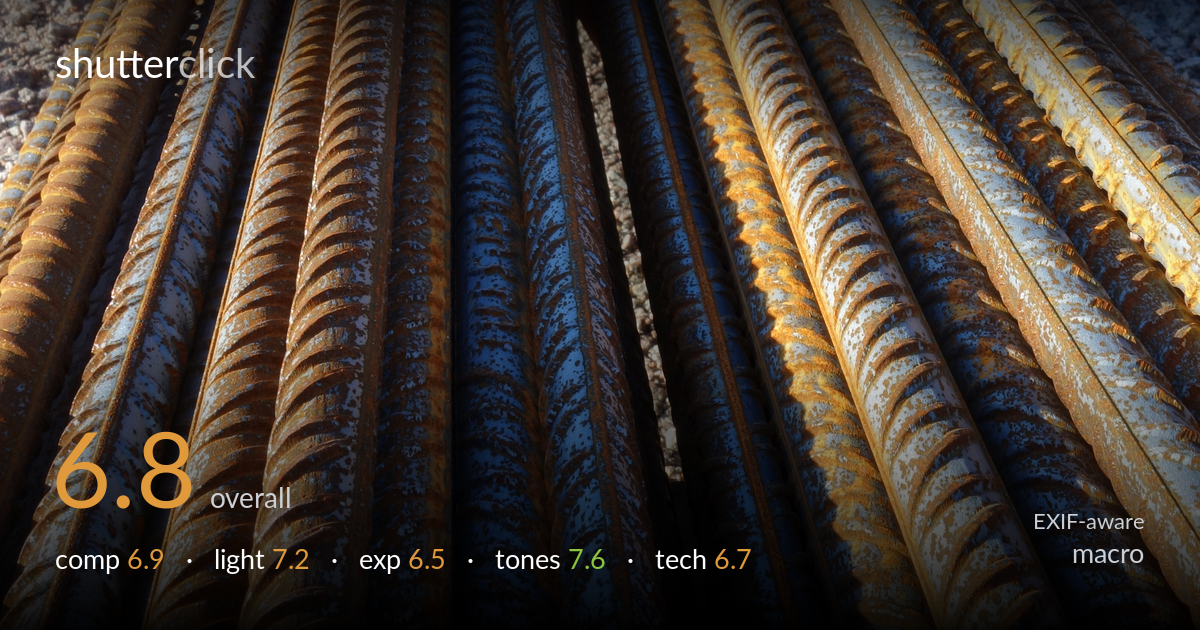
Rusted rebar in raking light
Photo by W.carter

| Focal length | 10 mm |
| Aperture | f / 11.0 |
| Shutter | 1/40 s |
| ISO | ISO 125 |
| Exp. comp. | 0.0 EV |
| Shot at | 18:48 · Aug 10, 2016 |
A strong textural study of weathered rebar that succeeds chiefly on colour and surface — the interplay of rust orange, steel blue, and frost-like mineral mottling carries real graphic appeal. The diagonal march of bars gives the frame rhythm and direction. What holds it back is the gravel intrusion in the upper-left and the central gap, which break the otherwise tight pattern and pull the eye to dead space. Exposure leans dark in the shadowed grooves, sacrificing some detail there. Tighter framing on pure rebar and a touch more shadow lift would turn a good texture shot into a clean abstract.
The diagonal run of bars from lower-left to upper-right gives the frame strong directional energy and a satisfying repeating rhythm. The varied widths and the cluster of converging rods at right read well as pattern. The weakness is the gravel ground intruding at top-left and through the central gap — it breaks the uniform field and drops the eye into empty, low-interest area. Filling the frame edge to edge with metal, or shifting to eliminate the background entirely, would tighten the abstraction considerably.
Low, raking light is the right call here — it skims across the ribbed deformations and rust pitting, raising the texture that makes the image. The warm directional quality enhances the orange oxidation and gives each groove a defined shadow edge. The trade-off is deep shadow in the channels between bars, where detail goes nearly black. Slightly more frontal or diffused fill would keep the surface relief while recovering those crushed shadow lines. As shot, the light shapes the subject well.
Exposure is biased toward the highlights, which keeps the rust and frosted steel from blowing out — a sensible choice for these reflective surfaces. The cost is the deep grooves and the gravel gaps falling to near-black, losing texture in the shadow channels. The histogram likely leans left with a highlight cluster on the bright steel. A third of a stop more, or a shadow lift in post, would recover groove detail without endangering the bright mottling. Overall deliberate but slightly conservative.
The tonal palette is the standout — rust orange against cold steel blue is a natural complementary pairing, and the white mineral speckling adds a third register that keeps it from feeling flat. White balance reads accurate, neither pushed warm nor cool, letting the metal's true colours carry. Contrast is healthy, with the grooves giving micro-contrast that reinforces texture. Saturation sits at a believable level. A subtle vibrance lift on the blues would deepen the colour interplay further without tipping into garish.
f/11 is a sound choice for this near-flat subject plane, giving depth of field across the angled bars so foreground and the receding rods at right stay acceptably sharp. ISO 125 keeps noise negligible, and the rendering is clean throughout. Focus lands where it should, on the textured ribbing in the central-foreground bars, and the deformation patterns resolve crisply. The 10mm focal length on the RX100 gives a slightly wider field than ideal for a tight macro — it pulls in the distracting gravel edges. The 1/40s shutter is fine for a static subject on what appears to be a steady support, with no visible blur. The main technical limitation is depth of field versus framing distance rather than settings themselves: a longer working focal length and closer crop would isolate pure texture and lose the background. Diffraction at f/11 on a 1-inch sensor is just beginning but does not visibly soften this frame. Solid execution overall.
What would elevate it
Tags
Shot something like this?
Expert photo critique, on demand — scored across six categories, EXIF-aware. Start with 3 free critiques, no credit card.
critique my photo — free