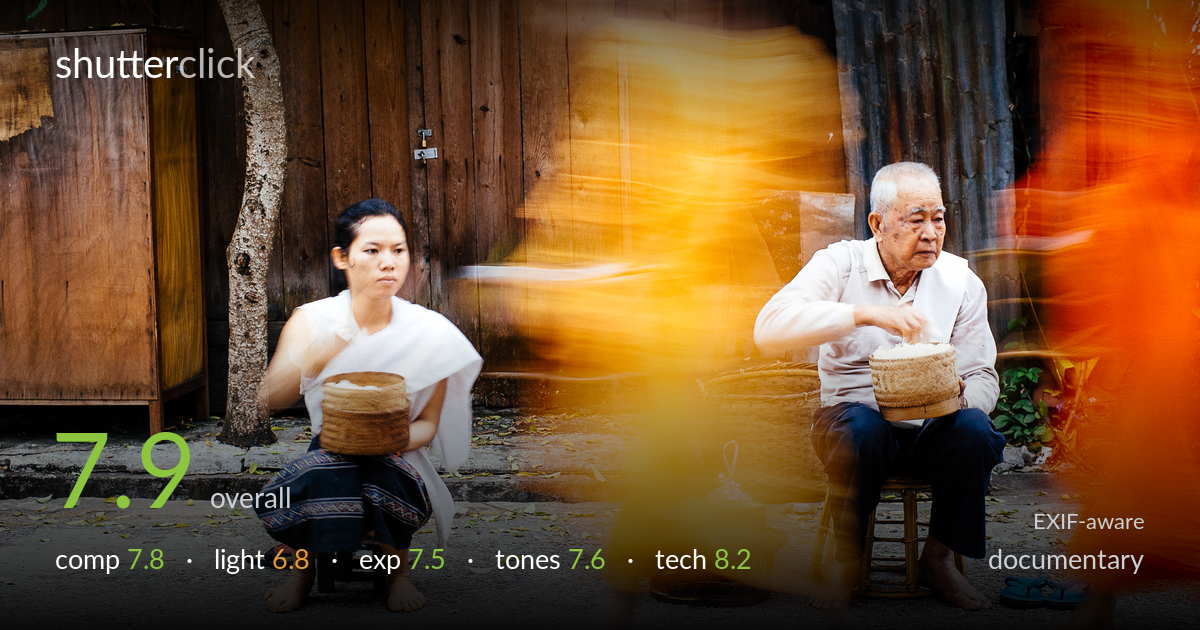
Saffron alms procession
Photo by Martin Sojka

| Focal length | 50 mm |
| Aperture | f / 5.6 |
| Shutter | 1/2 s |
| ISO | ISO 400 |
| Exp. comp. | 0.0 EV |
| Shot at | 06:23 · Nov 24, 2013 |
A confident motion-blur treatment of the Lao alms-giving ritual, where streaking saffron robes sweep between two still, sharply rendered almsgivers. The decision to hold the camera steady and let the monks dissolve into colour is the picture's strongest idea — it separates the transient procession from the patient givers and reads instantly as documentary about devotion and time. What holds it back is that the central orange smear partially obscures the seated man and crowds the frame's middle, and the flat, overcast light leaves the scene a touch dull outside the robe colour. The two seated figures carry the narrative cleanly.
The two static figures anchor left and right thirds while the blurred monks fill the centre, a strong structural contrast between stillness and movement. The seated woman with her rice basket is beautifully placed against the wooden wall and tree. On the right, however, the orange streak overlaps and partly swallows the seated man, weakening his read. The far-right robe is clipped awkwardly at the edge. The wooden facade and scattered leaves give honest context. A slightly wider gap between the man and the passing blur would have let both elements breathe.
Soft, shadowless overcast light suits the candid, observational tone and keeps faces evenly lit without harsh contrast — fitting for documentary work. It renders skin and the wooden backdrop faithfully. The trade-off is flatness: there is little directional modelling to shape the seated figures or add dimensionality, so the frame relies almost entirely on the robe colour for vibrancy. Earlier golden light, common during morning alms rounds, would have warmed the whole scene and lifted the saffron further. The light serves the moment honestly rather than dramatically.
Exposure is well judged for the conditions. The brightly lit saffron robes hold colour and texture in their streaks without blowing out, which is a real achievement given how often that orange clips. Shadow detail in the dark doorway and the woman's patterned sarong is retained, and skin tones sit at a believable midtone. The pale concrete in the foreground stays controlled. Nothing here looks accidental — the 1/2 second was a deliberate choice to capture the procession's movement while the standing scene remained correctly metered.
The saffron-to-orange range is the tonal engine of the frame, and it pops convincingly against the muted browns of the wood and grey of the street. White balance is neutral and accurate on skin and the white shirts. The overall palette is restrained, which lets the robes dominate as intended. Saturation looks natural rather than pushed. The greys of the pavement carry the foreground without distraction. Slightly more separation in the dull mid browns of the background wall would add depth, but the colour story is coherent.
The 1/2 second shutter is the deliberate heart of this image, and it pays off: the camera was held or braced steady enough that both seated figures stay genuinely sharp while the walking monks render as flowing saffron streaks. That balance is hard to nail in one frame and it succeeds here. At f/5.6 on the Zeiss Planar 50mm, depth of field is sufficient to keep both the foreground woman and the more distant man acceptably sharp, and the lens delivers its characteristic crisp rendering on the static elements — the woman's face and basket weave hold fine detail. ISO 400 keeps noise negligible. Focus appears placed on the seated subjects rather than the blur, which is correct. The only technical caveat is that with no tripod evident, a slightly faster intermediate speed bracketed alongside would have offered a safety frame, but the chosen exposure clearly worked. Overall this is well-executed intentional motion blur, not accidental shake.
What would elevate it
Tags
Shot something like this?
Expert photo critique, on demand — scored across six categories, EXIF-aware. Start with 3 free critiques, no credit card.
critique my photo — free