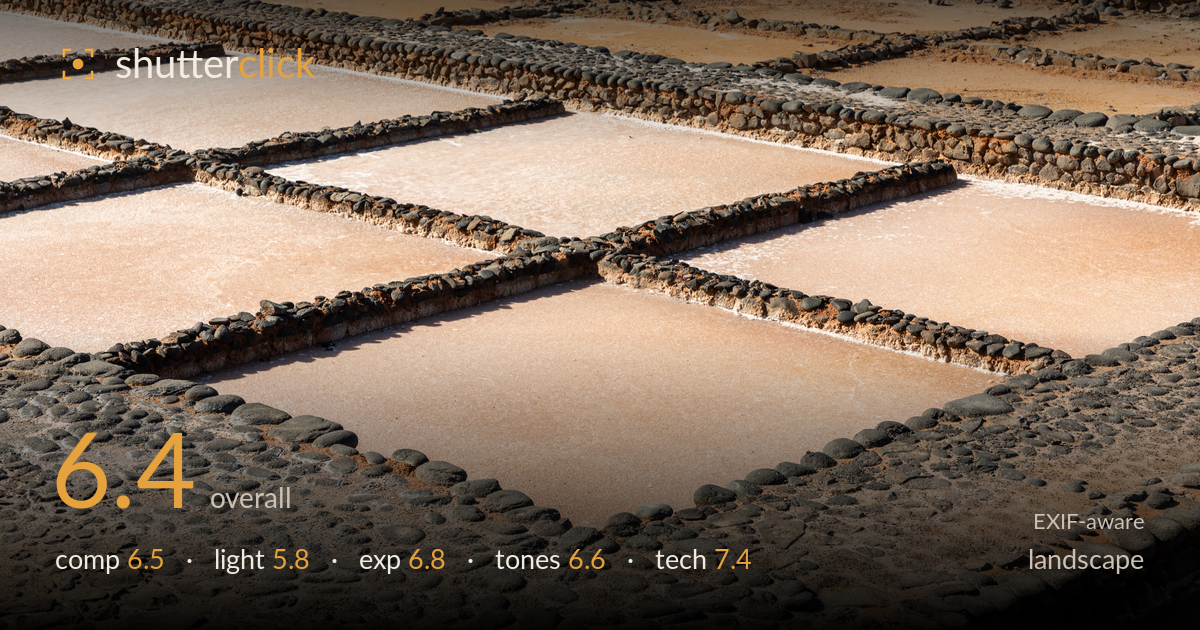
Salt pans in the afternoon
Photo by Dietmar Rabich

| Focal length | 64 mm |
| Aperture | f / 10.0 |
| Shutter | 1/200 s |
| ISO | ISO 100 |
| Exp. comp. | 0.0 EV |
| Shot at | 14:16 · Feb 1, 2025 |
The salt pans offer a strong graphic subject — the grid of stone-bordered evaporation basins builds natural repetition and rhythm across the frame. The recessional diagonals pull the eye into the scene effectively, and the earthy, muted palette suits the arid setting. What holds the image back most is the light: flat, high-sun illumination that flattens the stone texture and mutes the potential drama of the geometry. The framing also feels cropped rather than resolved — no clear anchor or endpoint, and the top edge cuts off before the pattern gives any sense of scale or horizon. A stronger sense of intention would lift this from a record shot toward a compelling study of place.
The repeating grid of basins creates genuine graphic interest, and the diagonal recession from the foreground stone border into the distance gives depth and a sense of receding pattern. The choice to include the rough cobble border in the lower foreground grounds the frame. However, the composition lacks a clear focal anchor — the eye wanders across similar cells without settling. The top edge crops the pattern arbitrarily rather than resolving to a horizon or endpoint, and the near-central salt pan competes rather than leads. A stronger organising diagonal or a single hero basin would sharpen the read.
This is the weakest element. The high, near-frontal sun produces flat, even light that suppresses the texture of the porous lava stones and the crystalline salt surfaces — both of which would benefit enormously from raking light. Shadows are short and give little relief or dimensionality to the basin walls. The warm cast is pleasant but the overall rendering feels midday and lifeless. Low-angle side light at golden hour would carve the stone borders, throw long directional shadows across the pans, and add the drama this subject deserves.
Exposure is handled competently. The pale salt surfaces retain detail without clipping to blank white, and the darker stone borders hold shadow information — a reasonable balance across a scene with notable brightness range. The histogram appears well contained with no serious blown highlights on the reflective salt, which is the obvious risk here. Midtones sit a touch flat, contributing to the muted overall feel, but that reads more as a light-quality issue than an exposure error. A slight negative compensation could have protected the brightest salt edges further.
The warm ochre and salmon palette is cohesive and true to the volcanic, salt-flat environment. White balance leans warm, which suits the setting though it edges toward monotony — the whole frame occupies a narrow band of earth tones with little contrast to break it up. The pale pinks of the salt pans and the grey-black of the lava stones provide the main tonal separation. Contrast is on the soft side, again tied to the flat light. Slightly cooler shadows would add tonal variety and separate the stone from the earth.
The settings are well matched to the subject. At f/10 on the 24-105mm at 64mm, depth of field is deep enough to hold sharpness from the foreground cobbles through to the distant basins, which is exactly what this receding pattern needs. ISO 100 keeps the image clean with no visible noise, and 1/200s is more than adequate for a static landscape handheld with the lens's stabilisation. Focus appears accurate through the mid-frame, and the foreground stones show good detail. The 5D Mark IV's resolution renders the salt crystals and stone texture crisply where light permits. The only technical refinement worth considering: a slightly narrower aperture is unnecessary here and f/8 would sit closer to the lens's sharpness sweet spot without sacrificing meaningful depth. A polariser could have cut glare on the wet salt surfaces and deepened tonal separation. Overall the execution is solid and clean — this is a case where technique is not the limiting factor.
What would elevate it
Tags
Shot something like this?
Expert photo critique, on demand — scored across six categories, EXIF-aware. Start with 3 free critiques, no credit card.
critique my photo — free