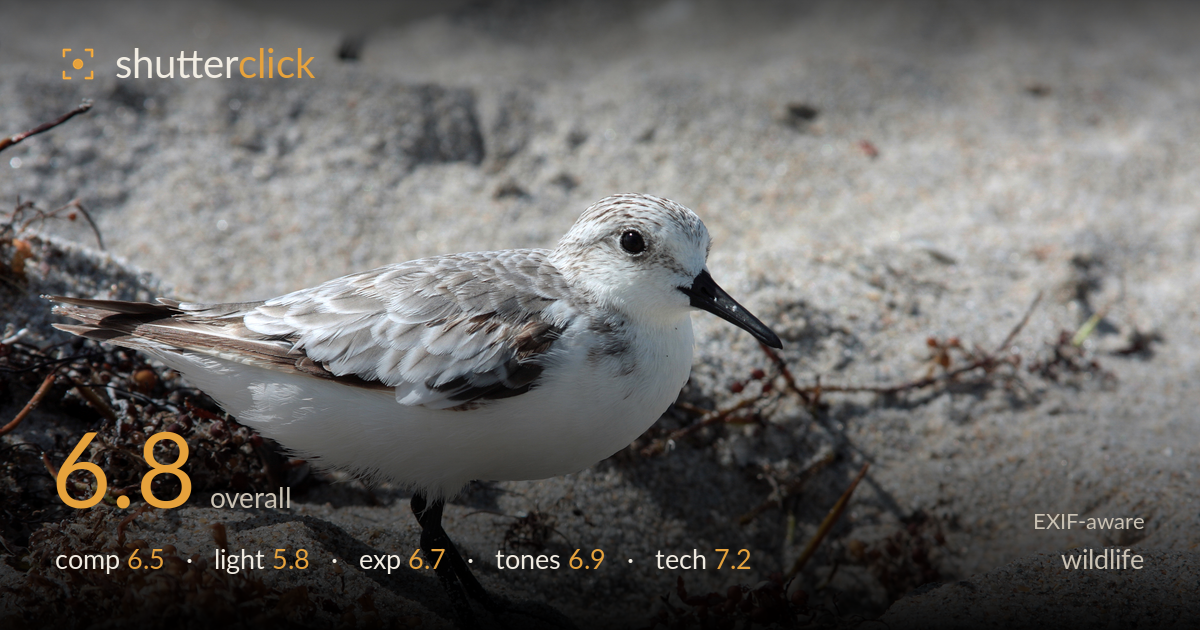
Sanderling on the sand
Photo by Ianaré Sévi

| Focal length | 135 mm |
| Aperture | f / 10.0 |
| Shutter | 1/320 s |
| ISO | ISO 100 |
| Exp. comp. | 0.0 EV |
| Shot at | 14:46 · Oct 4, 2008 |
A clean, well-focused sanderling portrait at eye level, let down most by harsh midday light and a busy foreground. The bird sits at a natural moment mid-stride with a sharp, catchlit eye and good separation from the softly rendered background. What holds it back is the flat, top-down sun that produces hard shadows under the body and flattens the white plumage, plus a cluttered tangle of seaweed crowding the lower frame. Shot in softer light with a touch more breathing room ahead of the bird, this becomes considerably stronger. The foundations — focus, working distance, moment — are solid.
Eye-level framing pays off, putting the viewer in the bird's world and giving the soft sand background. Subject placement works, with the bird facing into open frame space to the right so its gaze has room. The diagonal of the seaweed leads toward the bird but also competes with it, cluttering the lower left. The second blurred bird top-left is a distraction rather than an asset. A little more clearance beneath the feet and cleaner foreground would tighten the read considerably.
The weakest element. Hard overhead midday sun casts unflattering shadows beneath the belly and legs and drains modelling from the white breast, leaving it looking flat where subtle gradation should sit. Direction is largely top-front, so the plumage texture on the back reads reasonably, but the harshness gives the whole frame a contrasty, unforgiving quality. Early or late golden light, or an overcast sky, would wrap the bird more gently and preserve highlight detail in the white feathers.
Well managed for a bright white subject under strong sun. The white breast and flank retain feather detail without blowing out, which is the real risk here, and the dark eye and bill hold their shape. The sand highlights sit close to the top of the range but stay just inside it. Shadows under the body go a touch dense but hold enough information. ISO 100 keeps everything clean. Overall a deliberate, controlled reading of a difficult tonal spread.
Neutral, believable colour throughout, with clean whites in the plumage and warm reddish-browns in the seaweed providing a pleasant complementary note against the cool grey sand. White balance looks accurate. Contrast runs high because of the light rather than the grade, which pushes the whites and the dark bill hard against each other. The sand's tonal range is a little monotone across the frame. A slight lift in the shadows would recover gradation without flattening the pleasing overall palette.
Focus is accurately placed on the eye, which is critical for wildlife, and the bill and head detail are crisp. At 135mm and f/10 the depth of field is generous enough to keep the whole bird sharp while the background falls away softly — a sensible aperture choice, though f/7.1 or f/8 would have gained a little separation and let in more light without meaningfully softening the bird. Shutter at 1/320s comfortably froze this near-stationary bird; for a walking or feeding sanderling that is adequate, but 1/800s or faster would give safety margin for sudden head movement. ISO 100 was the right call in full sun, delivering clean, noise-free files. The 135mm focal length is on the short side for wildlife, meaning close working distance was needed; more reach would allow a cleaner, more distant background and less pressure to crop. Execution overall is sound — the technical fundamentals are the strongest part of this frame.
What would elevate it
Tags
Shot something like this?
Expert photo critique, on demand — scored across six categories, EXIF-aware. Start with 3 free critiques, no credit card.
critique my photo — free