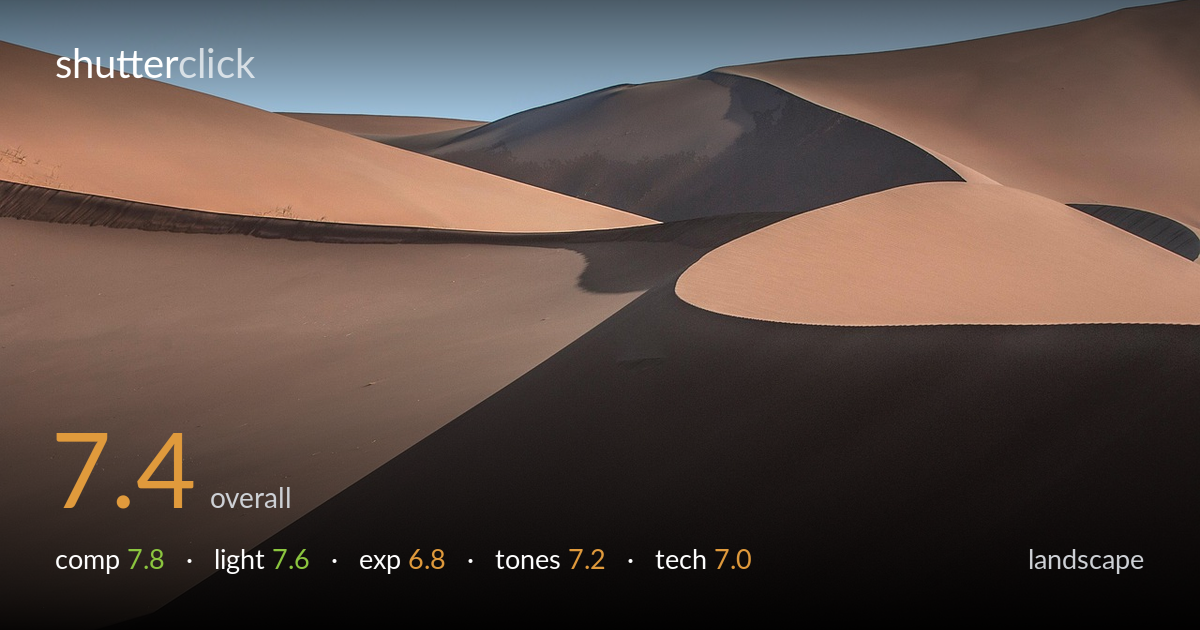
Sculpted desert dunes
Photo by PuaBar

No EXIF metadata in this file
Technical analysis based on visual assessment only.
A strong study in dune form, where light and shadow carve the frame into interlocking curves and triangles. The crossing diagonal ridgelines and the bright sunlit crest against deep shadow give the image real graphic strength. What most holds it back is the foreground shadow, which falls into near-black and loses the subtle texture the sand surface offers elsewhere. A thin strip of sky at the top adds little and dilutes the abstraction. Tightening to the dunes themselves and lifting the deepest shadows would let this become the pure form study it wants to be.
The interplay of dune ridgelines works well, with the bright spur descending from the right meeting the dark foreground slope to form a balanced set of intersecting curves. The crest catching light against shadow at center-right anchors the eye. The strip of pale sky across the top, however, contributes little and competes with the abstraction below; the strongest material is the sand itself. The dark foreground triangle is large and heavy, weighting the lower frame. A crop emphasizing the dune forms over the sky would sharpen the graphic intent.
Low, raking light is what makes this image — it separates the dunes into distinct sunlit and shadowed planes and defines the sculptural ridgelines. The grazing angle reveals the smooth flow of the sand surface on the lit faces. The trade-off is the very deep shadow on the near slope, where the light gives up entirely and detail collapses to black. Shooting slightly earlier or later, with a touch more light spilling onto that foreground face, would preserve the form without sacrificing the shadow-to-light drama.
Exposure protects the highlights on the bright crests, which retain their soft tonal gradation rather than blowing out, and that is the right priority for this scene. The cost is the foreground shadow, which sits near pure black and surrenders the sand texture visible on the lit slopes. Whether this is fully intentional is debatable — the shadow reads slightly heavier than the composition needs. A modest lift of the deepest tones, ideally captured in a raw file with room to recover, would balance the dynamic range more gracefully.
The warm sand tones are pleasant and the contrast between sunlit ochre and cool blue sky is natural. The gradation across the lit dune faces is smooth and convincing. The shadowed slopes carry a muted, slightly muddy quality where they transition toward black, and the deepest foreground reads flat. White balance is believable. A gentle warming of the midtones and a little more separation in the shadow tones would give the dunes more dimensional richness without pushing the palette into artificiality.
Sharpness across the lit dune faces is good, with the smooth sand surfaces rendered cleanly and the ridgelines crisp where light defines them. Depth of field appears more than sufficient for a scene at this distance, with no visible focus fall-off issues. Noise is well controlled in the midtones and lit areas. The main technical limitation lies in the deep foreground shadow, where tonal information is thin and any noise or banding would show most readily if those tones were lifted in post — capturing this in raw would give far more latitude there. The lens handles the scene without obvious distortion, and the framing holds the horizon level. Overall execution is clean and competent; the image is limited less by technique than by the choices around shadow depth and the inclusion of sky, both of which are addressable in the field and in processing.
What would elevate it
Tags
Shot something like this?
Expert photo critique, on demand — scored across six categories, EXIF-aware. Start with 3 free critiques, no credit card.
critique my photo — free