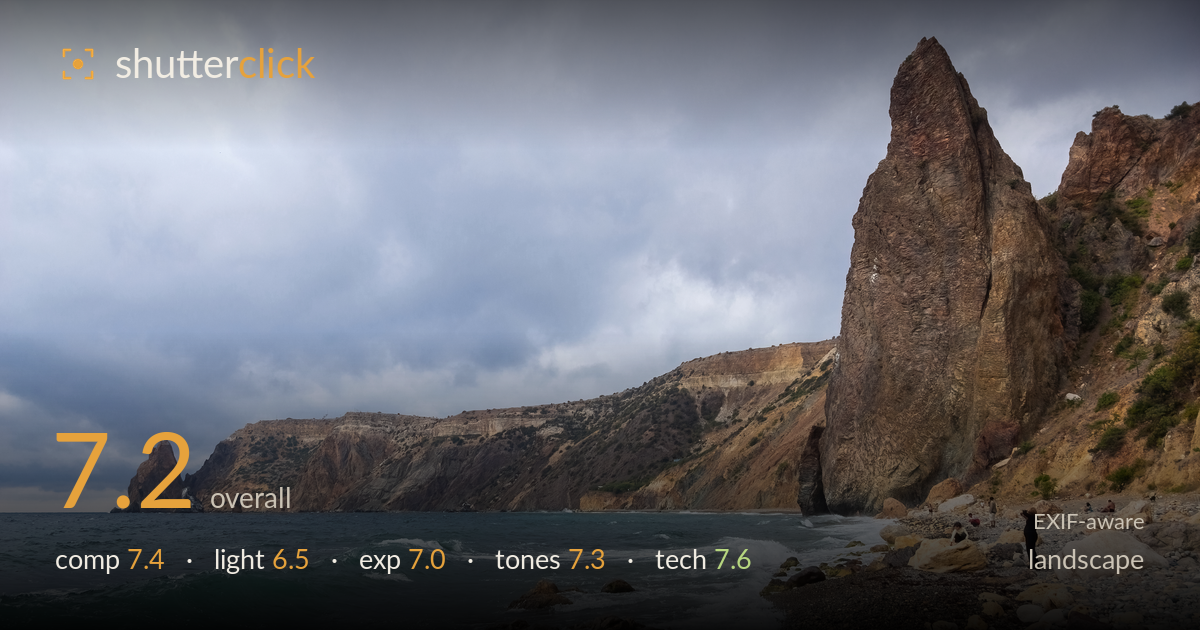
Sea stack over a stormy coast
Photo by Vyacheslav Argenberg

| Focal length | 17 mm |
| Aperture | f / 4.0 |
| Shutter | 1/640 s |
| ISO | ISO 100 |
| Exp. comp. | 0.0 EV |
| Shot at | 14:18 · Sep 23, 2014 |
A commanding coastal scene anchored by that blade-like sea stack on the right, with a receding cliff line that gives real depth. The rock-strewn foreground and breaking surf lead the eye well into the frame, and the human figures on the beach provide welcome scale. What most holds it back is the sky: a large, flat expanse of grey cloud eats roughly half the frame without adding much drama, and the overcast light flattens the cliffs' texture. Tighter horizon placement and a slightly more selective moment in the light would lift this from strong documentation to a memorable image.
The diagonal sweep of the shoreline and cliffs is the strongest element, drawing the eye from the foreground surf back to the towering sea stack. Foreground rocks and breaking waves give solid depth, and the distant figures add scale. The horizon sits low, which is a sound choice, but the sky above is a large, undifferentiated grey mass that carries little interest. The dramatic peak crowds the right edge slightly. A touch more room around that stack, or a wider berth from the frame edge, would let it breathe.
Flat, diffuse overcast light dominates. It renders the scene evenly and avoids blown highlights, but it also flattens the cliffs' relief and mutes the sea stack's form — the drama in that shape is left on the table. The moody sky suits a brooding coastal mood, yet there is no directional light to model the rock or separate planes of the receding headlands. A break in the cloud casting a shaft onto the peak, or the warmer angle of late day, would transform the same composition.
Exposure is well controlled for tricky overcast conditions. The bright surf holds detail without clipping, and shadow areas in the cliffs and foreground rocks retain information. The turquoise water sits at a pleasing midtone. The sky is a touch flat and could carry marginally more tonal separation, but nothing is badly under or over. Overall a balanced, deliberate rendering that uses the sensor's dynamic range sensibly, with the histogram sitting comfortably away from either extreme across most of the frame.
The teal of the water against the warm ochre and rust of the cliffs is the tonal highlight, and the two play off each other nicely. White balance reads a little cool overall, which reinforces the overcast mood but leaves the grey sky feeling somewhat lifeless. Contrast in the cliffs is decent, though the sky's midtones are muddy and compressed. Selective work to add gradation and subtle warmth in the highlights would give the flat cloud cover more presence without breaking the atmosphere.
The 17mm wide angle suits this expansive coastal scene, and keeping the sea stack near the right edge minimizes the perspective distortion a wide lens can introduce. f/4 at this focal length yields ample depth of field, holding both the foreground rocks and distant cliffs acceptably sharp, though f/8 would have squeezed out a little more edge-to-edge crispness and optimal lens performance. 1/640s comfortably freezes the breaking surf while retaining its texture and motion. ISO 100 keeps noise absent and tonal quality clean. Focus appears accurately placed with front-to-back sharpness intact. The verticals read reasonably level, and the horizon is close to true. Settings are well matched to the conditions overall — the only real gain available technically would be stopping down slightly for peak sharpness across the frame, since neither shutter speed nor a shallow aperture were needed here. Solid, confident execution of the fundamentals.
What would elevate it
Tags
Shot something like this?
Expert photo critique, on demand — scored across six categories, EXIF-aware. Start with 3 free critiques, no credit card.
critique my photo — free