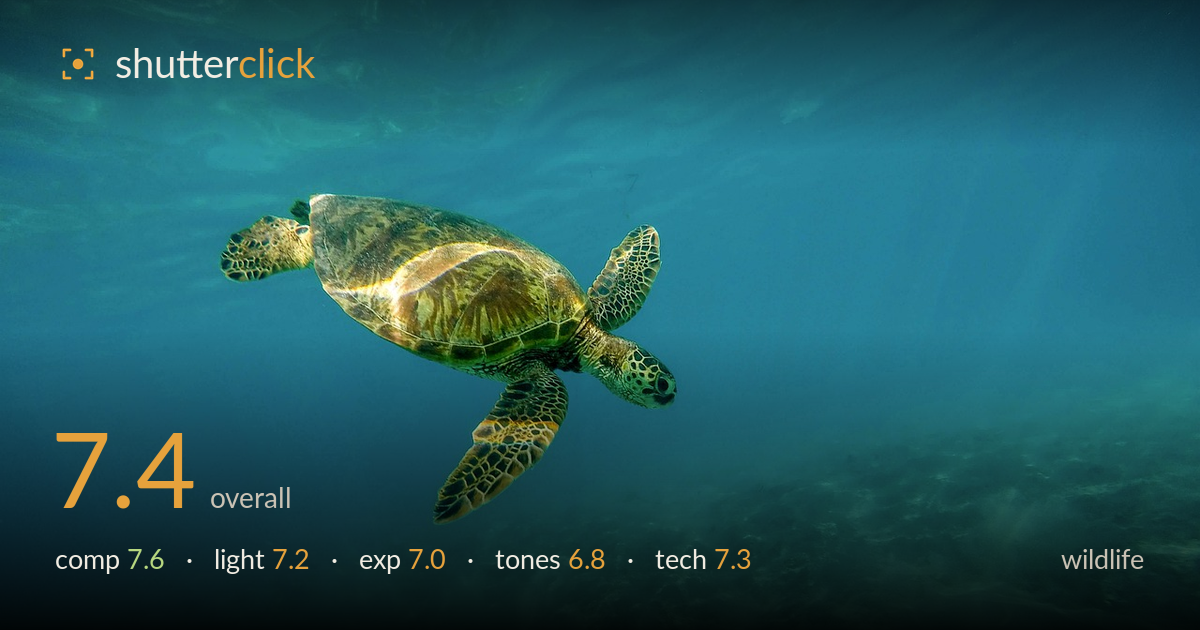
Sea turtle gliding through open water
Photo by Pexels

No EXIF metadata in this file
Technical analysis based on visual assessment only.
A clean, well-timed underwater wildlife frame carried by the turtle's upper-left placement and the open water it swims into. The animal is caught mid-glide with flippers extended and head turned slightly toward the lens, giving it presence. What most holds the shot back is the overall soft, milky rendering typical of shooting through water — colour saturation is low, contrast is muted, and the shell detail lacks bite. The heavy cyan cast, while authentic, flattens the tonal range. Getting closer to the subject would cut through the water column and recover both sharpness and colour on the shell.
The turtle sits high and left, swimming into the open expanse of blue on the right — a natural, effective use of lead room that gives the animal somewhere to go. The rippled surface up top and the dappled seabed along the bottom frame the subject in its environment without crowding it. The diagonal orientation of the body adds motion. The lower-right seabed is a touch busy and pulls slightly, but the negative space is the frame's strength and it's handled well.
Ambient sunlight filtered through the surface provides even, soft illumination and the visible light shafts add depth and atmosphere. The top-down direction catches the shell's ridges and the flipper scales adequately. However, water absorbs light and warmth with depth, so the scene reads flat and low-contrast — there's no directional punch to model the turtle three-dimensionally. Fill flash or strobe close to the subject would restore contrast and reveal the true colour of the shell and skin.
Exposure is balanced across a tricky scene — the bright surface ripples hold without fully blowing out, and the shaded seabed retains detail. The turtle itself sits at a reasonable midtone, though the shell's darker areas verge on flat rather than clipped. Overall the histogram appears well-contained with no serious loss at either end. The image reads slightly bright and hazy overall, a natural consequence of scattering in the water column rather than an exposure error, but a touch more contrast would give it snap.
The pervasive cyan-teal cast is authentic to the underwater setting but dominates to the point of muting everything. The turtle's shell and skin should carry warm browns and golds; here they're desaturated and pulled toward the ambient blue-green. White balance correction in post — warming the image and adding back red — would recover a lot of the lost colour. Tonal range is narrow and the midtones cluster, giving a soft, milky feel. Selective contrast on the subject would help it separate.
Focus lands acceptably on the turtle, with the shell pattern and near flipper showing usable detail, though the whole subject is softened by the water between lens and animal — an unavoidable consequence of distance underwater rather than a focus miss. Depth of field appears deep enough to hold both the turtle and the seabed, appropriate for the scene. There's no motion blur despite the swimming subject, suggesting a shutter speed quick enough to freeze the glide. The main technical limitation is the shooting distance: the further from the subject, the more suspended particles and light scatter degrade sharpness, contrast, and colour. Closing that gap would do more for image quality than any single setting change. Sensor noise isn't intrusive here. A wide-angle approach right up close, common in underwater work, would let the whole animal fill the frame while minimising the water column, sharpening detail and deepening colour simultaneously. Execution is solid for available-light snorkel conditions.
What would elevate it
Tags
Shot something like this?
Expert photo critique, on demand — scored across six categories, EXIF-aware. Start with 3 free critiques, no credit card.
critique my photo — free