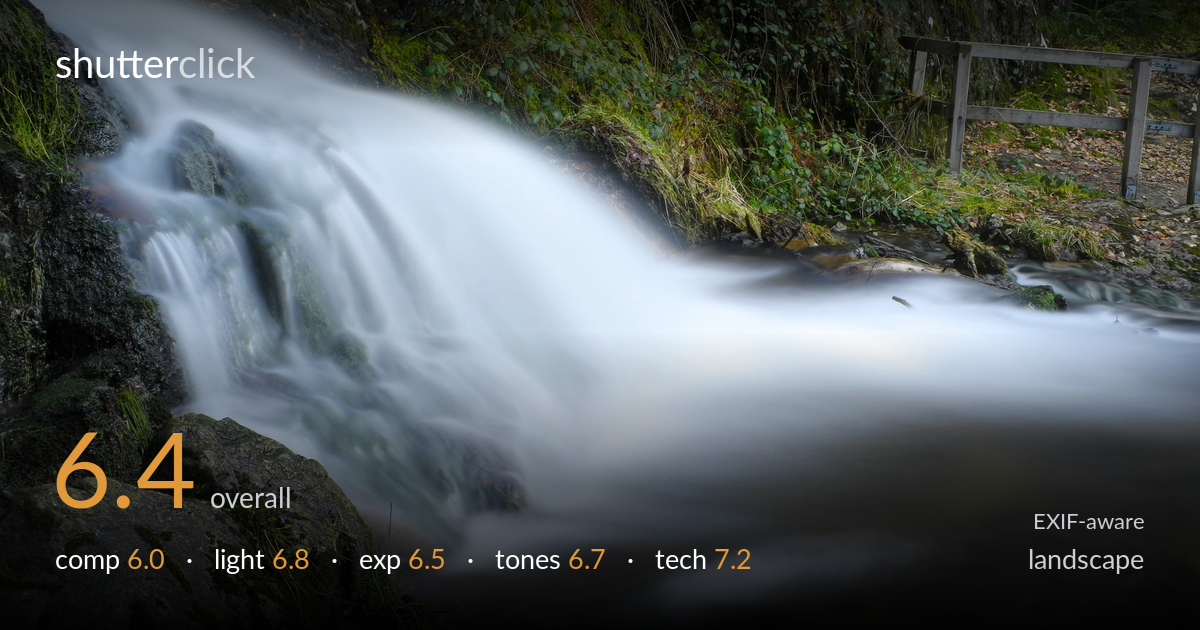
Silky woodland cascade
Photo by Thomas Bresson

| Focal length | 8 mm |
| Aperture | f / 8.0 |
| Shutter | 20.0 s |
| ISO | ISO 100 |
| Exp. comp. | 0.0 EV |
| Shot at | 15:52 · Mar 5, 2014 |
The silky water motion is the clear win here — a long exposure handled cleanly with no blown highlights in the rapids, which is harder than it looks. What most holds the frame back is organization: the water cuts diagonally through the scene but the composition lacks a clear anchor, and the wooden railing in the upper right pulls the eye toward a man-made distraction. The foreground rock is a strong textural element but sits heavily in the corner without enough purpose. A tighter, more intentional frame around the cascade would lift this from a pleasant record shot to a deliberate image.
The diagonal flow of water from upper left to lower right gives the frame energy and a natural reading path. The mossy foreground rock anchors the bottom-left corner with good texture. The weakness is the upper-right quadrant: the wooden fence and scattered leaves introduce a man-made distraction that competes with the cascade and adds nothing. The frame also tries to hold too much — the cliff, vegetation, fence, and pool all jostle without a single dominant subject. A tighter crop on the falls would concentrate the impact.
Soft, even overcast light suits flowing water well — it avoids harsh highlights on the white cascade and keeps the wet rocks and moss saturated rather than glaring. The diffuse quality renders the green vegetation richly and holds detail across the scene. What's missing is direction; the flat light leaves the rock faces and cliff slightly lifeless, with little modeling to give them form. Early or late side light would carve more texture into the stone, though it would risk clipping the water highlights.
The exposure is well judged for a long-exposure cascade. The flowing water retains texture and roll-off rather than blowing to pure white, which is the common failure of this kind of shot. Shadow detail in the rocks and the dark recesses on the left holds up without sinking to black. The overall balance reads slightly flat and dark in the mid-tones, and a touch more brightness in the pool would add depth. Histogram usage is sensible with no hard clipping evident.
The cool, muted palette fits the damp woodland mood, with the white water playing against deep greens and grey-brown stone. White balance leans slightly cool, which suits the overcast feel but leaves the scene a touch lifeless. The greens of the moss and ivy are the strongest colour note, and they hold up well. Contrast is gentle, perhaps too gentle in the mid-tones — the rocks could use more separation. A small lift in micro-contrast on the stone would give the frame more bite.
The 20-second exposure at f/8 and ISO 100 is a textbook approach to flowing water, and it pays off — the cascade silks beautifully while the rocks and vegetation stay sharp, confirming a stable tripod and no camera shake across a long exposure. ISO 100 keeps noise invisible and tonal smoothness intact. f/8 on this small-sensor compact sits near the lens's sharpest aperture and yields front-to-back depth, appropriate for the scene. Focus appears accurate on the mid-ground rocks. At 8mm (roughly 35mm equivalent on this sensor) the field of view is moderate-wide and handles the scene adequately. The only technical caveat: with a 20-second shutter in daytime, this likely required an ND filter, and there's a faint loss of crispness in the fine detail that may stem from the lens's small sensor or filter quality rather than technique. Execution overall is clean and deliberate — the settings were well chosen for the subject.
What would elevate it
Tags
Shot something like this?
Expert photo critique, on demand — scored across six categories, EXIF-aware. Start with 3 free critiques, no credit card.
critique my photo — free