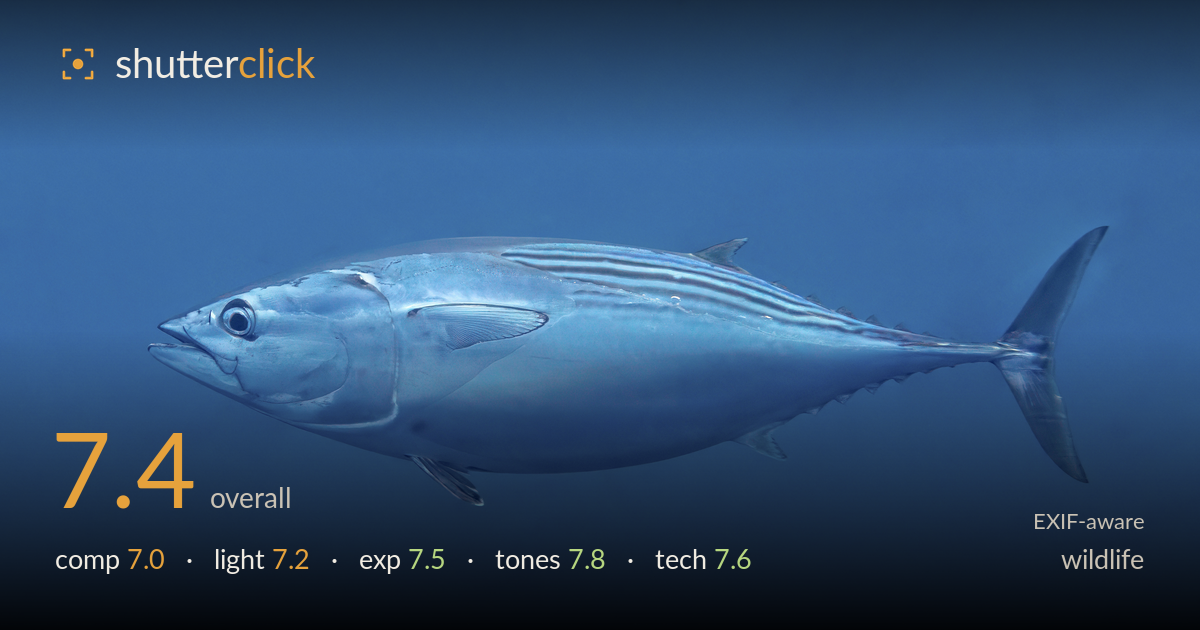
Skipjack tuna in open water
Photo by Diego Delso

| Focal length | 100 mm |
| Aperture | f / 6.3 |
| Shutter | 1/250 s |
| ISO | ISO 500 |
| Exp. comp. | -1.0 EV |
| Shot at | 02:30 · Dec 21, 2024 |
A clean, textbook-perfect lateral profile of a skipjack tuna against an even blue field — an image that reads almost like a field-guide plate, which is both its strength and its ceiling. The subject is tack-sharp along the head and eye, the silver flank holds beautiful iridescence, and the negative space is generous and calm. What holds it back is the very stillness that makes it clean: the fish is a static broadside with no behaviour, gesture, or environmental interest beyond blue water. A sense of motion, interaction, or a school would lift it from specimen record to compelling wildlife moment.
The full-body lateral profile is well isolated with plenty of breathing room, and the fish's leftward orientation gives the negative space on the right something to hold. Placement slightly high and left keeps the head — the eye — near a natural reading point. That said, the composition is very literal: a horizontal specimen centred vertically, with the empty right third feeling more like dead space than deliberate lead room. Angling the frame with the fish swimming into the space, or a diagonal, would add dynamism.
Soft, directional ambient light from above catches the silver flank and picks out the metallic sheen along the dorsal stripes and gill plate nicely — flattering for the reflective body. The underwater light is inherently diffuse here, which avoids harsh hotspots but also means the modelling on the flank is subtle to the point of flatness. A touch more raking light or a strobe kiss on the near side would sculpt the body's volume and separate it further from the uniform background.
The -1 EV compensation was a smart call for a bright silver subject against blue — it preserves the metallic highlights on the flank rather than blowing them, and detail survives across the reflective belly. Shadows in the fins and gill area retain information without muddiness. The overall reading is a hair dark in the lower body, but nothing crushed. This is a controlled, deliberate exposure that respects the difficult reflective subject and the high-key silver against a mid-tone field.
The blue-on-silver palette is the image's real pleasure — a clean, cohesive cool grade with just enough iridescent warmth in the flank to keep it from feeling monochrome. White balance sits believably for open water, neither too cyan nor too muddy. Tonal separation between the fish and background is good, and the subtle purples and pinks along the lateral stripes add life. The gradation in the blue water is smooth and free of banding, giving a refined, natural backdrop.
A 100mm f/2.8L macro is an unusual but defensible choice underwater — it delivers the resolving power to render fine detail, and here the eye and gill structures are critically sharp. At f/6.3 the depth of field is enough to hold the near flank and head in focus, though the far tail softens slightly, acceptable given the plane of a broadside subject. 1/250s froze the fish cleanly with no motion smear, a sensible shutter for a moving animal, and ISO 500 on the 5DS R keeps noise negligible while retaining the sensor's considerable detail. Focus landed precisely on the eye, which is exactly right for wildlife. The main technical limitation is that a macro lens has narrow working range underwater; a slightly faster shutter would have added insurance against a sudden dart, and stopping down marginally further would have brought the entire fish into equal sharpness. Overall a well-judged, disciplined capture of a fast reflective subject.
What would elevate it
Tags
Shot something like this?
Expert photo critique, on demand — scored across six categories, EXIF-aware. Start with 3 free critiques, no credit card.
critique my photo — free