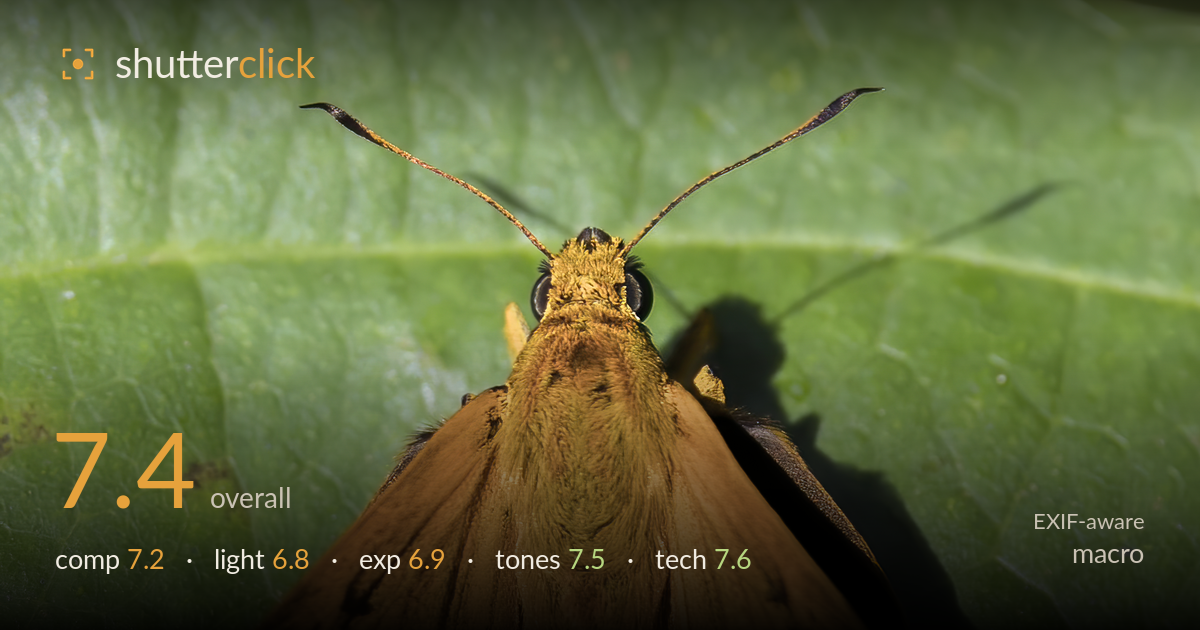
Skipper resting on a leaf
Photo by Charles J. Sharp

| Focal length | 500 mm |
| Aperture | f / 8.0 |
| Shutter | 1/640 s |
| ISO | ISO 800 |
| Exp. comp. | 0.0 EV |
| Shot at | 08:29 · Nov 2, 2021 |
A clean, well-executed skipper portrait carried by strong wing detail and a pleasing colour contrast against the green leaf. The symmetrical head-on view sits the subject firmly in the frame with the antennae fanning out to give scale. What most holds it back is the hard directional sun: it carves a distracting shadow to the right and pushes the highlight side of the wings toward glare while leaving the left in deeper tone. The focus plane lands well on the near wings but the eyes and head sit slightly soft. A softened light and a focus point pulled forward would lift this from competent to genuinely striking.
The head-on symmetry works for this species, placing the body on the centre line with the wings spreading evenly and the antennae reaching into upper negative space — a natural, balanced arrangement. The leaf's diagonal veins add subtle structure without competing. The main weakness is the harsh cast shadow to the lower right, which pulls weight off-centre and clutters otherwise clean background. A touch more room above the antenna tips would breathe better, as the left antenna nearly grazes the frame edge and the right one exits it entirely.
Direct hard sunlight from the upper right models the wing texture but at a cost. It rakes enough to reveal the fine scales and hair on the thorax, which is a genuine plus for macro, yet it also throws a strong, hard-edged shadow across the leaf and pushes the right wing toward specular glare while the left falls into muddier shade. The result is uneven illumination across a symmetrical subject. A diffuser or open shade would even the wings and kill the distracting cast shadow.
Exposure is broadly well judged — the orange wings hold colour and the darker wing margins retain detail without blocking up. The brightest scale areas on the right wing edge toward glare but stop short of full clipping. Shadow areas in the folded hindwing and the cast shadow keep some information. The leaf background sits at a comfortable midtone. Slightly more restraint, perhaps a third of a stop down, would have protected the hottest highlights on the sunlit wing surface.
The colour relationship is the strongest element: warm amber and rust wings against cool, saturated green make a clean complementary pairing that carries the frame. White balance reads natural, with the greens neither too yellow nor too blue. Contrast is healthy, the dark wing bands anchoring the softer body tones. Saturation is pushed a touch on the green but stays believable. The gradation across the wing from bright to shadow is smooth where the light allows, though the shaded left side loses a little tonal life.
Shooting a small insect at 500mm on the RF100-500 is a sound reach-and-working-distance choice, and f/8 is a reasonable compromise for depth of field at this magnification. It is enough to hold both spread wings acceptably sharp along their flat plane, and the near wing scales show fine, crisp detail. 1/640s is comfortably fast for a static subject and shows no motion blur, while ISO 800 keeps noise negligible on the R6. The chief issue is focus placement: the plane appears to favour the wings and thorax, leaving the compound eyes and head slightly soft — the very point a viewer looks to first. Focusing on the eye, or a short focus stack blending the head and wings, would sharpen the critical detail without stopping down further. The single flat-on angle plays to the shallow depth well; a hair more aperture or stacking would only help the deeper hindwing edge.
What would elevate it
Tags
Shot something like this?
Expert photo critique, on demand — scored across six categories, EXIF-aware. Start with 3 free critiques, no credit card.
critique my photo — free