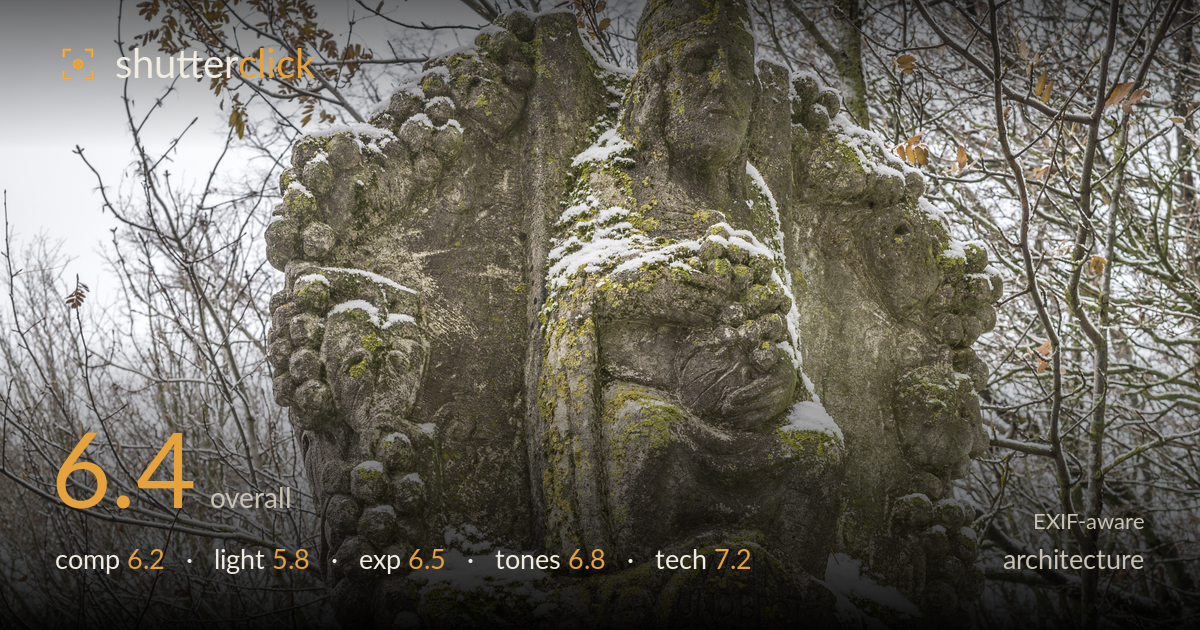
Snow-dusted stone shrine in winter woods
Photo by Plozessor

| Focal length | 18 mm |
| Aperture | f / 5.0 |
| Shutter | 1/80 s |
| ISO | ISO 100 |
| Exp. comp. | 0.7 EV |
| Shot at | 10:52 · Dec 1, 2023 |
A characterful weathered shrine, its moss, lichen and dusting of snow beautifully rendered, is undercut by a busy winter backdrop that competes for attention. The stonework detail — the carved figure of St. Urban, the fruit garland, the inscribed cartouche — is the clear strength, and the frontal framing respects the monument's geometry. What most holds the shot back is separation: the tangle of bare branches behind mirrors the tones of the stone and flattens the subject. Softer, more directional light and a cleaner angle would let the carving stand forward instead of dissolving into the thicket.
The frontal, slightly low viewpoint suits the monument and keeps the shaft rising cleanly through the lower frame. Placing the carved head near the upper third works. The problem is the background: the dense web of bare branches surrounds the sculpture on every side and offers no rest for the eye, so the ornate stonework fights the equally busy foliage. The green shrub bottom-left adds a stray colour block. A vantage isolating the monument against the pale sky, or a tighter crop excluding the lower distractions, would strengthen the read.
Flat, overcast winter light gives even, shadowless illumination that keeps the whole carving legible and avoids blown highlights on the snow — a reasonable choice for documenting detail. But it also robs the stone of relief. The deep undercuts of the garland and the folds of drapery need raking, directional light to reveal their three-dimensional form; here they read as texture rather than depth. Soft light also flattens the tonal separation between subject and the similarly grey branches, worsening the background clutter problem.
The +0.7 EV compensation is a sound call against the bright overcast sky, lifting the stone off middle grey and holding detail in the shadowed carving. The white sky sits near clipping but is not distractingly so, and the snow retains subtle texture. Shadow detail in the recesses of the sculpture is well preserved without looking lifted or muddy. Midtones on the stone are placed cleanly. Overall a controlled, deliberate exposure that handles the high-key winter conditions competently.
The muted winter palette is the image's quiet success: cool grey stone, ochre lichen and clinging beech leaves, and the faint green moss form a restrained, coherent set of earth tones. White balance reads neutral to slightly cool, appropriate for the snowy scene. Contrast is gentle, matching the flat light, though a touch more local contrast on the stone would help the detail pop. Saturation is tastefully held back. The greenery bottom-left is the one note that sits slightly apart from the otherwise unified scheme.
The GR III's 18mm (28mm equivalent) fixed lens is well suited to this middle-distance architectural subject, keeping perspective distortion minimal and verticals largely honest. At f/5.0 the depth of field is ample for a near-planar subject, carrying sharpness from the carved head through the inscribed shaft. Focus appears accurately placed on the sculpture, and the fine surface detail — lichen granules, chiselled lettering, snow crystals — is crisply resolved, which is exactly what this kind of documentation needs. ISO 100 delivers clean, noise-free files with good tonal latitude, sensible given the static subject and daylight. 1/80s is more than adequate for a handheld shot at this focal length and freezes everything cleanly. The one execution note is that the wide aperture still couldn't isolate the subject from the cluttered branches; stepping closer or shifting angle would have done more than any aperture change. Technically this is sound, deliberate work — the settings match the conditions and the sensor's strengths.
What would elevate it
Tags
Shot something like this?
Expert photo critique, on demand — scored across six categories, EXIF-aware. Start with 3 free critiques, no credit card.
critique my photo — free