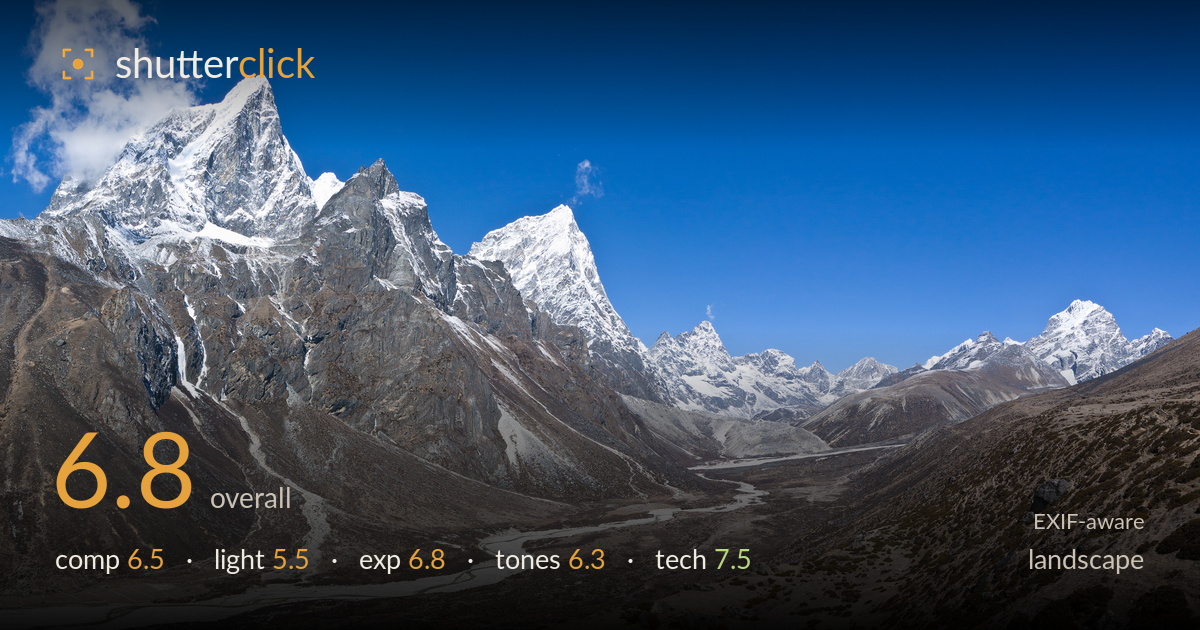
Snow peaks above a braided valley
Photo by Faj2323

| Aperture | f / 8.0 |
| Shutter | 1/500 s |
| ISO | ISO 100 |
| Shot at | 09:26 · Apr 8, 2012 |
A commanding Himalayan valley scene with genuine depth — the river braiding through the foreground draws the eye toward Cholatse's dramatic snow spire. The high-Himalaya grandeur is real, and the layered ridgelines build good recession. What most holds the frame back is the timing: harsh midday light flattens the rock faces and drains the dimensionality that raking golden-hour light would carve into these peaks. The upper-right sky occupies a large, empty portion of the frame without earning its keep, and the overall tonality leans flat. Strong material, undersold by the hour it was shot.
The S-curve of the braided river is the strongest compositional asset, leading cleanly from the lower foreground into the mountain base and giving real depth. The peak cluster is well placed left of centre, and the layered ridges recede convincingly. However, the sky claims roughly the upper-right third with little cloud interest, leaving dead space that unbalances the frame. The right-hand slope is a heavy, near-featureless wedge that pulls weight without contributing. A tighter horizontal crop favouring the peaks and valley floor would concentrate the energy.
Midday sun sits high and roughly frontal, which is the frame's biggest limitation. The flat, hard light flattens the rock faces of Cholatse and the surrounding ridges, robbing them of the texture and modelling that dimension demands. Snow reads bright and clean but without the warm rim or long shadow relief that raking light provides. Shadows are short and offer little to sculpt the terrain. The scene is legible and the atmosphere clear, but the light does the least it could to reveal this landscape's structure.
Exposure is well handled for a high-altitude scene with bright snow. Highlights on the sunlit snowfields hold detail rather than blowing out, and the shadowed rock retains texture in the darker faces. The histogram appears to sit comfortably across the range without significant clipping at either end. Some of the deepest shadowed rock on the left flank runs a touch dense, but nothing critical is lost. A slight overall lift or gentle shadow recovery would open the darker slopes without threatening the highlights.
The deep, saturated blue sky is characteristic of high altitude and reads authentically, though it darkens noticeably toward the top-right corner in a way that draws attention. Rock and scrub tones are earthy and reasonably natural, but overall contrast is muted by the flat light, leaving mid-tones without much separation. The snow is clean and neutral. A modest contrast boost and selective clarity on the rock faces would restore some of the tonal punch the midday light strips away, and evening the sky gradient would help.
The settings are well chosen for landscape work. f/8 on the Micro Four Thirds sensor sits near the lens's sharpness sweet spot and delivers deep front-to-back focus, keeping the foreground river and distant peaks acceptably sharp. ISO 100 keeps noise negligible and preserves clean tonality in the snow and sky. The 1/500 shutter is far faster than a static landscape needs — tripod-and-slower territory would have been fine — but at this ISO it costs nothing and eliminates any handheld shake risk. Focus appears well placed through the mid-distance, and depth of field carries the scene. The G1 is an older, modest sensor and the dynamic range shows its limits in the deeper shadows and the banding-prone blue sky, but the exposure choices work within those constraints. Execution here is sound; the technical decisions are not what limit the image. A polariser would have deepened the sky more evenly and cut haze on the distant ridges.
What would elevate it
Tags
Shot something like this?
Expert photo critique, on demand — scored across six categories, EXIF-aware. Start with 3 free critiques, no credit card.
critique my photo — free