Snowy forested slope
Photo by jonathansautter

No EXIF metadata in this file
Technical analysis based on visual assessment only.
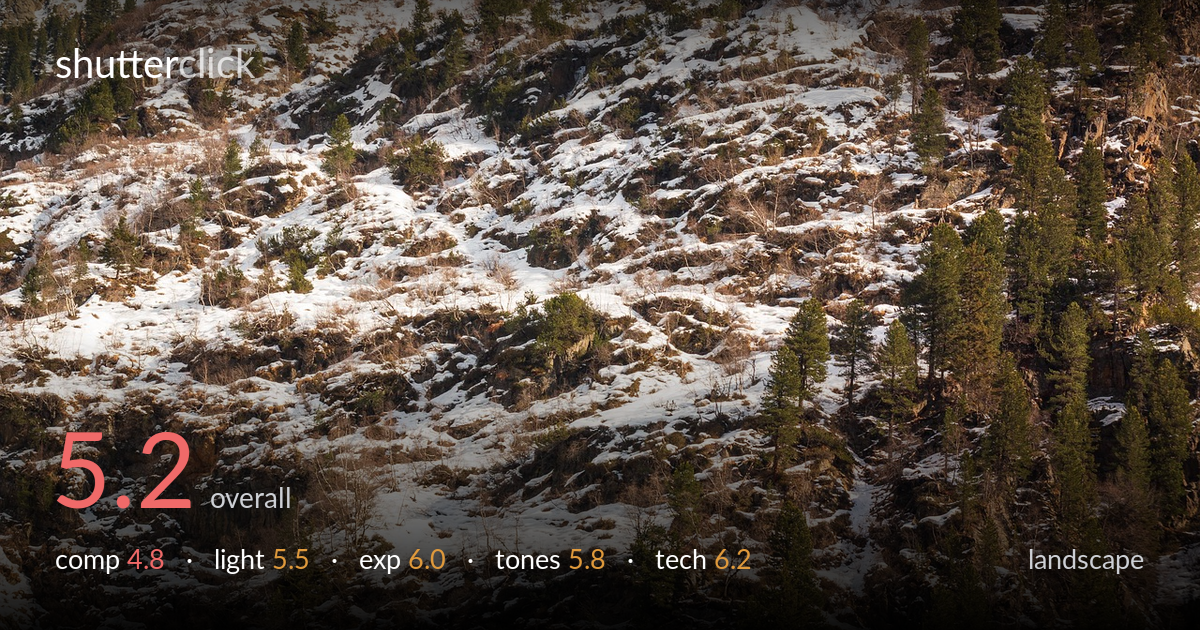
This is a flat, frame-filling view of a snow-patched slope that reads more as texture study than landscape — and the absence of a clear focal point is what most holds it back. The eye wanders across scattered conifers and snow without ever settling. There's no horizon, no sky, no sense of scale, and no foreground anchor to lead into the scene. The mottled patchwork of snow, rock, and pine has a certain tapestry-like quality, and the detail rendering is decent, but the composition gives the viewer nowhere to rest. A stronger organising element or a wider context would transform it.
The frame is filled edge to edge with slope, which flattens the scene into a busy patchwork lacking any hierarchy. There's no clear subject, no leading line, and no foreground-to-background depth — the eye drifts without landing. The cluster of darker pines along the right edge is the strongest anchor, but it's pushed to the margin rather than used. With no horizon or sky, the sense of scale collapses. Isolating a single ridge feature or including context above the slope would give the image a backbone.
The light appears to be low-angle, warm sun raking across the slope, which picks out the dried grasses and warms the rock faces — that's the most promising element here. However, the illumination is fairly even across the whole frame, so it doesn't sculpt any one area or create the directional shadow play that would add depth. The snow holds gentle modelling rather than harsh blowout. A lower, more grazing angle would deepen shadows in the rock crevices and separate the layers of the terrain.
Exposure is well controlled given the high-contrast mix of bright snow and dark conifers. The snow retains texture and gradation rather than clipping to white, and the shadowed pines hold detail without blocking up. Midtones in the rock and dried vegetation sit naturally. The histogram is likely well spread across the range. Nothing here looks accidental — the brightness placement is deliberate and handles the tricky dynamic range capably. There's little to fault on the technical brightness front.
The palette is a muted mix of warm browns, snow whites, and deep conifer greens, with the low sun lending a pleasant amber cast to the grasses and rock. White balance is reasonable, leaning slightly warm in a way that suits the light. Contrast is moderate and the tonal range is broad. The greens feel a touch dull and the overall grade is a little flat — a gentle lift in micro-contrast and selective warmth on the highlights would make the scene feel more alive.
From visual evidence, this appears to be a long-lens compression shot of a distant slope, which explains the flattened, layered look. Sharpness across the frame is reasonable but not crisp — the finer pine needles and grass blades show some softness that suggests either atmospheric haze between camera and subject, slight focus imperfection, or diffraction from a small aperture. Depth of field is effectively deep, appropriate for terrain at this distance. Noise is well controlled, indicating a sensible ISO. The telephoto choice is defensible for isolating the slope, but it also amplifies the lack of a subject by removing all spatial cues. A tripod and careful single-point focus on the strongest cluster of trees would sharpen the most important plane. Shooting at the lens's optimal aperture rather than fully stopped down would recover edge crispness without sacrificing the needed depth. Technically competent execution, but the gear choices serve documentation more than composition.
What would elevate it
Tags
Shot something like this?
Expert photo critique, on demand — scored across six categories, EXIF-aware. Start with 3 free critiques, no credit card.
critique my photo — free