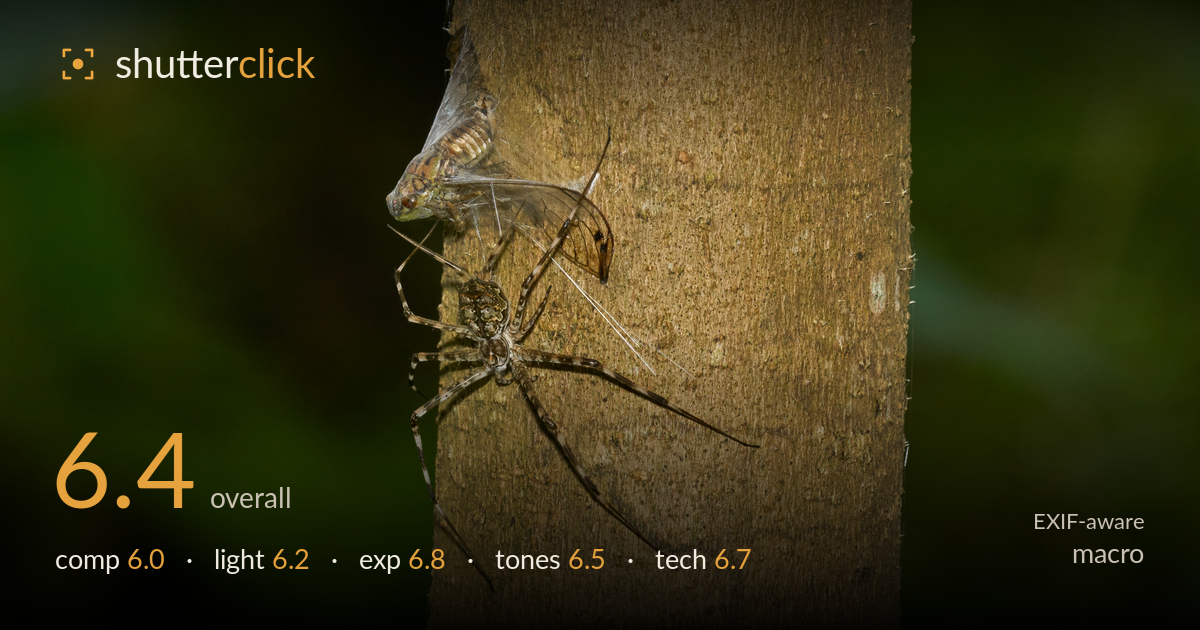
Spider with wrapped prey on bark
Photo by Jeevan Jose, Kerala, India

| Focal length | 150 mm |
| Aperture | f / 11.0 |
| Shutter | 1/160 s |
| ISO | ISO 320 |
| Exp. comp. | 0.0 EV |
| Shot at | 14:36 · Jun 19, 2016 |
A genuine behavioural moment — a spider with freshly captured prey wrapped in silk — carries this frame, and that narrative is its strongest asset. The trunk offers a natural, uncluttered surface that keeps the scene legible against a pleasingly soft green background. What most holds it back is focus placement: the spider's body and the prey compete for the plane of sharpness, and neither lands with full crispness, particularly the spider's eyes. The vertical trunk splits the frame and pins the subject to the left edge, cramping the sprawling legs. Cleaner focus on the spider and more breathing room would lift this considerably.
The vertical trunk divides the frame roughly in half, leaving the right side as blank bark while the subject and prey crowd the left edge — the outstretched legs nearly touch the border, which feels cramped. Placing the spider on a thirds line with the trunk running as a diagonal would give the legs room to breathe. The soft green negative space on the left works well, and the silk-wrapped prey above the spider builds a clear predator-and-catch story that anchors the composition.
Light is directional from the upper left, giving the bark texture some relief and picking out the translucent wings of the wrapped prey nicely. However, it is fairly flat across the spider itself, so its body and legs lack the modelling that would separate them from the trunk. The dark green backdrop provides good contrast for the subject. Softer fill or a reflector on the shadow side would open up the spider's underside and reveal more of its patterning without losing the texture the raking light provides.
Exposure is well judged overall. The bark's midtones sit comfortably without clipping, and the dark foliage retains its depth rather than blocking to pure black. The translucent prey wings hold highlight detail, which is the trickiest area here. The spider's darker markings keep shadow information. Nothing appears blown or crushed accidentally, and the histogram would sit in a healthy middle range. A touch more exposure on the shadowed spider body could have been lifted in post to reveal detail, but the base capture is sound.
The warm browns of the trunk against the deep, desaturated green background make a natural, harmonious palette suited to the forest setting. White balance reads accurate — no obvious colour cast on the neutral bark. Contrast is moderate and appropriate; the tonal range spans from the bright silk highlights to the shadowed foliage without feeling harsh. The spider's mottled greys and browns blend a little too closely with the bark, which is naturally camouflaged, so a slight local contrast lift on the subject would help it stand apart tonally.
At f/11 on a 150mm macro, the depth of field is a reasonable choice for a subject with sprawling legs across a curved trunk, but the plane of focus appears to have landed on the bark texture and the prey rather than squarely on the spider's carapace and eyes — the head reads slightly soft where it most needs to be sharp. For macro, focus on the animal's eyes is the priority. 1/160s handheld at this magnification risks subtle motion softness; the light was sufficient, so a faster shutter or a tripod with a remote release would have locked in critical sharpness. ISO 320 is clean and well within the camera's comfort range, contributing no visible noise. Given the ample bark surface, f/11 may not have been enough to hold both the near legs and the prey; focus stacking, or stopping to f/13–16 with added light, would carry the whole subject. Lens and focal length are well matched to the working distance for a wary spider.
What would elevate it
Tags
Shot something like this?
Expert photo critique, on demand — scored across six categories, EXIF-aware. Start with 3 free critiques, no credit card.
critique my photo — free