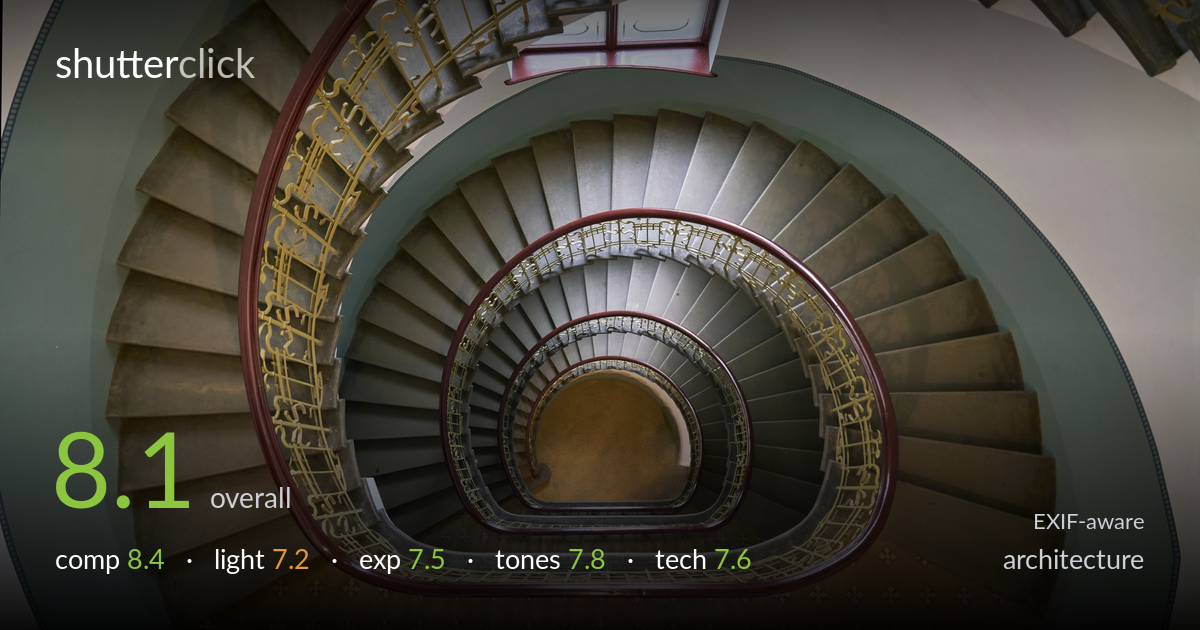
Spiral descent through the stairwell
Photo by Virtual-Pano

| Focal length | 24 mm |
| Aperture | f / 4.0 |
| Shutter | 1/13 s |
| ISO | ISO 800 |
| Exp. comp. | 0.0 EV |
| Shot at | 13:55 · Jul 19, 2022 |
A confident spiral descent that exploits the staircase's nautilus geometry to its full potential, leading the eye inward to the tiled floor at the vortex. The repeating oxblood handrail and gilded Art Nouveau ironwork carry the rhythm beautifully. The strongest element is the spiral pull itself, tight and unbroken. What holds it back is a slightly off-centre placement of the innermost point, which sits left of frame and weakens the otherwise perfect convergence, and a flat, even ambient light that flattens the stone treads. A cleaner vanishing point and a touch more directional light would lift this from very good to outstanding.
The spiral is the whole show here, and it works — the eye is pulled down through receding concentric loops to the floor at the centre. The oxblood rail and golden filigree provide a strong recurring line that holds the rhythm together. The chief weakness is the focal point: the innermost loop sits left and slightly low rather than dead centre, so the convergence doesn't fully resolve. The bright window reflection upper-centre also competes for attention. Centring the vortex more precisely would tighten the whole geometry.
The ambient daylight is soft and even, which renders the ironwork detail cleanly across all the loops without harsh shadows — useful for an interior with this much intricate filigree. The trade-off is that the light is flat and directionless, so the stone treads read as a uniform grey mass with little of the texture or modelling that raking light would reveal. The window reflection upper-centre introduces a bright hotspot that pulls slightly against the otherwise controlled tonal field. Directional side light would add depth.
Exposure is well managed for a tricky interior with a wide brightness range. Shadow detail holds in the deepest stairwell loops, and the warm floor tiles at the centre retain their pattern rather than blocking up. The window reflection upper-centre clips to near-white, but it's a small area and not distracting. Midtones across the stone sit a touch flat, leaving the image reading slightly heavy in the grey range. A modest highlight recovery and a small midtone lift would add a bit more dimensionality.
The palette is the image's quiet strength — muted sage-green walls, warm ochre floor, and the recurring oxblood rail with gold ironwork form a coherent, restrained scheme. White balance is neutral and believable. Contrast is moderate, which suits the soft light but leaves the stone treads sitting in a single grey band without much tonal separation between loops. The gold filigree could carry a touch more luminosity to pop against the stone. Overall the colour relationships are handled with care and feel deliberate.
At 24mm and f/4 the wide angle is well suited to capturing the full spiral from the top landing, and the focus is accurate through the critical near loops with sharpness holding deep into the receding centre. f/4 provides adequate depth of field for this top-down geometry where everything sits at a comparable working distance. The bigger achievement is the 1/13s handheld at ISO 800 — slow enough to risk blur, yet the frame reads crisp, suggesting steady support or careful bracing. ISO 800 keeps noise well controlled in the shadowed loops. The 24mm focal length does introduce mild barrel distortion at the frame edges, visible in the slight bowing of the outer walls, which is normal for the lens but worth correcting. Stopping down to f/5.6 with a faster ISO would have firmed up the deepest centre loops slightly, though the gain would be marginal. Execution overall is solid and the difficult slow-shutter handheld grab paid off.
What would elevate it
Tags
Shot something like this?
Expert photo critique, on demand — scored across six categories, EXIF-aware. Start with 3 free critiques, no credit card.
critique my photo — free