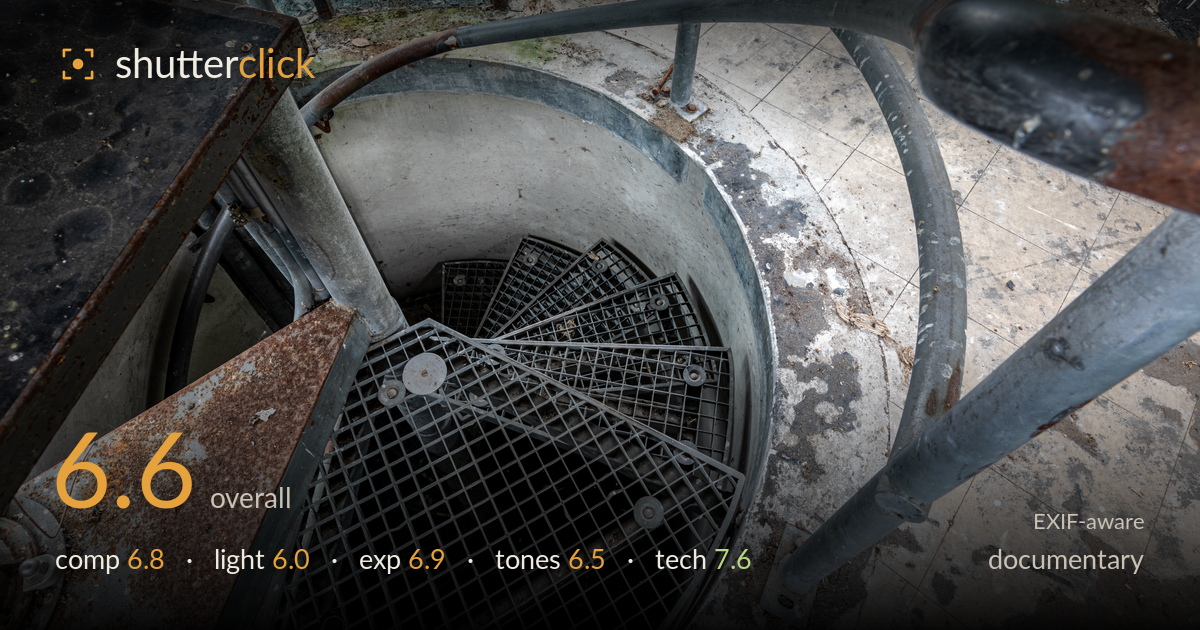
Spiral stair in an abandoned plant
Photo by Dietmar Rabich

| Focal length | 20 mm |
| Aperture | f / 13.0 |
| Shutter | 1/4 s |
| ISO | ISO 100 |
| Exp. comp. | -2.67 EV |
| Shot at | 07:46 · Jul 13, 2024 |
A strong sense of place carries this abandoned-industrial frame — the spiralling metal grate staircase makes a compelling geometric anchor, and the decay reads richly through paint loss, rust and grime. What holds it back is the busy upper zone: the tangle of galvanised railings, the black table edge and the cropped equipment crowd the top of the frame and pull attention away from the descending stair that should command it. The flat, diffuse daylight documents everything faithfully but does little to shape the forms. A cleaner reading of the spiral, and light with more direction, would lift this from a solid record into a genuinely arresting image.
The high downward angle onto the spiral stair is the frame's best decision — the fanning treads create a natural focal spiral, and the curved railing echoes it. But the top third is congested: multiple pipes, the black table corner and cropped-off gear compete and flatten the depth. The eye enters well at lower centre yet gets snagged by the clutter above. Letting the stairwell breathe with fewer intersecting rails, or dropping the framing to isolate the spiral, would strengthen the read considerably.
Soft, even ambient daylight fills the space without harsh clipping, which suits documentary honesty and preserves detail across grate, concrete and rust. The trade-off is flatness: with no directional light, the metalwork's texture and the depth of the shaft stay muted, and the treads lack the modelling that would give them dimension. A raking side light or a shot timed to a stronger window beam would carve out the grate texture and separate the stair from the well below.
The -2.67 EV compensation was a sensible call to protect the bright concrete and pale floor tiles, and highlights hold together without blowing. Shadow detail in the dark shaft beneath the grate falls off but stays plausible for the scene. Midtones sit a touch low, giving the frame a slightly heavy, overcast feel. A lift in the darker mid-region during processing would recover a little presence in the lower shaft without pushing highlights toward clipping.
A muted, near-monochrome palette of galvanised grey, concrete white and oxide rust suits the subject, with the small patch of teal peeling paint top-left offering welcome relief. White balance reads slightly cool, reinforcing the cold industrial mood. Contrast is moderate but the overall tonal range clusters in the mid-greys, leaving the image a little muddy. A touch more separation between the metal greys and the darker recesses would give the tones more snap and depth.
The technical execution is sound and well matched to the scene. At f/13 on the 20mm, front-to-back depth of field is deep, keeping the near table edge, the spiral treads and the far peeling floor all acceptably sharp — the right call for an interior documenting layered decay. ISO 100 keeps noise negligible and preserves fine detail in the grate mesh. The 1/4s shutter is only viable on a tripod, and the frame is clean of camera shake, so stabilisation was handled properly. The 20mm wide angle exaggerates the near railings and stretches the perimeter, which adds drama but also amplifies the top-frame clutter; a slightly longer focal length or a step back would tame that distortion. Focus is placed well through the mid-scene, and corner-to-corner sharpness is respectable for the Art lens stopped down. Overall the gear choices are deliberate and competent — the main technical lever left is managing wide-angle distortion at the frame edges.
What would elevate it
Tags
Shot something like this?
Expert photo critique, on demand — scored across six categories, EXIF-aware. Start with 3 free critiques, no credit card.
critique my photo — free