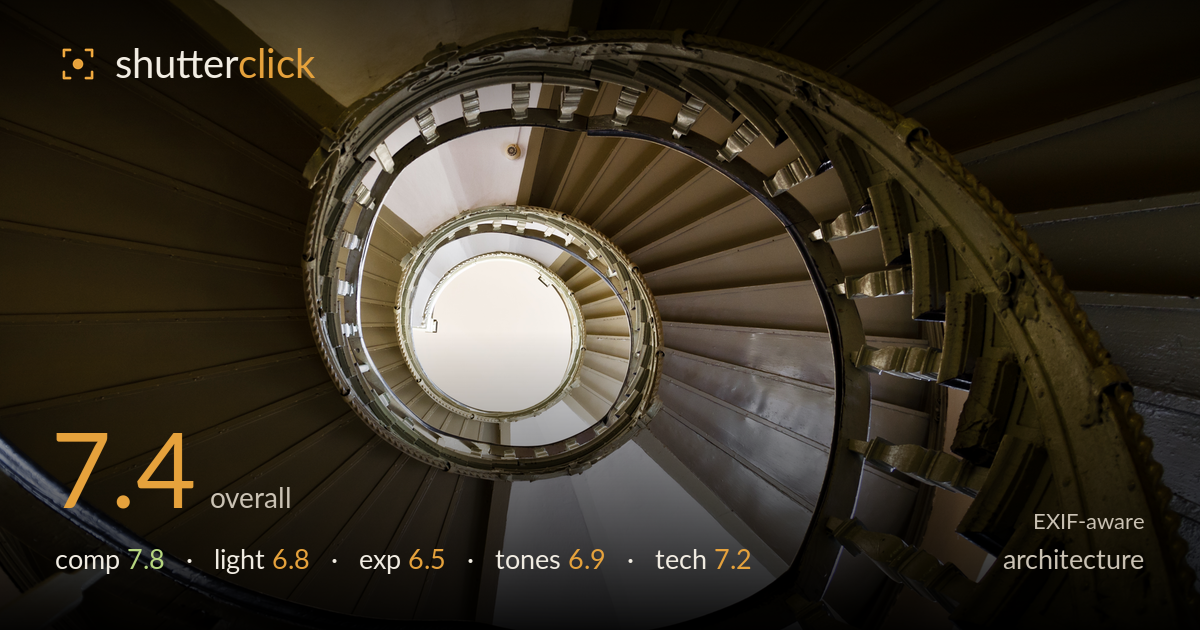
Spiralling up the staircase
Photo by Jacek Halicki

| Focal length | 18 mm |
| Aperture | f / 3.5 |
| Shutter | 1/2 s |
| ISO | ISO 200 |
| Exp. comp. | 0.0 EV |
| Shot at | 09:38 · Mar 20, 2014 |
A confident spiral staircase shot that rides the natural pull of the coiling handrail into a bright central skylight — the strongest asset here. The upward vantage and wide focal length exaggerate the vortex effectively, and the recession of steps carries the eye inward. What holds it back is the blown-out skylight at the core, which loses all detail and pulls attention as a bright hole rather than a resolved highlight, and a slightly heavy, muddy shadow rendering on the underside of the treads. The centre of the spiral also sits high and left rather than anchoring the frame, softening the swirl's payoff.
The spiral is the whole point and it works — the coiling handrail acts as a natural leading line that draws the eye inward and upward to the bright vanishing point. The upward angle exaggerates the vortex nicely. Weaknesses: the spiral's core sits high and left of centre, so the swirl feels slightly off-balance rather than tightly wound around a clear anchor. The dark upper-right ceiling and near-black lower-left rail eat frame space without adding much. A centring that placed the core nearer the middle would tighten the geometry.
Light is entirely dependent on the skylight at the spiral's centre, which floods the core while the outer treads fall into progressively deeper shadow. That gradient reinforces the sense of depth and the pull toward the top, which is a genuine strength. But the single overhead source leaves the undersides of the steps flat and murky, and the texture of the ironwork balusters gets lost in shadow rather than being revealed by raking light. There is little that could be controlled here beyond timing — a softer, more overcast sky would have tamed the core blowout.
The central skylight is fully clipped to paper white, losing all detail — the biggest exposure weakness, since it becomes a featureless void rather than a resolved bright point. Exposing for the mid-toned treads was a reasonable compromise given the extreme dynamic range, but the shadows on the outer steps still block up and go muddy. A bracketed exposure blended in post would recover both the skylight highlight and the shadow detail on the underside of the steps. As shot, the histogram is stretched at both ends with tone lost on each.
The warm olive-and-brass palette suits the aged ironwork and gives the frame a coherent, slightly vintage character. Contrast is strong, which helps the spiral read, but the shadows tip toward a flat, muddy brown rather than clean deep tones, and the warm cast on the walls edges toward monotony. White balance looks slightly warm overall. A touch more separation between the mid browns and a cooler, cleaner shadow point would give the metalwork more dimensionality and stop the darker regions reading as a single flat mass.
At 18mm the wide field captures the full sweep of the spiral, an appropriate lens choice for the interior. But f/3.5 is the weak decision: wide open on this superzoom, corner sharpness suffers and depth of field is shallower than an architectural interior wants — some of the nearer balusters drift soft. Stopping down to f/8 would have sharpened the whole coil and the ironwork detail, and the 1/2s shutter already implies a tripod, so there was no reason to shoot wide open. ISO 200 is fine and keeps noise negligible. The half-second exposure is well handled with no visible shake, confirming a stable support. Focus appears to sit on the mid treads rather than being optimised for overall sharpness. The main takeaways: a narrower aperture would have transformed the crispness of the geometry, and since the camera was already static, there was no shutter-speed cost to closing down.
What would elevate it
Tags
Shot something like this?
Expert photo critique, on demand — scored across six categories, EXIF-aware. Start with 3 free critiques, no credit card.
critique my photo — free